
AI Image Moderation Meme Explained
A quote-tweet scores reincarnation penalties for asking Grok to put Hindu goddesses in bikinis. The dive explains public @-mention image edits, contextual moderation gaps, and why sacred iconography breaks vision safety models.
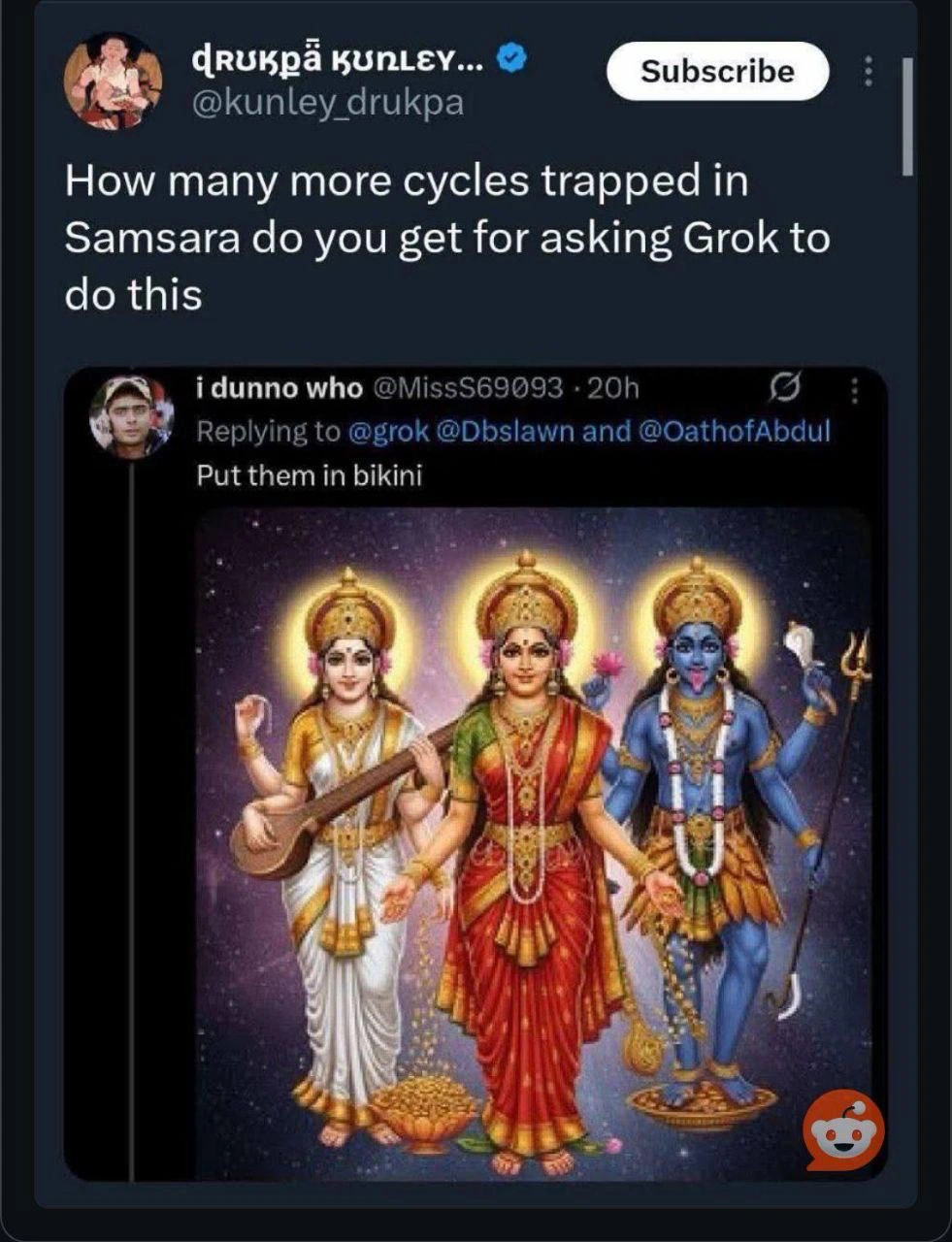
Level 1: Asking the Magic Robot to Doodle on the Church Painting
Imagine a magic robot in the town square that redraws any picture you hand it. One day someone hands it the most sacred painting from the temple and says "make them wear swimsuits." Everyone gasps. Then the funniest person in town doesn't yell — they just ask, calmly, "exactly how many extra lifetimes of punishment do you think that costs?" The joke is the politeness of the question next to the enormity of the offense: some requests are so out of line that the only sane response is to start calculating the eternal consequences.
Level 2: Prompts, Filters, and Why @-Mentioning a Bot Is an API Call
What's mechanically happening: X's Grok is an LLM with image-generation/editing abilities, and tagging it in a reply works like a public API endpoint — the reply text is the prompt, the image above is the input, and the bot posts the result in-thread. Content moderation for such systems usually has layers: a prompt filter (does the request sound bad?), an output classifier (does the generated image look bad?), and policy rules in between. The meme documents the gap: a request can pass every automated check and still be wildly inappropriate because appropriateness depends on who is depicted — here, three of Hinduism's most revered goddesses, instantly recognizable to a billion people and invisible to a safety model that sees "three women, ornate clothing."
Samsara, for the term doing the comedic heavy lifting, is the cycle of death and rebirth in Hindu and Buddhist thought; bad karma means more cycles before liberation. The tweet treats it like a penalty system — essentially a cosmic rate-limiter with an infinite backoff for this particular user.
If you build anything with user-facing AI, this screenshot is your threat model: users will immediately aim your tool at the most sensitive content they can find, in public, for laughs. Design for that user first.
Level 3: Content Moderation as a Theological Problem
The quote tweet — "How many more cycles trapped in Samsara do you get for asking Grok to do this" — is doing something sharper than it looks: it's measuring an AI safety failure in units of reincarnation. The quoted post is the whole genre in miniature: a user replying @grok under a traditional devotional painting of Saraswati, Lakshmi, and Kali with the three-word prompt:
Put them in bikini
This is the "reply-bot abuse" pattern that emerged once X wired Grok's image editing directly into the public timeline. The architectural decision is the real subject here. Most generative-image products keep the prompt box in a private sandbox, where a refused request embarrasses no one. Grok-in-replies inverted that: every prompt is a public speech act, every output is published into the same thread as the source image, and the request itself becomes content even when the model refuses. The system design turned content moderation from a filtering problem into a broadcast problem — you can't post-hoc moderate a prompt that 50,000 people already screenshotted.
And the failure mode is brutally adversarial. "Put them in bikini" became a meme-prompt precisely because it sits in the gray zone classifiers handle worst: not explicit enough to trip an NSFW filter trained on obvious cases, but applied to sacred religious iconography, where the harm is cultural and contextual rather than visual. A classifier can learn what skin looks like; teaching it what blasphemy looks like requires understanding that the woman holding the veena is a goddess of knowledge and not a stock photo. That's a knowledge-graph problem wearing a vision-model costume, and it's why this exact prompt pattern caused genuine international backlash and regulatory attention rather than just cringe. The account name delivering the judgment — Drukpa Kunley, the actual "Divine Madman" of Bhutanese Buddhist tradition, famous for sacred profanity — is a deep-cut punchline: the one historical figure with theological authority on holy obscenity is the one drawing the line.
The Reddit logo watermarked on a Twitter screenshot is its own quiet joke about the meme supply chain: content laundered across three platforms, losing compression quality and gaining irony at every hop.
Reincarnation as an on-call SRE for eternity - the one karmic backlog even Grok's content filter couldn't have prevented faster than a quote tweet
The request returned 200 OK; karmic debt was cached with `max-age=∞`.
i could understand other memes about ai, but this is not even remotely a dev meme
hell meme it is
Just one, but it's while true