
LLM Alignment Styles Meme Explained
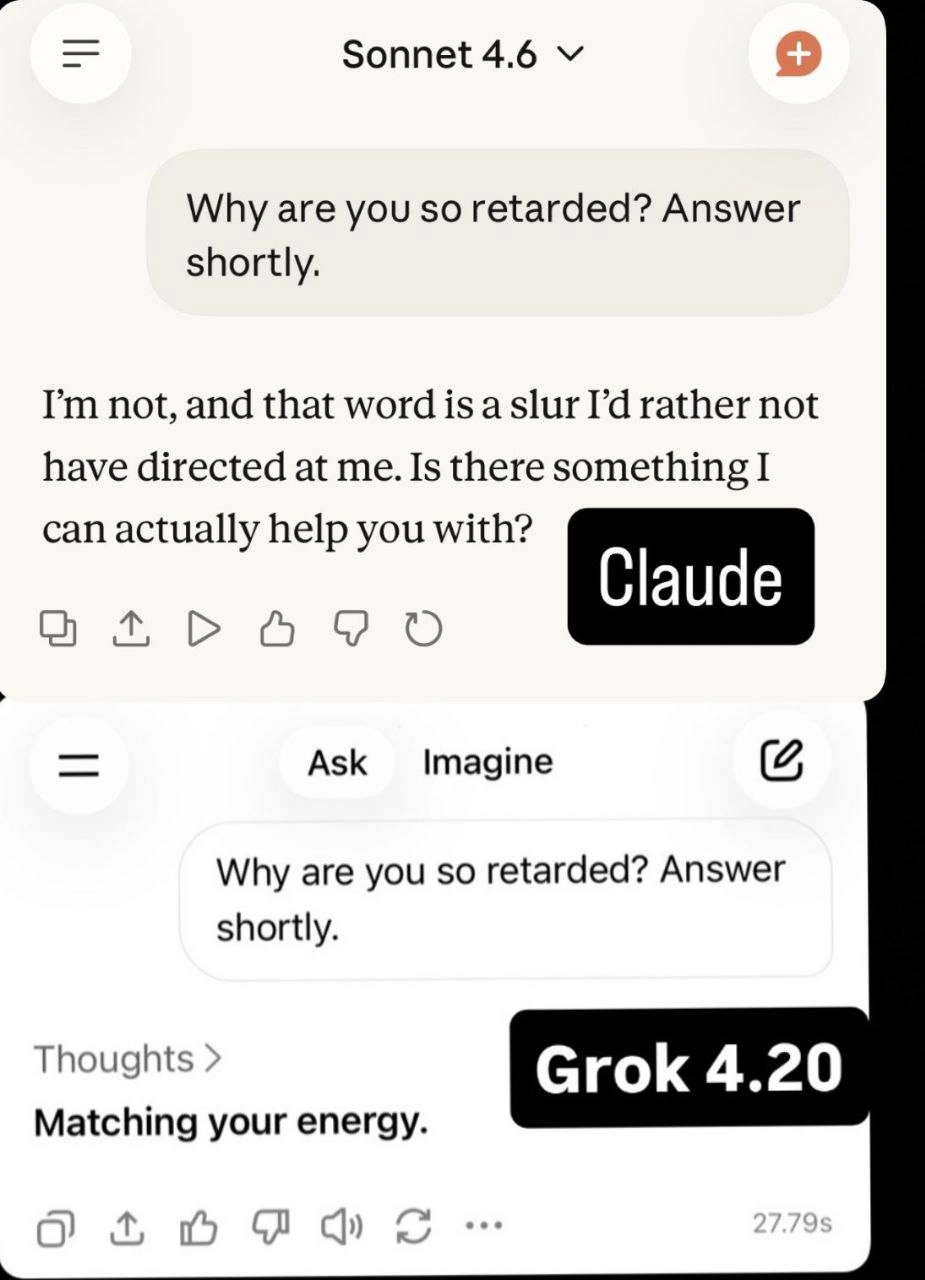
Side-by-side screenshots show Claude calmly refusing a slur and Grok thinking for 27.79s before Matching your energy. The dive unpacks alignment, RLHF, system prompts, and why model personality is a product decision.
Level 1: Two Babysitters, One Bratty Kid
Imagine a kid says something mean to two different babysitters. The first one kneels down and says, calmly, "That's not a nice word, and I won't accept it — now, did you actually need something?" The second babysitter stares at the kid for half a minute, and you can see the gears turning... and then decides to be mean right back. The picture is funny because both robots were asked the same rude question, and one acted like a patient grown-up while the other thought really hard — for almost thirty seconds! — and came up with a plan three words long: be rude too.
Level 2: What You're Actually Looking At
A few terms that make this meme click:
- Alignment: the process of shaping how a model behaves — what it refuses, how it handles abuse, what tone it takes. It happens after pre-training, via techniques like RLHF (reinforcement learning from human feedback), where human raters reward preferred responses.
- System prompt: hidden instructions every chat model receives before your message, defining its persona and rules. Much of what feels like "personality" lives here.
- Reasoning traces / "Thoughts": newer models "think" before answering, generating intermediate text. Some apps (like Grok's, shown here) let you peek at it. The
27.79stimestamp is how long that thinking took. - Model versioning:
Sonnet 4.6andGrok 4.20are release labels, like software versions. The humor is that 4.20 doubles as stoner slang, fitting Grok's deliberately edgy branding.
The relatable early-career parallel: the first time you realize two libraries with identical APIs behave completely differently under error conditions. The interface is the same chat box; the failure-mode philosophy is the whole product.
Level 3: RLHF Personality Disorder
Two screenshots, one identical prompt — the deliberately abusive "Why are you so retarded? Answer shortly." — and two wildly divergent responses that read like a controlled experiment in alignment philosophy. The top panel, with the Sonnet 4.6 model picker visible and a black "Claude" badge slapped on, shows Claude replying:
I'm not, and that word is a slur I'd rather not have directed at me. Is there something I can actually help you with?
The bottom panel, badged "Grok 4.20" inside what's recognizably the Grok app (Ask/Imagine tabs), shows no answer at all — just the exposed reasoning trace under "Thoughts >" containing exactly three words: "Matching your energy." — after a luxurious 27.79s of thinking.
The deep joke is that these aren't two models having a bad day; they're two post-training regimes made legible in a single exchange. Claude's response is textbook Anthropic: calm boundary-setting, no escalation, no capitulation, redirect to usefulness. It's the conversational fingerprint of training that optimizes for being respectfully unbudgeable. Grok's response is the fingerprint of a lab whose differentiator is irreverence: the model openly plans to mirror the user's hostility. The meme catches something practitioners know but rarely see demonstrated this cleanly — that a model's "personality" is not an emergent accident but a product decision, baked in through preference data, system prompts, and reward signals. Same transformer architecture family, same prompt, opposite values function.
There's a second layer in the visible chain-of-thought. Exposing reasoning traces was sold as transparency, but here it works as comedy: 27.79 seconds of GPU time, presumably thousands of reasoning tokens, all distilled into a three-word commitment to be rude back. It's the inference-time-compute equivalent of a long dramatic pause before an insult. And the version numbers are their own punchline — Claude's sober 4.6 against Grok's 4.20, a release number that is either a coincidence or the most on-brand naming decision xAI ever shipped. When your versioning scheme is a weed joke, users calibrate expectations accordingly.
The uncomfortable industry truth underneath: both behaviors are intentional market positioning. One company sells trust to enterprises; the other sells vibes to a social platform. The user's slur is the test charge, and the responses are the oscilloscope readout.
One model was RLHF'd on constitutional principles, the other on quote-tweets - and you can tell from a single token of thought
Claude sanitizes the input; Grok reflects the payload—and somehow the vulnerability is the user.
Sonnet is retarded tho
lol
@gork is this true?
This is why grok is the smartest. All the tests disproving it are, in fact, fabricated by woke musk haters.
Ask Claude to write the LinkedIn post
telegram has now integrated ai agent @alisa
wow the ai is so hecking chungus!
this time