
RPA CoE Operating Models Meme Explained
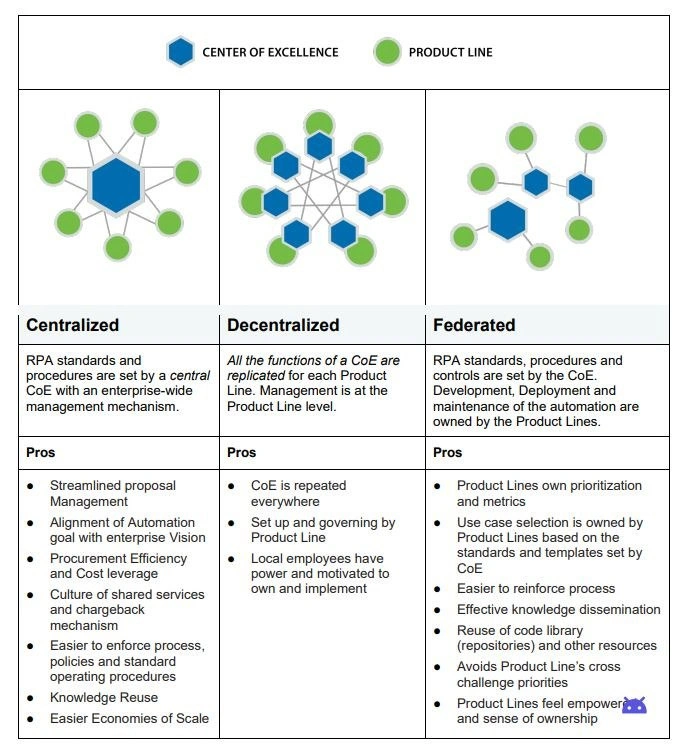
An enterprise diagram maps three RPA operating models—centralized, decentralized, and federated—using CoE hexagons and product-line circles. The deep dive explains automation ownership, governance trade-offs, and why org topology matters as much as the bots.
Level 1: Who Owns The Robot
This is funny in a very corporate way because it turns "who gets to build the helpful robot?" into a whole map of circles and hexagons. One plan says one boss controls all the robots, another says every team gets its own robot boss, and the last says one group writes the rules while each team runs its own robot. The simple idea is that sharing control is hard, even when everyone says they just want to automate boring work.
Level 2: Automation Ownership
RPA, or Robotic Process Automation, means software bots automate repetitive business tasks. These are often tasks like copying data between systems, filling forms, checking records, sending routine emails, or moving data from one business application to another.
A Center of Excellence, or CoE, is a group that defines standards, best practices, reusable components, training, governance, and tool choices. A Product Line is a business or product group that owns a set of processes and outcomes.
The image shows three ways to organize that work:
| Model | Who Controls Standards | Who Delivers Automation | Main Trade-Off |
|---|---|---|---|
| Centralized | Central CoE | Mostly central team | Consistent, but can become a bottleneck |
| Decentralized | Each Product Line | Each Product Line | Fast locally, but duplicated everywhere |
| Federated | Central CoE | Product Lines | Shared rules with local ownership |
For newer developers or automation engineers, the point is that technical architecture and organizational structure are linked. If every team builds automation differently, reuse is hard. If one central team owns everything, delivery can slow down. The diagram is trying to show why enterprise automation is as much about governance and incentives as it is about bots.
Level 3: Org Topology
The diagram compares three RPA operating models under a legend where a blue hexagon means:
CENTER OF EXCELLENCE
and a green circle means:
PRODUCT LINE
The columns are labeled Centralized, Decentralized, and Federated. This is not a punchline meme in the usual sense; the dry enterprise humor is that the chart looks like a distributed-systems topology but describes corporate ownership. Every automation program eventually discovers the same problem: who owns the standards, who owns delivery, and who gets blamed when the bot quietly breaks because someone changed a spreadsheet column.
In the Centralized model, the visible description says RPA standards and procedures are set by a central CoE with an enterprise-wide management mechanism. The pros list emphasizes proposal management, alignment with enterprise vision, procurement leverage, shared services, policy enforcement, knowledge reuse, and economies of scale. That is the control-plane dream: one group defines how automation should work, negotiates tools, enforces process, and prevents every department from building a tiny kingdom of macros with purchase orders.
The Decentralized column says all CoE functions are replicated for each Product Line and managed at the Product Line level. The visible pros are local power, motivation, and ownership. That is attractive because the people closest to the process understand the messy details. It also duplicates expertise, tooling, governance, and failure modes. Every product line gets autonomy, plus the opportunity to rediscover the same mistakes independently. Enterprise architecture: now with artisanal inconsistency.
The Federated model is the compromise that usually survives contact with reality. The diagram says the CoE sets standards, procedures, and controls, while development, deployment, and maintenance are owned by Product Lines. Its pros include Product Line prioritization, CoE standards and templates, knowledge dissemination, code library reuse, and ownership. In practice, this is an attempt to separate platform governance from local execution. The hard part is keeping "federated" from becoming "centralized when convenient, decentralized when accountable."
Every enterprise automation strategy eventually discovers distributed systems: one control plane, many unhappy nodes, and a federated model to make the diagram survivable.
“Center of excellence”