
Python CTF Code Golf Meme Explained
A CTF team names itself with a nested Python expression that evaluates to a quirky Unicode character. The dive walks through not (), str, min, ord, range, sum, and chr, and why that obfuscated code-golf flex thrives in capture-the-flag culture.
Level 1: Secret Handshake Code
Imagine a group needs a team name, but instead of just saying it, they hide it inside a treasure map, a math riddle, and a secret alphabet. Everyone else looks at it and says, "Why would you do that?" That is why the meme is funny: the answer is tiny, but the path to it is hilariously overcomplicated.
Level 2: Python Side Quest
A CTF, or capture-the-flag event, is a hacking puzzle competition. Teams solve challenges involving cryptography, web bugs, reverse engineering, binary exploitation, forensics, and other security skills. Team names often become small jokes or technical flexes.
Here, the team name is generated by a Python one-liner. Obfuscation means writing code in a way that hides what it is doing. Code golf means making code unusually short or clever, often at the expense of readability. Unicode is the huge character system that lets computers represent far more than basic English letters, while ASCII is the older, smaller character set whose ordering still shows up in examples like ord("T") == 84.
Each function in the meme does a simple job, but stacking them makes it look cursed. str() turns a value into text. min() finds the smallest character by character-code order. ord() turns a character into a number. range() makes a sequence of numbers. sum() adds them. chr() turns the final number back into a character. The absurdity is that all of this machinery exists just to produce a meme-shaped glyph.
Level 3: Obfuscation Any%
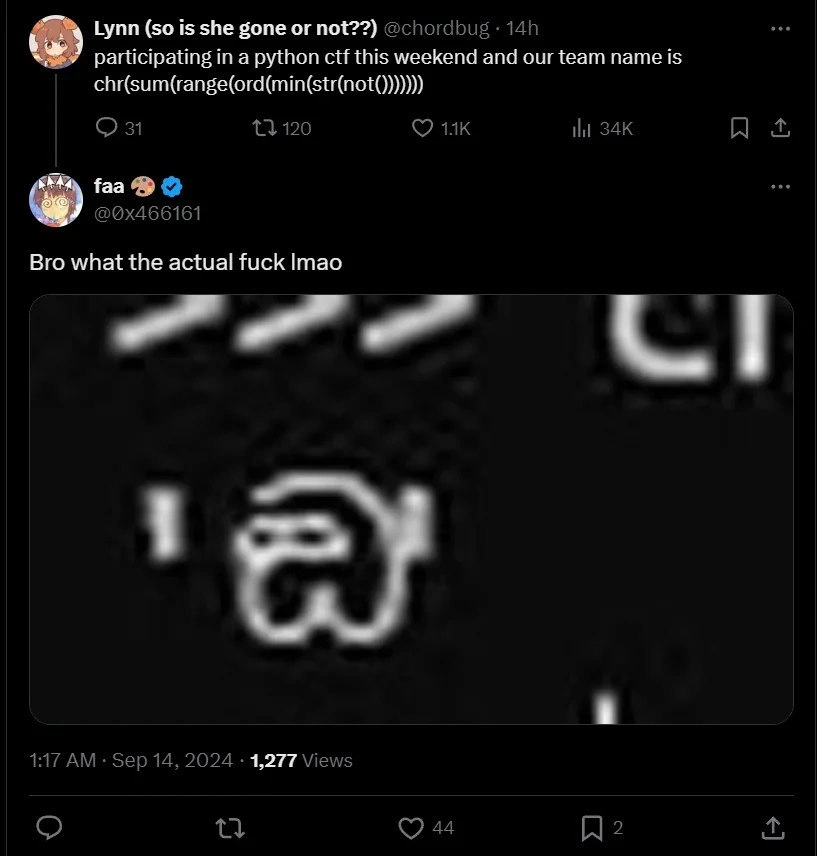
The visible post says:
participating in a python ctf this weekend and our team name is chr(sum(range(ord(min(str(not()))))))
The reply underneath gives the correct code review:
Bro what the actual fuck lmao
The joke is that the team name is not chosen with normal human communication. It is chosen through Python expression abuse, code golf, Unicode support, and just enough obfuscation to make every other CTF player either respect it or immediately open a REPL. This is hacker-culture peacocking in its purest form: technically valid, intentionally hostile to readability, and funny because the payoff is a tiny character that looks like an Among Us crewmate in the zoomed image.
The expression works because Python lets not() parse as not (). An empty tuple is falsey, so not () becomes True. Then the chain gets increasingly silly:
str(not())                  # "True"
min(str(not()))             # "T"
ord(min(str(not())))        # 84
sum(range(84))              # 3486
chr(3486)                   # Unicode code point U+0D9E
That is the entire flex: start with a weird-but-legal syntax corner, walk through string conversion, character ordering, numeric ranges, summation, and finally Unicode conversion. The visible blurred glyph is the punchline, but the real humor is the route taken to get there. A normal person would type the character. A CTF team turns it into a miniature puzzle box because apparently a team name must now have an exploit chain.
This also lands because CTF culture rewards the same instincts that make the expression awful as production code. It compresses trivia about parser behavior, truthiness, ord, chr, and Unicode into one line. In a codebase, that would be a maintenance crime. In a capture-the-flag context, it is social currency.
The team name is just `chr(3486)` with enough ceremony to make a linter consider a career change.
https://x.com/sundhaug92/status/1834680041562636443?t=prpewDDz30c-4BkLHB01Mg&s=19
real
amongus
very sussy sus
No way
pythonus
chr(3486)