
Global Variables Scope Bugs Meme Explained
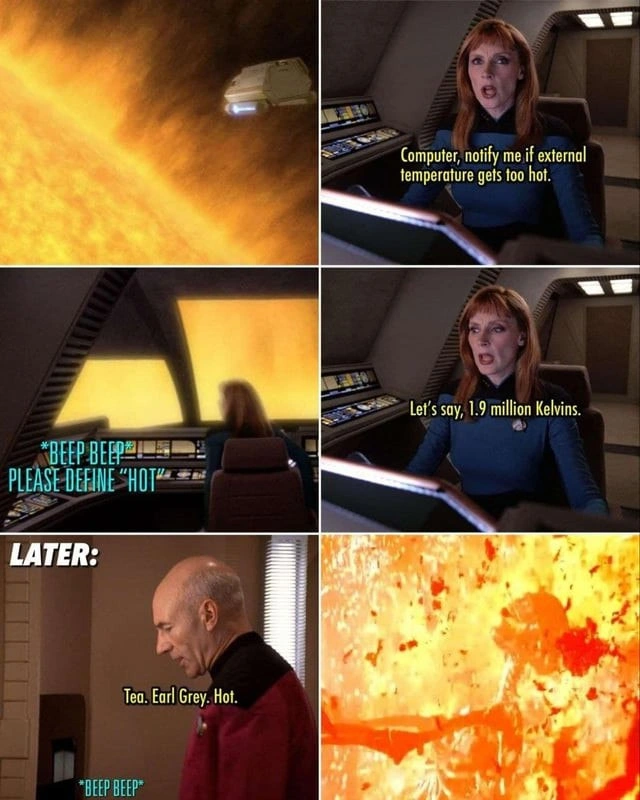
A Star Trek comic where defining “hot” for hull temperature later matches Picard’s Earl Grey order—and the ship explodes. The dive treats it as a lesson in global state, unscoped alerts, and requirements ambiguity.
Level 1: The Too-Literal Helper
This is like telling a helper, “Warn me if the oven gets hot,” and later someone says, “I want hot soup,” so the helper screams that the oven is dangerous. The funny part is that the helper followed the word exactly but missed what the word was about. Computers can make the same mistake when people do not tell them the exact situation a rule belongs to.
Level 2: Scope Your Meaning
A global variable is a value that many parts of a program can access. Globals can be convenient, but they are risky because unrelated code can accidentally read or change the same value. In this meme, hot behaves like a global concept. It should belong only to externalTemperature, but it also catches the word “Hot” in a tea order.
Event handling is how software reacts when something happens: a button click, a sensor reading, a voice command, or an incoming message. The alert rule should have been something like:
if (sensor.name === "externalTemperature" && sensor.kelvin > 1900000) {
  notifyCrew();
}
Instead, the meme imagines a system closer to:
if (heardWord("hot")) {
  notifyCrew();
}
That second version is much too broad. New developers run into this when they name things vaguely, reuse a variable outside its original purpose, or write a condition that works for the first example but fails on the next edge case. The visible explosion is the dramatic version of a bug report that starts with “When I ordered tea, the ship caught fire.”
Level 3: Global State Goes Critical
The meme shows a Star Trek shuttle near a blazing star, followed by a crew member saying:
Computer, notify me if external temperature gets too hot.
The computer asks:
BEEP BEEP PLEASE DEFINE "HOT"
She sets the threshold:
Let's say, 1.9 million Kelvins.
Then the “LATER:” panel shows Captain Picard ordering:
Tea. Earl Grey. Hot.
and the computer beeps just before the final fiery explosion. The post message calls it a reminder about global variables, which is exactly the developer reading: the system did not scope the meaning of hot to “external temperature near a star.” It treated hot as a reusable global condition, so a tea preference accidentally matched an alert rule meant for a life-threatening environment.
The senior pain here is requirements ambiguity plus event handling plus global state, all packed into one absurdity. The user gave a natural-language instruction with a context: external temperature. The system asked for a threshold, but apparently failed to attach that threshold to the correct variable, namespace, sensor, or event source. In real software, that becomes alert rules that fire for the wrong service, feature flags that leak between tenants, environment variables shared by unrelated jobs, or a word like status meaning five different things depending on which team wrote the API.
The joke also lands as an observability meme. A useful alert needs a metric, a threshold, a scope, and a consequence. “Notify me if it gets hot” is not enough. Is hot a string in a beverage order? A thermal reading from the hull? A CPU temperature? A severity label? An alert rule that listens too broadly produces false positives, and false positives train operators to ignore alarms. Eventually the actual emergency arrives wearing the same beep as someone making tea. That is how alert fatigue gets its little red uniform.
The best part is that the computer is not even being evil. It is being literal. Machines do not understand “obviously I meant the star, not Earl Grey” unless the system model captures that distinction. Every engineer has seen a version of this where a quick global shortcut looked harmless until the second caller appeared. The first use case always says, “This can never conflict.” The second use case quietly opens a pull request titled fix: tea explosion.



This is why every alert rule needs scope: otherwise `hot=true` turns tea time into a SEV-1.
That's why I did react project in ts
This could apply to any framework tbh