
Boolean Flag API Meme Explained
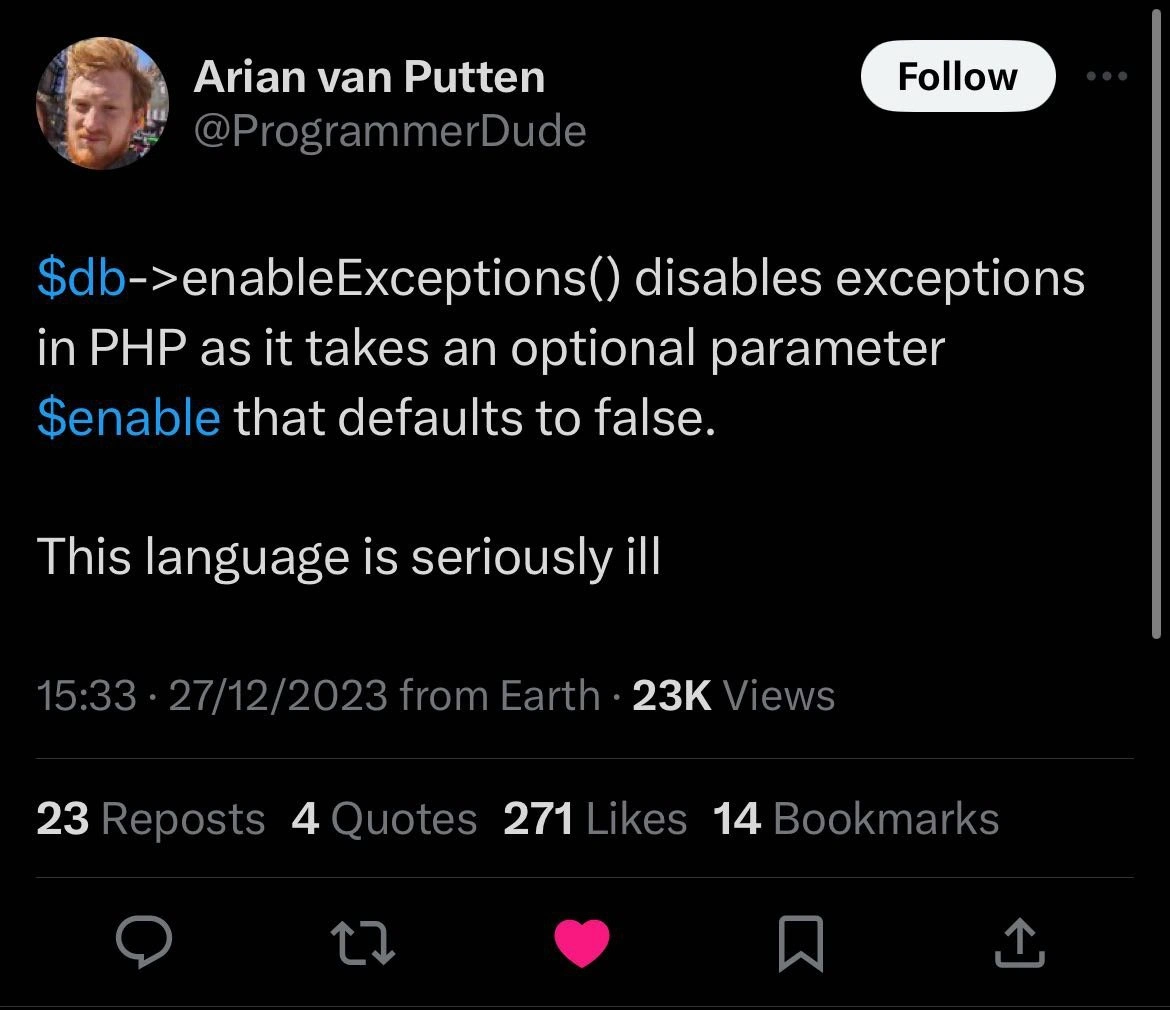
A tweet roasts PHP for a method named enableExceptions that leaves exceptions off unless you pass true. The dive covers optional boolean defaults, flag-argument design flaws, and why API names should match actual behavior.
Level 1: Opposite Day in Code
Imagine you have a light switch on the wall that’s labeled “ON,” but when you flip it up, the lights actually turn off. Pretty silly, right? You’d flip the switch expecting the room to light up, but instead you’d be left in the dark. This meme is laughing at a programming mistake just like that! In the code, there was a function named like it would turn something on (it says “enable exceptions,” kind of like “enable = on”). But if you used it in the obvious way, it secretly kept things off unless you gave it special instructions. It’s as if someone mislabeled the switch.
Why is this funny to programmers? Because it’s a goofy mix-up! It’s like saying “yes, let’s do it!” but actually meaning “no, don’t do it” unless you add extra words. Everyone can relate to being confused by something that does the opposite of what it says. It makes us laugh a bit and shake our heads. In simple terms, the code was having an “opposite day” moment – the name said one thing, but it behaved in the reverse way. And that little absurd surprise is what gave developers a reason to joke about the PHP language being “seriously ill” (just exaggerating for comedic effect). It’s like the code had a prank up its sleeve, and we’re all in on the joke now!
Level 2: When "On" Means Off
Let’s break down what’s going on in simpler terms. The meme is talking about PHP, a programming language often used for web development. In PHP (as in many languages), an exception is a special error object that stops normal program flow and needs to be handled (caught) explicitly. By default, some PHP database code doesn’t throw exceptions when something goes wrong; instead, it might return an error code or a false value, or it might trigger a warning. Many developers prefer exceptions because they can make error handling more consistent and harder to ignore. To accommodate this, PHP’s database libraries often allow you to turn on exception-throwing for errors.
Now, the crux of the joke: there’s a method (think of a function attached to an object) called $db->enableExceptions() – presumably on a database object (often $db is a variable for a database connection). You’d intuitively think calling this will enable exception mode (make the database throw exceptions on errors). However, this function is defined with an optional parameter $enable that has a default value of false. In PHP, a function definition might look like:
function enableExceptions($enable = false) {
    // ... do something based on $enable ...
}
The $enable = false part means if you call enableExceptions() without passing any argument, PHP will automatically assume $enable is false. So calling $db->enableExceptions() is effectively doing $db->enableExceptions(false) behind the scenes. In other words, you are telling it not to enable exceptions (because $enable is false). Surprise! You actually disabled or left exceptions off, even though the function’s name sounds like you wanted them on.
To actually turn exceptions on, you’d have to call the method with a true argument, like $db->enableExceptions(true). Then $enable would be true, and it would do what you expect. The tweet highlights this very awkward situation. Here’s a short example to illustrate:
$db->enableExceptions();      // This uses default false, so exceptions stay OFF (no throwing).
// (It’s like calling enableExceptions(false) which DISABLES exceptions.)

$db->enableExceptions(true);  // Exceptions are now ON (this is the proper way to enable them).
The humor (and frustration) is in that first line: $db->enableExceptions(); sounds like it should enable the exceptions, but because of the default false, it doesn’t! It’s like a trick or a gotcha in the code.
Why would the language or library be set up this way? Sometimes it comes down to naming conventions and old decisions:
- It might be that originally, exceptions were not used, and this function was later introduced to give programmers the option to turn them on. To avoid breaking older programs that weren’t expecting exceptions, the developers made the default behavior “do nothing” (i.e., leave exceptions off) unless you explicitly pass
true. - Unfortunately, having a method named
enableExceptionsdefault to false is very misleading. It violates a basic principle of good API design: functions should do what they sound like they do, and default settings should be sensible. In this case, a new programmer or anyone reading the code could be easily confused. You seeenableExceptions()in someone’s code and you’d reasonably assume exceptions are enabled afterward – but nope, not unless thattruewas passed! This is why it’s flagged as a bad practice or a design bug.
This kind of mistake is part of why people joke about PHP’s language quirks. PHP has been around for over 25 years, and along the way, different parts of the language were created by different people, at different times, without a single consistent style guide. The result is a bit of a messy toolbox: some functions or methods have surprising names or behaviors. A method like this, where you have to read the fine print (the optional parameter default) to understand what it really does, can cause real developer frustration. It might lead to bugs where error exceptions weren’t being thrown when they should have been, simply because the programmer didn’t realize they needed to pass that true.
In summary, the meme points out:
- An odd API design (
enableExceptions()with default false) that causes confusion. - The irony that calling something that says “enable” can end up doing the exact opposite (disabling exceptions) if you’re not careful.
- How this reflects on PHP’s overall reputation for inconsistent design choices (hence the hyperbolic “This language is seriously ill” comment – they’re joking that PHP must be sick to have such weird behavior!).
For a junior developer, the takeaway here (besides a chuckle or a facepalm) is the importance of clear naming and understanding default parameters. Always check if a function has optional arguments and what their defaults are. And when designing your own functions or classes, try to avoid confusing names or double negatives. If you saw code like this in a code review, you might suggest renaming the method or changing how it’s called to make it clearer. After all, code is read more often than it’s written, and we don’t want future readers to scratch their heads thinking “Did that just do the opposite of what it says?!”.
Level 3: Boolean Default Blunder
At first glance, $db->enableExceptions() sounds like it should turn on exception handling. But in true PHP fashion, this innocently named method comes with a twist: it has an optional boolean parameter $enable that defaults to false. In other words, calling enableExceptions() with no arguments actually calls enableExceptions(false). The result? Exceptions remain disabled – a classic double negative in API design. Senior developers reading this are probably smirking (or groaning) at the flag argument fiasco here. This is a textbook example of a boolean parameter creating ambiguous behavior: the method’s name says “enable”, but by default it does the opposite. Talk about confusing!
Why would anyone design it this way? Likely backwards compatibility strikes again. PHP has a notorious history of preserving old behaviors to avoid breaking legacy code. Perhaps in some early version, exceptions were off by default for database operations, and they offered a new enableExceptions($enable) toggling feature. To avoid surprising existing users (who weren’t expecting exceptions), the default was set to false – meaning “do nothing unless explicitly asked.” It’s a perverse incentive: trying not to break old scripts ended up creating a naming nightmare for everyone else. This is why the tweet quips “This language is seriously ill” – it’s highlighting how PHP’s API naming conventions can feel downright sickly due to years of accumulated quirks. Seasoned devs have seen this pattern before: naming conventions gone wrong, where function names and default behaviors contradict each other in the name of not rocking the boat.
From an API design perspective, this is almost a comedy of errors:
- The method conflates two actions (enabling or disabling exceptions) into one call with a boolean flag. In clean code principles, such flag arguments are often considered a bad practice. Why? Because they make the code harder to read – you have to check what the flag value is to know what the function will do.
- The default
falseturns the method name into a liar. CallingenableExceptions()doesn’t enable anything unless you override the default. It’s like a booby trap for unwary developers. Developer frustration ensues when you confidently call a method that sounds right, only to discover it quietly did nothing (or the opposite of what you intended). - This double-negative design is an anti-pattern. Ideally, the library could have had two clearer methods: e.g.
enableExceptions()anddisableExceptions(), each with no parameters, doing exactly what they say. Or require the boolean argument always, without a default, forcing the programmer to be explicit (enableExceptions(true)vsenableExceptions(false)). Either approach would avoid this paradox.
Veterans of PHP can probably rattle off similar cases where the language’s notorious naming inconsistency and long-term backward compatibility lead to ill-designed interfaces. PHP’s standard library is a minefield of historically inconsistent naming: e.g., some functions use underscores (html_entity_decode), others don’t (htmlspecialchars), parameter orders vary unpredictably (needle-then-haystack vs haystack-then-needle), and return values like false could mean “error” or just a legitimate result (as in strpos). Over decades, PHP accumulated these warts because changing them would break too many websites. The PDO (PHP Data Objects) and related database extensions weren’t spared either – they carry the baggage of early design decisions. The result is what the meme describes: an API that feels like an archaeological dig through layers of old decisions. Each stratum has its own conventions, leading to weird artifacts like a function named to enable something but requiring a true parameter to actually do so.
In short, the humor here comes from the absurdity of an API design that does the exact opposite of what its name advertises unless you know the secret handshake (passing true). It’s a senior-dev inside joke: “Yep, that’s PHP for you – where calling enableExceptions() might disable exceptions by default.” It’s funny in the same way a dark joke is funny: you laugh to keep from crying, especially if you’ve been bitten by this in a late-night debugging session. The meme resonates because it crystalizes a shared annoyance: naming and defaults in PHP can be so illogical at times that one might half-jokingly declare the language “seriously ill.” 😅

Somewhere in the PHP core someone wrote `enableExceptions(false)` and thought, “Perfect - self-documenting code.”
After 20 years in the industry, I've learned that PHP's enableExceptions(false) is just the language's way of preparing us for production - where exceptions are enabled but error reporting is disabled, logs are write-only, and the only debugging tool is customer complaints
Ah yes, PHP's `enableExceptions($enable = false)` - because nothing says 'enable' quite like defaulting to 'disable'. It's the API design equivalent of a fire alarm that's off by default. At least it's consistently inconsistent with PHP's long tradition of making you question whether you're the one who's confused or if the language designers were just having a laugh. This is the kind of footgun that makes you appreciate languages where 'enable' actually means 'turn on' and not 'maybe turn on if you remember to pass true, otherwise definitely keep off'. It's like ordering a coffee and having to explicitly specify you want it hot, or it arrives frozen
PHP's enableExceptions(false): the API equivalent of a 'Do Not Enter' sign on the exception highway - silent crashes for all
Nothing says enterprise maturity like enableExceptions(false): a boolean trap preserving backward compatibility while maximally violating the Principle of Least Surprise
Only in PHP do you call enableExceptions() and, by default, get fewer exceptions - Boolean Trap meets naming inversion, the kind of DX that turns observability into an optional parameter
Still better than Java
The PHP is fine. The script kiddy that used a function without consulting the manual (took code from so? ) - is a лох on the other hand
I think the thing folks are also missing about this 'language' problem is that the code is referencing the functions of an object without even calling out the name of the class being used?? It's part of the SQLite3 extension and I don't even know anyone who uses it; The only ones I've seen people regularly use are either PDO or mysqli
https://github.com/php/doc-en/blob/master/reference/sqlite3/sqlite3/enableExceptions.xml this method's class was made 8 years ago and nobody ever even made a pull request to change the name. People must not care enough.
seriously ill is the person who still uses php
People judge a language by the weird implementation of a library is weird...
you scare me. I will absolutely not fight you. you're chaotic and unpredictable
and all i use is php and js 🥲
Oh man, you don’t know fcking perl
Every language is fucked up in its own way, though some of them are leaning towards unfucking themselves while others go the opposite way, that's how you can choose a better one if you're not masochist
🤭
Its not about the language, its about that concrete Sqlite library implementation, that is extention to php, writen by someone. That gullible soy cant distinguish language and it's implementation.
It's the same if you dive in shit written project and blame the language on it. Blame specific people, who did concrete shit. Even weak languages and platforms (php not one of them) can be used to write decent projects if you know wacha doing.
They main problem with php is that, it was just a web template language and because there was no alternative, community turned it into general server language. Thats what some of the languages flaws come from. But the benefit of the rapid development outweighs all of them.