
C26 vs C89 Standards War Meme Explained
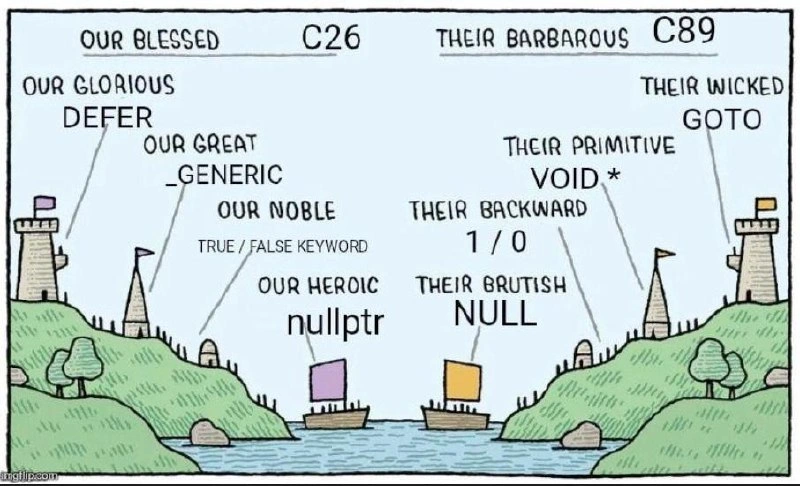
A Tom Gauld-style cartoon pits Our Blessed C26 against Their Barbarous C89 across a river, pairing modern keywords with older idioms. The deep dive maps nullptr, true/false, defer, and _Generic onto NULL, 1/0, goto cleanup, and void*, and notes how standards often canonize existing practice.
Level 1: Two Villages Arguing About Forks
Picture two villages on opposite hills, waving flags and shouting insults across a river. One village eats with "noble gleaming forks," and they're disgusted that the other village eats with "barbarous pointy sticks." But if you look closely... a fork is just several pointy sticks glued together. That's the whole joke. Both groups of programmers use the same language, invented by the same people, to do the same things — one group just has newer words for it. The comic makes fun of how people turn tiny technical differences into holy wars, declaring everything ours glorious and everything theirs wicked, when a visitor from outside couldn't tell the two villages apart.
Level 2: A Field Guide to Both Kingdoms
The terms on the banners, decoded:
- C89 — the first ANSI/ISO standard for C (1989), the dialect of K&R's second edition. Variables declared at the top of the block,
/* comments only */, no booleans. Still the lowest common denominator for portable code. - C26 — the upcoming C standard, continuing what C23 started (which made
true,false, andnullptrreal keywords). NULLvsnullptr—NULLis a macro for a null pointer; because it can expand to plain0, it sometimes behaves like an integer in surprising places.nullptris a dedicated keyword with its own type, so the compiler can't confuse it with a number.goto— jumps execution to a label. Infamous for producing "spaghetti code," but widely used in C for error-handling cleanup.defer— schedules code (likefree()orfclose()) to run automatically when the current scope exits, so cleanup can't be forgotten. Go and Zig programmers have had this for years.void *— a pointer to "anything." Maximum flexibility, zero type safety: the compiler stops checking what you're pointing at._Generic— a C11 mechanism that picks different code depending on an argument's type, giving C a primitive form of overloading.
The early-career lesson: when you join a C codebase, the standard version in the build flags (-std=c89 vs -std=c2x) tells you which kingdom you've enlisted in, and you fight with that army's weapons.
Level 3: Thirty-Seven Years of Committee Warfare
The cartoon — drawn in the unmistakable Tom Gauld style of two fortified hills glaring at each other across a river, watchtowers and little sailboats included — maps the oldest joke in anthropology onto ISO standardization: our things are blessed, their identical things are barbarous. The left kingdom flies the banner "OUR BLESSED C26" with annotations reading "our glorious defer," "our great _Generic," "our noble true/false keyword," and "our heroic nullptr." Across the water, "THEIR BARBAROUS C89" fields "their wicked goto," "their primitive void *," "their backward 1/0," and "their brutish NULL."
The satirical payload is in the pairings, because each one is the same concept wearing different decades:
| Blessed (C26) | Barbarous (C89) | Actual difference |
|---|---|---|
nullptr |
NULL |
A real type (nullptr_t) vs. a macro that might be 0 or ((void*)0) |
true/false keywords |
1/0 |
First-class booleans vs. integers cosplaying as booleans |
defer |
goto cleanup |
Structured scope-exit vs. the hand-rolled idiom every C codebase already uses |
_Generic |
void * |
Compile-time type dispatch vs. "the type system is a suggestion" |
The defer/goto pairing is the sharpest cut. Dijkstra's famous letter made goto the original programming heresy, yet the single most defensible use of goto ever found — jumping to a cleanup label to release resources, the pattern holding up the Linux kernel — is exactly what defer standardizes. The blessed feature is the barbarous feature with a helmet polished by WG14. That's the comic's quiet thesis: language standards don't conquer old idioms, they canonize them. And the river between the hills is doing real work too — it's the migration gap. Untold billions of lines of embedded firmware, banking systems, and vendor SDKs still compile as C89 because the toolchain for that one automotive microcontroller hasn't been updated since the compiler shipped on a CD. The C26 kingdom can wave its banners all it likes; the barbarians own most of the installed base, and both kingdoms ship identical undefined behavior the moment anyone dereferences past an array.
The deeper historical gag is that C has watched this war from both hills. In the 1990s, C was the barbarous kingdom in C++'s version of this cartoon. Every language lives long enough to become the legacy standard somebody draws a fortress around.


Two kingdoms at war, yet both ship the same UB - the only thing C standards have deprecated successfully is each other's vocabulary
At last, `goto cleanup` has been refactored into a keyword with better public relations.
They actually added boolean without linking a lib? Or is it just named int constants?
Whatever, pinch me when C++ modules are really supported
The main feature of C is universal support. New features are only supported on new compilers, so you might as well use any other modern language.
and no one checked that _Generic isn’t actually a «generic» in the usual sense but rather a function overload for a finite number of types (defined by the user) it’s more like @singledispatch in Python
They finally have true/false keywords, the only thing I lacked in C
Defer in C???