
Samsung 200X Zoom Meme Explained
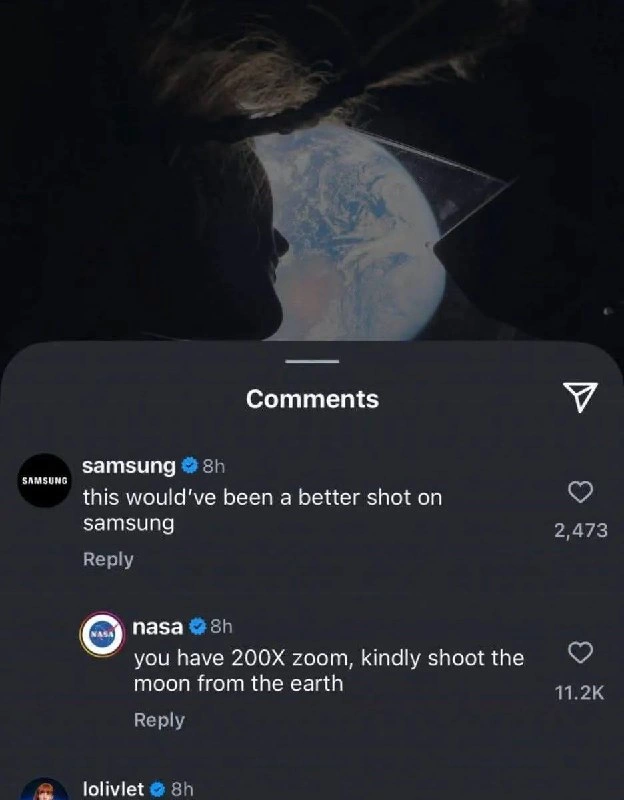
Under a NASA space photo, Samsung claims a better shot and NASA replies: use that 200X zoom on the moon. The dive explains optical vs digital zoom, Space Zoom marketing, and the scene-optimizer moon-hallucination controversy.
Level 1: The Crayon Telescope
A toy company brags that its toy telescope can see all the way to the Moon. A real astronaut posts a photo taken from actual space, and the toy company shouts, "Our telescope would've taken a better picture!" The astronaut calmly replies, "Great — point yours at the Moon and show us." Everyone laughs, because they all remember the time someone caught that telescope secretly drawing the Moon with crayons when it couldn't really see it. It's funny the way it's always funny when a show-off gets asked to actually do the thing they brag about — politely, with the word kindly.
Level 2: Optical vs. "200X"
The key concepts hiding behind the comeback:
- Optical zoom: real magnification from physical lenses. Phones manage maybe 3x–10x because telephoto optics need length, which flat phones don't have (periscope lenses fold the light path sideways to cheat a little).
- Digital zoom: cropping the sensor image and enlarging it. No new detail is captured — you're just stretching pixels.
- Computational photography / scene optimizer: software that merges multiple frames, sharpens, denoises, and — controversially — uses AI models that recognize subjects (faces, food, the moon) and paint in detail the lens never resolved.
- Why the moon specifically: it's the worst case for honest zoom (tiny, far, dim) and the best case for cheating (it always looks identical from Earth, so a model can memorize it).
- Ratio: when a reply massively out-likes the comment it answers — 11.2K vs 2,473 here — the crowd has voted on who won.
The relatable lesson for anyone early in their career: marketing claims are an API contract written by people who will not be on call when the implementation is discovered. Engineers eventually pay the interest on every "X" in "200X."
Level 3: When the Pixels Are Made Up and the Zoom Doesn't Matter
The screenshot captures a perfect collision between brand-account banter and a genuine technical controversy. Under a NASA-posted image — Earth glowing through what appears to be an astronaut's visor or spacecraft window — the verified Samsung account drops the classic ambush-marketing line, "this would've been a better shot on samsung" (2,473 likes), and NASA replies: "you have 200X zoom, kindly shoot the moon from the earth" — 11.2K likes, a ratio of roughly 4.5x, which in social-media physics is a confirmed kill.
The reply lands because it isn't just sass; it's a precision strike on computational photography's most embarrassing episode. Samsung's "Space Zoom" marketing promised 100X–200X magnification on a phone whose actual optics top out around 10x. Everything beyond that is digital crop plus aggressive AI reconstruction. The infamous community experiment: someone displayed a deliberately blurred, detail-free photo of the moon on a monitor, photographed it with the phone — and the camera produced a crisp moon with craters that did not exist in the source. The scene optimizer recognized "moon-shaped blob" and synthesized lunar texture from learned priors. That's not enhancement; that's the camera confidently hallucinating a moon at you. NASA telling Samsung to go shoot the moon is therefore the cruelest possible homework assignment — it's the one subject where Samsung's camera is known to cheat off a memorized answer key.
There's a sharper systemic point underneath the IndustryTrends_Hype dunk. Marketing departments and engineering departments ship different products: engineering ships a small sensor doing heroic multi-frame stacking; marketing ships "200X" in a font size no asterisk can survive. The gap between those two gets filled by ML models trained to make output look plausible rather than be faithful — the same epistemological problem now haunting every AI product category. When detail is generated rather than captured, "photo" quietly stops meaning "record of light that hit a sensor." NASA, an organization whose images are evidence used in actual science, flicking at that distinction in an Instagram comment is the institutional equivalent of a senior engineer leaving a one-line code review that ends the whole PR.



200X zoom: 10x optics, 20x marketing, and a diffusion model quietly drawing craters where the sensor gave up
That’s not a roast; it’s a 384,400-kilometre end-to-end test.
Is this real?
omg i love when brands are relatable ✨ they're just like our friends!! 🤩
Lmao didn't they fake the moon on anything dark and round at some point? I remember a video of a guy pointing it at the night light or something and it showed the craters
>kindly
Sir please kindly shoot the moon from the earth
pff, hold my beer
Why is an American government agency doing free pr for a South Korean electronics manufacturer