
Monkey Patching by Language Meme Explained
A four-panel meme contrasts JavaScript caution, Ruby open-class mania, old-school Lisp malleability, and Haskell’s “concept not found.” The dive defines monkey patching, prototype and class reopening risks, macros, and immutability that makes the bug class unrepresentable.
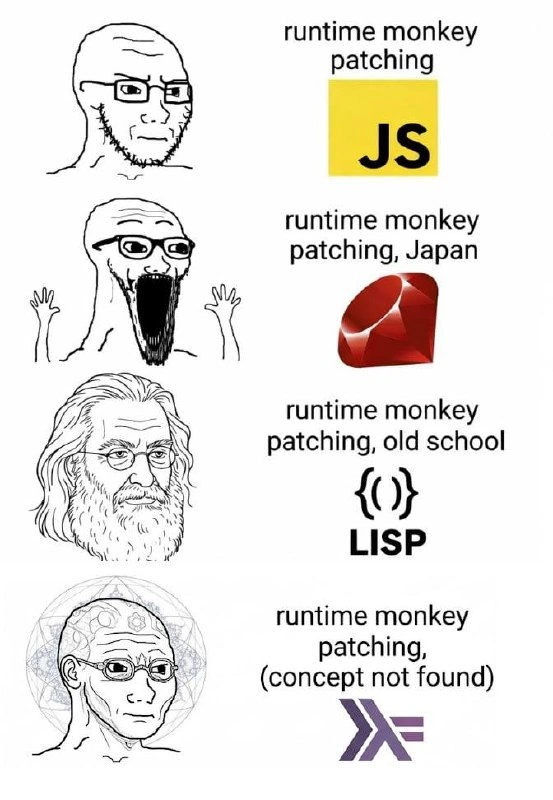
Level 1: Drawing on the Library Books
Imagine four people in a library. The first scribbles corrections in the margins of books but looks guilty about it. The second gleefully rewrites whole chapters with a crayon — and somehow the library encourages this. The third is an old sage who's been editing books since before the other two were born and knows exactly which pages can take the ink. The fourth sits glowing in the corner because in his library, the books are carved in stone — you literally cannot write on them, so the question "is scribbling okay?" doesn't even make sense to him. The joke is that the calmest person is the one who can't do the thing at all — and that's exactly why he's calm.
Level 2: What Monkey Patching Actually Is
Monkey patching = modifying or extending existing code — usually classes or modules you don't own, often from the standard library — at runtime, without touching their source.
# Ruby: reopen a core class. Every string in the program changes.
class String
  def shout = upcase + "!!!"
end
"deploy".shout  # => "DEPLOY!!!"
Why do it? Quick fixes for library bugs, adding conveniences, test mocking. Why fear it? The change is global and invisible — another file, another gem, another teammate sees behavior that matches no source code they can find. Debugging a monkey-patched codebase is your first lesson in why "it works on my machine" sometimes means "my machine has different patches." Immutability (Haskell's stance) means values and definitions can't change after creation — which removes the feature and the entire category of bugs it spawns. Macros (Lisp's stance) transform code before it runs, which is patching with a paper trail.
Level 3: Four Cultures, One Banana
The other three panels are an accurate ethnography of metaprogramming culture. The skeptical Nordic-gamer wojak glaring at the JS logo: JavaScript supports monkey patching trivially — Array.prototype.contains = ... and you've changed every array in the program — but the community treats it as a loaded weapon, ever since the SmooshGate affair, when a popular library's ancient Array.prototype.flatten patch forced TC39 to consider renaming a standard method to smoosh. Patch the prototype in a library and somewhere a standards committee weeps.
The screaming wojak beside the Ruby gem ("runtime monkey patching, Japan" — Matz created Ruby in Japan) captures a culture that embraced open classes as idiom: Rails' ActiveSupport teaches 5.days.ago by reopening Integer, and the ecosystem's history includes entire gems whose job was patching other gems' patches. Glorious, terrifying, occasionally both before lunch.
The wise elder beside {()} LISP ("old school") is the historical correction the meme slips in: none of this is new. Lisp systems from the 1970s onward let you redefine functions in a live image, inspect and rewrite the program as data (macros), and patch running systems — famously including debugging remote spacecraft software live. What JS and Ruby do with guilt, Lisp did with institutional pride decades earlier. The joke's architecture is a competence spectrum: suspicion → mania → mastery → transcendence, where transcendence means the question stops parsing.
Level 4: The Type System That Ate the Monkey
The Haskell panel — the enlightened wojak ringed in sacred geometry beside the lambda logo, captioned "runtime monkey patching, (concept not found)" — is making a claim about expressibility, and it's worth taking seriously. In JavaScript, Ruby, and Lisp, a program is a mutable structure living in a runtime: objects, classes, and symbols are first-class entities you can rebind while the program executes. Haskell's semantics simply contain no such operation. Top-level bindings are immutable; where and let introduce definitions, not assignments. Equational reasoning — the property that you can substitute any expression for its definition anywhere (referential transparency) — depends on definitions never changing out from under you. Monkey patching is precisely the destruction of that property, so a language built on it cannot admit the operation without ceasing to be itself.
The deeper layer is typeclass coherence. The closest Haskell analog to "patching someone else's class" would be an orphan instance — defining a typeclass instance for a type you don't own, in a module owning neither the class nor the type. GHC permits it but warns loudly, because coherence (every type has at most one instance per class, globally) is what lets the compiler resolve dictionaries deterministically at compile time. Ruby's refinements and Scala's implicits both rediscovered, painfully, why unrestricted local redefinition turns dispatch into a crime scene. The wojak's halo isn't smugness — okay, it's 20% smugness — it's the eerie calm of someone whose language made an entire bug class unrepresentable, which is the type-theoretic ideal: don't lint the error, deny it a syntax.

Haskell devs don't monkey patch - they spend three weeks convincing the type system the monkey never existed, then call it a refactor
Haskell did not ban monkey patching; the type checker proved the monkey never existed.
What's the bottom symbol?
Make them regret their life