
Windows AI Code Slop Meme Explained
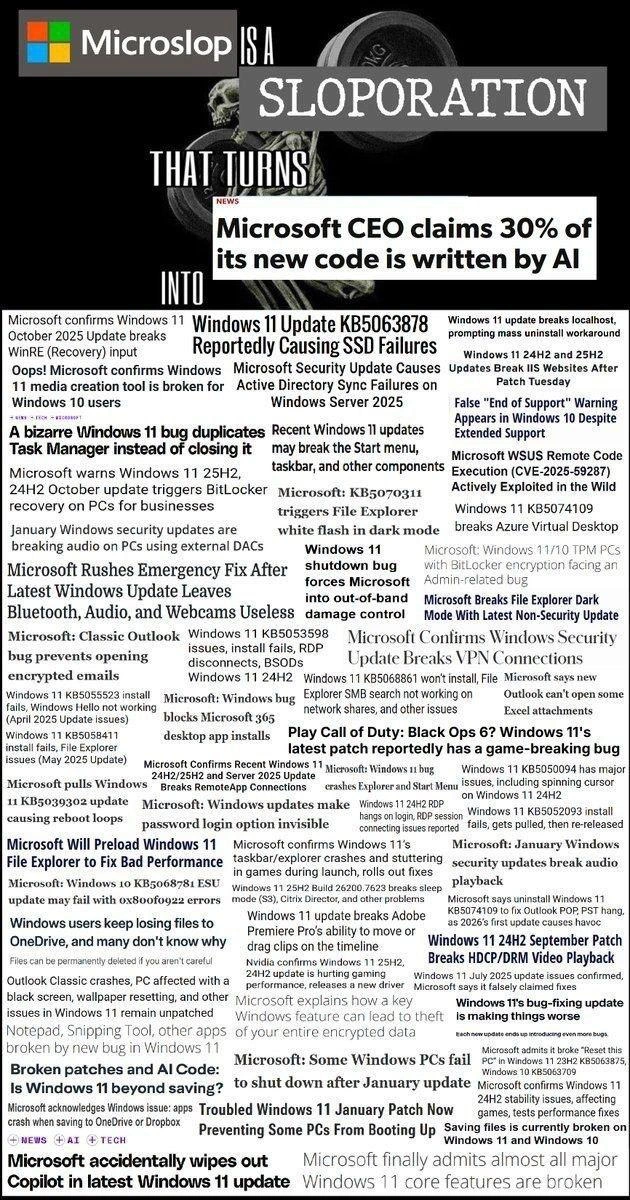
A newspaper-style wall of Windows 11 failure headlines surrounds Microsoft’s claim that 30% of new code is AI-written. The article shows Patch Tuesday regressions long predate transformers—and that “slop” amplifies whatever review culture already exists.
Level 1: The Robot Helper in the Kitchen
Imagine a restaurant owner proudly announcing, "A robot now cooks 30% of our food!" — while behind him, customers hold up plates with raw chicken, a soup with a fork melted into it, and a dessert that is somehow on fire. Maybe the robot cooked those exact plates, maybe it didn't — but the announcement and the disasters are sitting in the same room, and everyone is going to connect them. The joke is in the timing: never brag about your shiny new helper on the same day the kitchen is visibly on fire.
Level 2: Reading the Wall of Pain
- KB numbers (like
KB5063878): Knowledge Base identifiers for individual Windows updates. When a KB number trends on social media, it is never because the update went well. - BitLocker recovery: Windows' full-disk encryption demanding a 48-digit recovery key after an update confuses the boot measurements — effectively locking users out of their own machines until they find a key they were told to store "somewhere safe."
- CVE-2025-59287: a Common Vulnerabilities and Exposures entry; "RCE actively exploited in the wild" is the worst phrase in security, meaning attackers can run code on unpatched servers right now — which forces admins to install updates faster, from the same pipeline producing the other headlines. Lovely loop.
- AI slop: pejorative for low-effort generated content; applied to code, it means plausible-looking diffs that compile, pass the happy path, and detonate on edge cases nobody reviewed.
- Regression: when an update breaks something that previously worked — the unifying theme of every headline in the collage.
The junior-dev takeaway: every line that ships, whoever or whatever typed it, is your line once it's merged. "Copilot wrote it" appears in precisely zero incident reports as an accepted root cause.
Level 3: Correlation, Causation, and KB5063878
The format here is the oldest trick in propaganda and the newest trick in shitposting: the headline collage. Take one executive soundbite — "Microsoft CEO claims 30% of its new code is written by AI" — pin it dead center, then wallpaper every square inch around it with real Windows 11 failure headlines until the page itself becomes the argument. The masthead rebrand to "Microslop" ("a SLOPORATION that TURNS [this] INTO...") does the editorializing; the wall of KB numbers does the evidence-shaped part. And the wall is impressively specific: "Windows 11 Update KB5063878 Reportedly Causing SSD Failures", "KB5063878 triggers BitLocker recovery on PCs", "WSUS Remote Code Execution (CVE-2025-59287) Actively Exploited in the Wild", "A bizarre Windows 11 bug duplicates Task Manager instead of closing it", "Microsoft accidentally wipes out Copilot in latest Windows 11 update" — that last one being the only bug users reportedly asked to keep.
Anyone who has survived a few decades of Patch Tuesday knows the dirty secret the meme exploits: Windows updates broke SSDs, audio, printers, and VPNs long before a single transformer wrote a single line. The honest causal story is murkier and more damning in a different way. Microsoft gutted its dedicated SQA organization in 2014, shifted testing onto telemetry and the Insider Program (that is: onto you), and has been shipping an OS that is simultaneously a legacy-compatibility museum and a continuous-delivery experiment ever since. The AI-generated-code claim didn't create the quality crisis — it handed the crisis a narrative. "30% written by AI" plus "Task Manager now multiplies when you try to close it" is a syllogism nobody can resist, even though the regression pipeline that let both through is the same one that was rubber-stamping human slop in 2018.
That's the sharper satire buried in the collage: "slop" is a process property, not an authorship property. AI code review, AI-assisted commits, and AI-generated tests all amplify whatever quality culture already exists. Amplify rigorous review and you ship faster. Amplify "LGTM, merging before the sprint ends" and you get BitLocker recovery screens at airport kiosks. Executives quoting code-generation percentages as a productivity brag while users screenshot "Microsoft finally admits almost all major Windows 11 core features are broken" is the incentive mismatch in its purest form — the metric that gets a keynote slide is lines generated, not SSDs survived.
30% AI-written code, 100% AI-written postmortems - at least the incident reports ship on schedule
Thirty percent generated, seventy percent spent bisecting the regression.
waiting for Liza lgbt plus's comments under every post about vibecoding
So basically windows is windowsing even more now
Each time it gets posted, a couple new vulnerabilities are added
On linux side of things we'll have similar soon with all those rust rewrites...
I'm not into the topic. But vibecoding drivers just sounded like the worst possible idea to me, so I suggested it.
It's for the better
Pls
Like we now use the scuse of vibecoding? Windows ,as a true lover of this OS, since ever and Forever Will suck