
Lua One-Based Indexing Meme Explained
A SpongeBob meme says a LUA programmer is scared of zero. The dive explains Lua's one-based sequence tables versus zero-based arrays, off-by-one bugs, and why indexing conventions stick as muscle memory.
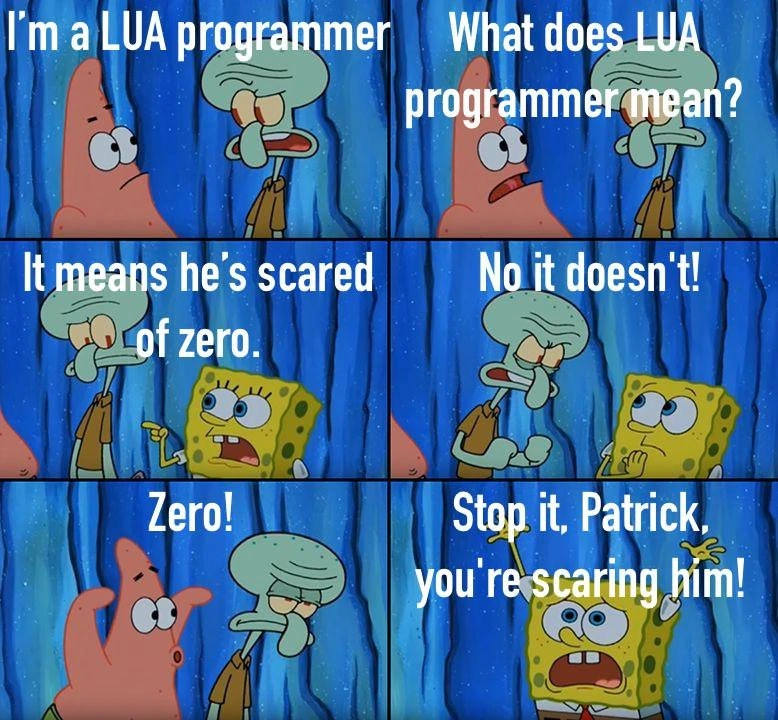
Level 1: Counting From a Different Start
This is like two kids counting seats in a row. One kid says the first seat is number 1, and another kid says the first seat is number 0. Neither kid is trying to be silly, but if they trade instructions, they will point to different seats. The joke is that the Lua programmer is so used to starting at 1 that hearing "zero" feels scary.
Level 2: First Means One
An index is a number used to pick an item from a collection. If a list contains red, green, and blue, a language needs some rule for which number selects red.
In many languages:
const colors = ["red", "green", "blue"];
colors[0]; // "red"
In typical Lua sequence style:
local colors = {"red", "green", "blue"}
print(colors[1]) -- "red"
That difference is the whole joke. Patrick says Zero! because zero-based indexing is normal to many programmers, but a Lua programmer is used to starting at 1. This connects to language quirks, data structures, and CS fundamentals because every loop over a collection has to respect the language's indexing strategy.
New developers meet this pain quickly. You write a loop, it runs one time too many or one time too few, and suddenly you understand why off-by-one error is a tag with emotional weight. The scary part is not the number zero itself; it is the possibility that every boundary in your code is shifted by one.
Level 3: Index Zero Panic
The six-panel SpongeBob format turns a language convention into a fear response. The visible setup says:
I'm a LUA programmer
then explains:
It means he's scared of zero.
The last two beats, Zero! and Stop it, Patrick, you're scaring him!, work because Lua is famously associated with one-based indexing. In many mainstream languages, arrays and lists start at index 0: the first item is items[0], the second is items[1], and so on. In Lua's conventional sequence tables, the first element is typically t[1]. So the meme imagines a Lua programmer reacting to 0 the way someone else might react to a ghost story.
The image says LUA, but the language name is normally written Lua. That detail even fits the joke: language communities care about tiny conventions because tiny conventions become muscle memory, tooling assumptions, and bug reports that start with "this should be obvious." Capitalization and indexing both look small from the outside; inside a programming culture, they are identity markers.
For experienced developers, this is really about off-by-one errors. Indexing conventions are one of those decisions that seem harmless until data crosses boundaries. A Lua script embedded in a game engine, a C API returning zero-based offsets, a JSON array consumed in JavaScript, and a database row number shown to a user can all disagree about what "first" means. The bug is rarely dramatic; it is just the wrong item, the missing boundary case, or the loop that skips exactly the thing you needed.
The humor is not that Lua is wrong. One-based indexing can align nicely with how humans count ordinary lists. Zero-based indexing aligns well with pointer arithmetic, offsets, and many lower-level representations. The joke is that developers internalize their language's worldview so deeply that another convention feels physically threatening. Somewhere, a loop counter just failed a vibe check.

Lua does not have off-by-one bugs; it has everyone else being off by one.
LUA
Zero!
They should have named it Luna
I’ve never messed with Lua before, what’s the joke here?
LUA
Luacy
i am really confused at this stage.
scared of switches too
Lua doesn't mean "LUA"?)
Lua is full name. LUA aka L.U.A., abbreviation.