
Date Localization MM/DD vs DD/MM Meme Explained
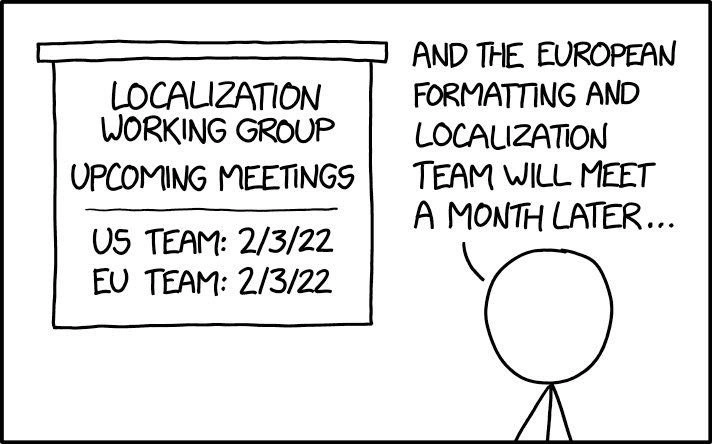
A stick-figure comic shows a localization group listing the same 2/3/22 for US and EU teams—February 3 vs March 2. The deep dive explains date-format ambiguity, internationalization, and why unambiguous ISO-style dates matter.
Level 1: Same Numbers, Different Day
This is like two friends agreeing to meet on "2/3" but one thinks it means February 3 and the other thinks it means March 2. Both are reading the note correctly in their own way. The funny part is that the people who are supposed to prevent this exact confusion caused it themselves.
Level 2: Dates Need Context
Localization means adapting software, documents, or interfaces for people in different regions. Internationalization is designing the system so that adaptation is possible without rewriting everything later. Dates are one of the classic traps because different places write the same date in different orders.
MM/DD/YY puts the month first. DD/MM/YY puts the day first. So 2/3/22 can mean February 3 or March 2. Both readings are reasonable depending on where you live. That is why user interfaces often use unambiguous formats like 2022-03-02, write out the month name, or display dates according to the user's locale.
The joke works because the group on the sign is literally a "LOCALIZATION WORKING GROUP." They should know better, but the meeting notice proves the problem before the meeting even happens. A junior developer will run into this same lesson the first time a date parser behaves differently on another machine, in another browser, or under another locale setting.
Level 3: Ambiguity In Production
The sign says:
LOCALIZATION WORKING GROUP
UPCOMING MEETINGS
US TEAM: 2/3/22
EU TEAM: 2/3/22
Then the speaker adds:
AND THE EUROPEAN FORMATTING AND LOCALIZATION TEAM WILL MEET A MONTH LATER...
That is the whole localization disaster in one tiny board. In common US formatting, 2/3/22 usually means February 3, 2022. In much of Europe, the same string is read as 2 March 2022. The sign uses identical text for two teams and accidentally schedules different realities. For a group explicitly dedicated to localization, this is not just a typo; it is the exact category of bug they exist to prevent. Naturally, it made it all the way to the meeting announcement.
This is why experienced engineers dislike ambiguous date strings. They look harmless until they cross a locale boundary, hit a parser with a different default, or get copied into a spreadsheet. Then suddenly a database migration, billing cycle, release freeze, or customer appointment shifts by a month and everyone has a meeting about "communication." The bug was not in the calendar. The bug was in assuming a date format is universal because it was familiar to the person typing it.
The comic also catches a product-management truth: internationalization is not just translating words. It includes formats, expectations, calendars, punctuation, units, sorting, pluralization, and the boring-looking details that become expensive when ignored. 2/3/22 is tiny. The confusion it creates is not.

The localization team found the bug in production: the requirements were stored as `MM/DD/YY` and parsed as organizational chaos.
but today is 2/2/22
actually today is the ideal day for us and eu localization team meetings
Only meeting that can happen is once in a month on 2/2/2022 3/3/2023 lol
YYYY-MM-DD: the SUPERIOR date format