
Frontier Model Churn Meme Explained
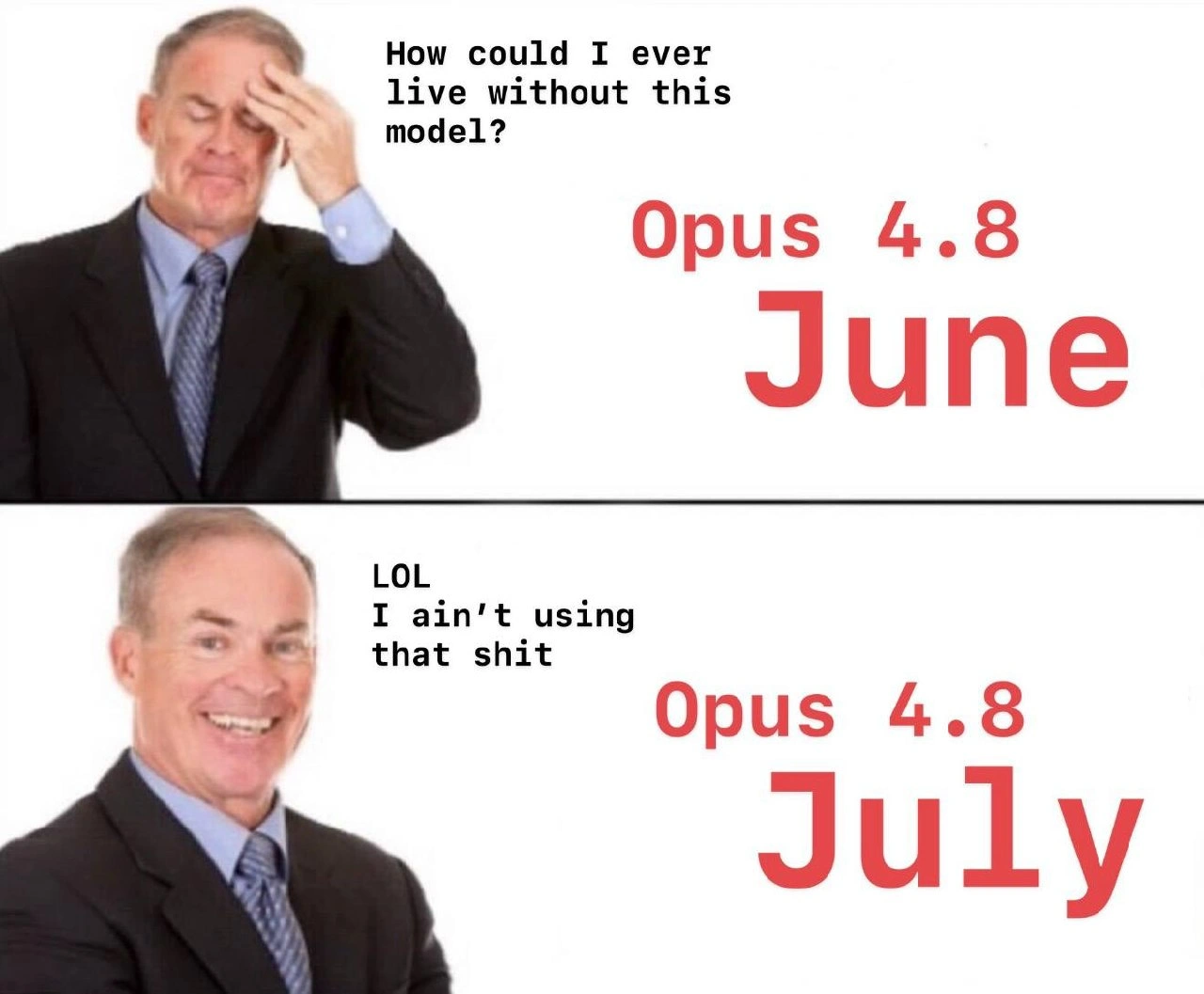
Two panels show Opus 4.8 worshipped in June and discarded in July without any weight update. The dive explains frontier-model churn, comparative judgments, and why developers need task-specific evaluations over hype.
Level 1: The New Favorite Toy
It is like a child crying because one favorite toy is missing, hugging the second-favorite toy all month, and then tossing it aside the moment the favorite comes back. Nothing happened to the second toy; it only looks worse beside the newly available choice. The same man switching from tears to a huge grin makes that fickle loyalty the joke.
Level 2: Why Models Feel Old Fast
An LLM, or large language model, generates text and code from patterns learned during training. Opus 4.8 is a particular Anthropic model version in the Claude family. A version label helps distinguish it from earlier or later models whose weights, training, safety behavior, or tool-use performance differ.
The word model in the meme does not mean an app by itself. The user’s experience also depends on a surrounding system:
prompt
  + selected model
  + tools
  + system instructions
  + context window
  + rate limits
  + product interface
  = observed workflow
That is why availability matters. If a more capable model disappears, the next option can suddenly become essential even though it was not the user’s first choice. When the preferred model returns, the fallback can be abandoned just as quickly.
State of the art means the strongest known performance at a given time and under some evaluation. It is not one permanent crown. Different models can lead at different tasks, and an evaluation can measure coding while missing tone, speed, cost, or accuracy on a company’s private data.
A sensible comparison uses a small repeatable test set:
| Question | What to Observe |
|---|---|
| Can it fix representative bugs? | Tests pass without unrelated changes |
| Can it navigate the codebase? | Correct files and dependencies are found |
| Can it follow constraints? | Requested scope and formatting are preserved |
| Can it use tools safely? | Commands are appropriate and errors are handled |
| Is it economical enough? | Latency and token cost fit the workload |
This is an evaluation, often shortened to eval. Without one, “the new model is better” may mean only that somebody saw an impressive demonstration. With one, a team can route complex tasks to a stronger model while retaining an older, cheaper, or faster model for simpler work.
The red June and July labels show how early adopters often skip that nuance. The emotional choice is binary: essential or unusable. Real tooling decisions are usually a matrix, which is less dramatic and tragically difficult to fit next to a stock-photo businessman.
Level 3: State of the Artlessness
The two panels keep the model name fixed and change everything around it. In the upper half, a suited man wipes his face beside:
How could I ever live without this model?
Large red type identifies Opus 4.8 and June. In the lower half, the same man beams with folded arms while saying:
LOL I ain’t using that shit
The red label is still Opus 4.8; only the month has become July. A supposedly indispensable model has not degraded between panels. The user’s reference point has changed.
The month labels encode a very specific Anthropic timeline. Claude Opus 4.8 launched on May 28, 2026. Claude Fable 5 arrived on June 9 but was suspended on June 12 after a US government export-control directive caused Anthropic to remove access globally. For much of the rest of June, Opus 4.8 was again the strongest broadly available Anthropic option and the fallback for affected workflows. Fable 5 access returned globally on July 1. The meme’s unnamed reason for July’s sudden contempt is therefore the return of a model users regarded as more capable.
That context makes the reversal less irrational than it initially looks. “I cannot live without Opus 4.8” can mean “I cannot live without the best model currently available inside this product and budget.” Once availability changes, the same user may route difficult tasks elsewhere. But the absolute language turns a practical ranking into melodrama: yesterday’s miracle becomes today’s refuse without receiving a single weight update.
This is frontier-model churn compressed into two stock photos. LLM users increasingly form judgments comparatively rather than absolutely. A model can remain excellent at coding, tool use, and long-form work while feeling obsolete because another model completes a favored task with fewer corrections. Capability has become an escalator: standing still is experienced as moving backward.
The cycle is accelerated by several forces:
- Vendors release models and revisions rapidly, often with overlapping families and access tiers.
- Public benchmarks collapse many behaviors into scores that encourage a simple leaderboard narrative.
- Social feeds amplify spectacular successes and failures before users have tested representative workloads.
- Coding agents make small reliability differences compound over many tool calls.
- Pricing, latency, rate limits, and availability can matter as much as raw model quality.
- Users anthropomorphize output style, becoming attached to a model that “gets” them until another one does.
The experienced response is not loyalty or contempt but task-specific evaluation. A developer needs to know whether a model edits the right files, follows repository constraints, preserves interfaces, passes tests, recovers from tool errors, and does so at an acceptable cost and latency. A benchmark improvement does not guarantee better performance on a particular codebase. Conversely, a superseded model may remain preferable for fast routine work, stable output, a lower price, or a workflow whose prompts were tuned around its behavior.
Replacing a model also has hidden migration cost. Prompts that worked reliably may become too verbose or insufficiently explicit. Tool-call formats can shift. Refusal boundaries, token consumption, and default style may change. Recorded evaluations need rerunning, caches may be invalidated, and teams must decide whether to pin a version or follow a moving alias. “Use the newest one” is a deployment strategy in the same sense that “YOLO” is a change-management framework.
The meme ultimately satirizes the AI hype cycle’s loss of historical scale. Opus 4.8 was only weeks old when the July panel pronounced it ancient. In mature infrastructure, teams prize predictable behavior and long support windows. In frontier AI, users may treat a month-old model like a forgotten JavaScript framework, except the framework at least had time for a migration guide.
Same weights, new month: the only regression was in user loyalty.