
String vs Number Types Meme Explained
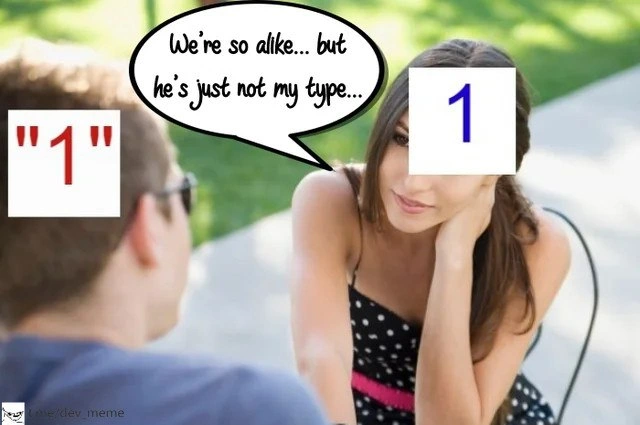
A dating meme labels two people "1" (string) and 1 (number); the numeric side says he’s just not my type. The dive explains data types, type coercion, strict equality, and why form inputs that look numeric still break when types disagree.
Level 1: Matching Clothes, Different Teams
This is like two people both wearing shirts with the number 1 on them, but one is a player and the other is a sign with a number printed on it. They look alike, but they are not the same kind of thing. The joke is that the number says they cannot be together because the other one is the wrong "type."
Level 2: Same Look, Different Kind
A data type tells a program what kind of value something is. Common types include numbers, strings, booleans, arrays, and objects.
In this meme:
"1"means the character1stored as text.1means the mathematical number one.- Type safety means the program keeps those categories separate so you do not accidentally treat text like a number.
- Type coercion means the program may automatically convert one type into another.
This matters because programs often receive information from users, files, websites, or databases. A value that looks numeric may still arrive as text. If the developer forgets to convert it, the program can make surprising decisions.
For example, adding numbers and combining strings are different operations. 1 + 1 should produce 2, but combining "1" and "1" as text can produce "11" in many languages or contexts. That is why developers care so much about types: they protect the meaning behind values, not just their appearance.
Level 3: Strict Equality Romance
The image places "1" on one person and 1 on the other, then gives the numeric 1 the line:
We're so alike... but he's just not my type...
That is an excellent programming pun because the two values look almost identical to a human reader while being different to a type system. "1" is a string: a piece of text containing the character one. 1 is a number: a numeric value that can be added, compared arithmetically, or stored using a numeric representation. They may display similarly, but they do not mean the same thing to a program.
The joke lands especially hard for developers who have debugged equality checks. Many bugs are born from assuming "looks the same" means "is the same." A form input, for example, may give you "1" because user input starts as text. A database field or API response may expect 1 as a number. If those meet in the wrong comparison, validation, cache key, or lookup table, the program can behave as if the obvious match is a stranger at the door.
Some languages lean into strictness and reject or separate these values clearly. Others perform type coercion, automatically converting one type to another in certain contexts. That convenience can be helpful, but it also creates cursed little moments where code appears to work until it encounters a boundary case.
1 == "1"   // true in JavaScript because coercion converts before comparing
1 === "1"  // false because strict equality checks value and type
The dating-scene format is doing more than decoration. "He's just not my type" is ordinary relationship language, but in programming it becomes a literal reason for incompatibility. Romance failed because the runtime demanded a schema.

Strict equality is basically relationship counseling with a compiler error.
true. hahaha because true=1, got it?)))
"text" and number
В JS 1 == '1'
JS haram ☝️🏼
PHP 1 == '1' 😄
fuck weak typing, all my homies uses strong typing