
Assembly Hello World Meme Explained
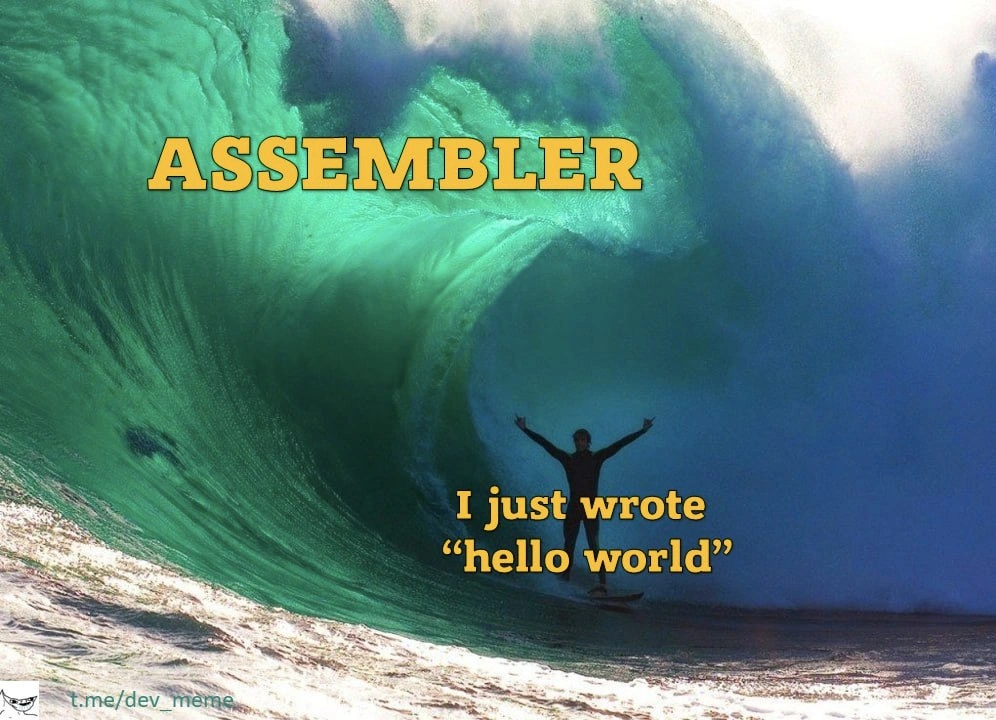
A tiny surfer under an ASSEMBLER wave claims they just wrote hello world. The deep dive unpacks why that beginner exercise in assembly still demands registers, calling conventions, system calls, object formats, and linkers that high-level languages hide.
Level 1: The Big Wave
This is like saying, "I only crossed the street," but the street is a giant ocean wave. The funny part is that writing a simple message in assembly can feel like doing something extreme, because the simple task sits inside a much harder environment.
Level 2: Tiny Program, Huge Setup
Assembly language is a low-level way to write instructions close to what the CPU actually runs. Instead of saying print, you often have to move data into specific registers and ask the operating system to write bytes somewhere.
That is why the meme shows a huge wave and a small surfer. The visible text says the person only wrote "hello world", but in assembly that can still feel difficult. A beginner has to learn about CPU instructions, memory addresses, registers, and the operating system's rules before seeing a simple message.
In languages like Python or JavaScript, Hello World is usually one line. In assembly, the same idea can become many details. The joke is that the accomplishment sounds small to outsiders, but to the person learning low-level programming, it feels enormous.
Level 3: Hello, Kernel
At senior-engineer depth, the joke is about how trivial tasks become heroic when the abstraction level drops. HelloWorld is supposed to be the smallest possible victory: prove the toolchain works, print a string, go home. In assembler, that "small" victory can require choosing syntax, target architecture, section layout, entry symbol, syscall ABI, and linker invocation before a single character appears.
The word "ASSEMBLER" is doing slightly messy but familiar meme work. Strictly, an assembler is the tool that translates assembly language into machine code; developers often use "assembler" casually to mean assembly programming itself. The meme is not trying to teach terminology. It is capturing the emotional truth that writing plain text to the screen can feel like surfing a cathedral-sized wall of water while pretending this was definitely a normal beginner exercise.
Experienced developers recognize the pride in the tiny surfer's pose. Low-level programming gives a rare kind of satisfaction because nothing was handed to you. When the program prints, it is not because a framework quietly patched over your confusion. It is because every register, address, byte count, and entry point lined up well enough for the kernel to tolerate your request. Naturally, the first successful run feels less like "hello world" and more like surviving a negotiation with a very literal machine.
The trade-off is exactly why high-level languages exist. They do not remove complexity; they package it behind stable interfaces. Assembly exposes the machinery directly, which is powerful for performance-critical routines, embedded systems, reverse engineering, bootloaders, and compiler back ends. It is also why nobody sane wants every web form written as register choreography. Some cliffs are beautiful. Some are just sprint planning with opcodes.
Level 4: Negotiating With Silicon
The image labels the towering wave "ASSEMBLER" and places a tiny surfer underneath saying, > "I just wrote "hello world"". That scale difference is technically honest. In a high-level language, print("hello world") asks a runtime, standard library, operating system, loader, and compiler toolchain to collaborate on your behalf. In assembly, much of that polite abstraction disappears, and the programmer has to speak closer to the machine's contract.
Even a tiny output program depends on layers that are usually invisible:
- Instruction set architecture defines which operations the CPU can execute, such as moving values into registers, jumping, comparing, and invoking privileged transitions.
- Registers act as named storage locations inside the CPU, and different architectures expose different register names and conventions.
- Calling conventions define where arguments go, which registers a function may destroy, and how the stack is maintained.
- System calls are the formal boundary where user code asks the kernel to do protected work, such as writing bytes to standard output or exiting the process.
- Object formats and linkers decide how labels, sections, entry points, and addresses become an executable file.
On a Unix-like system, "hello world" might mean loading a syscall number into one register, placing the file descriptor, buffer address, and byte count into others, invoking syscall, then issuing another syscall to exit. On another platform, the numbers, registers, ABI, assembler syntax, and executable format change. The mathematics is not hard; the unforgiving specificity is. Assembly is where "portable" goes to have a serious conversation with reality.
That is why the surfer visual works. The person has technically done a beginner exercise, but the environment around that exercise is immense: CPU architecture, kernel interfaces, memory layout, and toolchain mechanics all curling overhead. The wave is not just difficulty. It is abstraction debt being collected in full.
In assembly, printing a string is less "hello world" and more "negotiate with the kernel in its native dialect."
Ok
oh god dammit
*sleep mode
Нет, идинах.
I swear to God
Ahahh. It's 10 AM in my zone.
Correction it's •you didn't go to sleep on time• and not "you didn't went to sleep on time" Fix this bug 🐛
This is not a bug, this is a new mechanic.