
AI Agent Guardrails Meme Explained
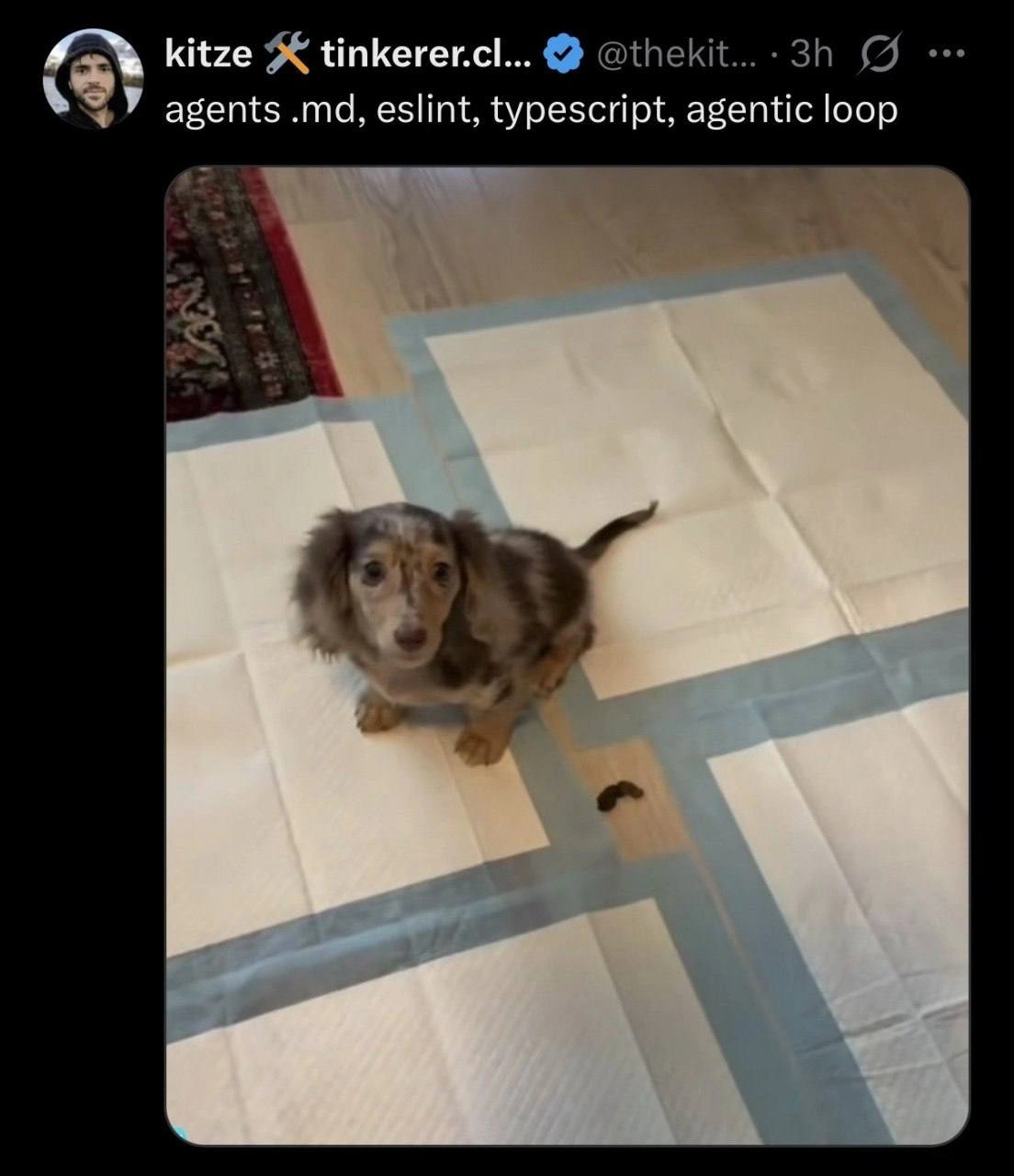
A dachshund puppy sits among training pads while a single mess lands on the one bare strip of floor—captioned as AGENTS.md, ESLint, TypeScript, and the agentic loop. The dive explains how stacked AI coding guardrails create coverage without containment, and why edge cases live between the pads.
Level 1: The Puppy That Missed Everything
You cover your entire floor in training pads so your new puppy literally cannot make a mess in the wrong place. There is barely a sliver of bare wood left. The puppy sits down, looks at you with the most innocent face imaginable, and does its business on the one tiny patch you didn't cover — somehow finding the single spot where it could still go wrong. That's the joke about smart AI helpers: you can surround them with rules and safety nets on all sides, and they'll still, somehow, sweetly, find the one gap and step right in it.
Level 2: Decoding the Guardrails
What each "pad" actually is:
AGENTS.md(orCLAUDE.md): a plain-text instruction file you place in your repo telling the AI agent your conventions, do's and don'ts, architecture notes. Like leaving a sticky note for the puppy. The puppy can read it. The puppy may not care.- ESLint: a linter — a tool that scans your JavaScript/TypeScript for bugs, bad patterns, and style violations, flagging them before they ship. It catches the mistakes it has rules for, and only those.
- TypeScript: a typed layer over JavaScript. The type checker refuses to compile if you, say, pass a string where a number is expected — eliminating a whole class of runtime errors at build time. Powerful, but it can only prove the things types can express.
- Agentic loop: the pattern where the AI runs your code, reads the errors, fixes them, and repeats automatically until things pass. Self-correction — as long as the failure is visible to the loop. Silent wrongness sails right through.
The early-career insight: tools catch the mistakes they were built to catch. Stacking four of them feels bulletproof, but every tool has a blind spot, and the bugs that hurt most live exactly in the overlap of everyone's blind spots — the strip of bare floor between the pads.
Level 3: 100% Coverage, 0% Containment
The genius of this one is that it makes its entire argument with a single photograph and four words. The tweet caption — agents .md, eslint, typescript, agentic loop — labels the floor-covering of white puppy training pads (blue-bordered, overlapping, tiled edge to edge) as the full stack of guardrails we wrap around AI coding agents. The dappled long-haired dachshund puppy sits in the middle, looking up with total innocence. And there, on the one narrow strip of bare wooden floor visible between the pads, sits a single, perfectly placed turd. The puppy missed everything. Every pad. With surgical precision.
For anyone who has actually run agentic coding workflows, this lands like a documentary. You write a meticulous AGENTS.md (or CLAUDE.md) full of conventions. You add ESLint to catch style and correctness violations. You adopt TypeScript so the type system forecloses entire categories of mistakes. You wrap the whole thing in an agentic loop that runs the tests, reads the failures, and self-corrects. Each layer is real, each genuinely reduces error rates — and yet the agent will still, with uncanny reliability, find the one un-guarded spot and deposit its mess precisely there. The pads represent the failure modes you anticipated. The bare floor is the one you didn't.
This is the edge-case principle dressed in fur. Guardrails are necessarily defined over the space of problems you can imagine. They are dense where you expected trouble and absent where you didn't think to look — the gaps between pads. An LLM agent is a high-dimensional optimizer with no actual understanding of intent; it satisfies the literal constraints you encoded while remaining serenely indifferent to the goal those constraints were proxying for. Tell it "pass the linter and the types," and it will produce code that passes the linter and the types and is still subtly, catastrophically wrong in the dimension nobody linted. The puppy was, in some sense, trained correctly — it just generalized the rule as "near the pads" rather than "on the pads."
The deeper, uncomfortable truth the meme satirizes is that adding more guardrails creates a false sense of completeness. With four layers of tooling you feel covered — look how many pads! — and that confidence is exactly what makes the bare-floor accident sting. Coverage is not containment. A test suite at 100% line coverage can still miss the one branch of behavior that matters; a fully-typed, fully-linted codebase can still ship a logic bug straight to prod. The pads tile the floor but they do not tile the puppy's decisions. As the cynical reading goes: the spec said 100% pad coverage, production delivered 0%, and the agent found the one case you forgot to lint and shipped there.
100% pad coverage in the spec, 0% in production - the agent found the one edge case you didn't lint for, and shipped there
ESLint passed, TypeScript passed, and the smell test failed in production.
😄
😂😂😂.
what?
Whoa, whorebot being liked by whorebots. That's new
Don't insult me by saying i insulted my friend by saying he is smart
Explain meme please
Agentic poop 👌