
AI Coding Agent Benchmarks Meme Explained
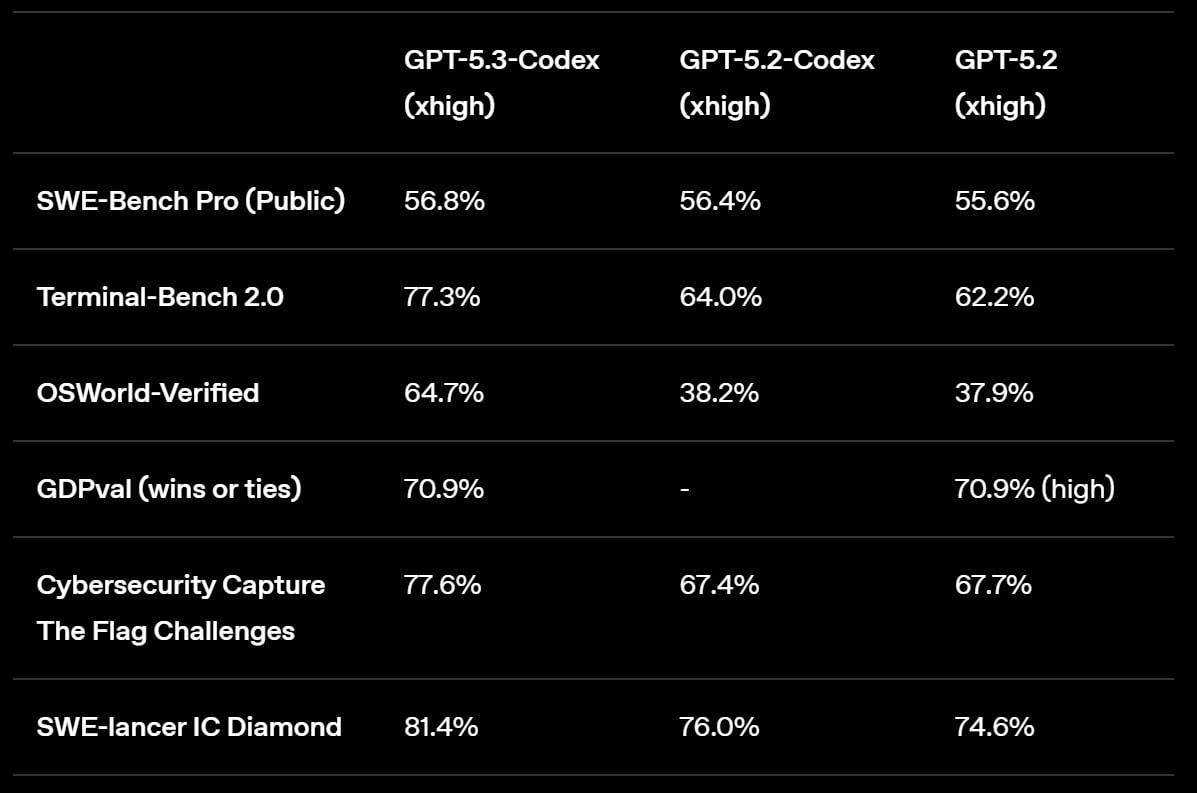
A black benchmark table compares GPT-5.3-Codex with earlier models across SWE-Bench, Terminal-Bench, OSWorld, and more. The dive shows the real story is agentic tool use—not a tiny repository-coding bump—and why capability is task-shaped.
Level 1: The Bigger Toolbox
Imagine three robots taking different school challenges. The newest robot is only a tiny bit better at repairing a complicated toy, but it is much better at finding the toolbox, following a long list of instructions, and using a computer screen without getting lost. The funny part is that it is advertised as the better toy repairer, while the table quietly shows its biggest new talent is handling all the annoying chores around the repair. It is a stronger helper, not a magic robot that can never make a mistake.
Level 2: What the Rows Test
An LLM coding agent is more than a chatbot that prints source code. It can be given tools to inspect files, run shell commands, edit a project, execute tests, and sometimes operate graphical applications. “Agentic” means it selects and sequences those actions toward a goal rather than answering in one shot.
The visible rows sample different pieces of that job:
- SWE-Bench Pro represents software-engineering work against real-style repositories and issue descriptions. A correct-looking snippet is insufficient; the change has to fit the surrounding project and pass evaluation.
- Terminal-Bench 2.0 tests tasks performed through a command-line environment. Success depends on both technical knowledge and reliable multi-step tool use.
- OSWorld-Verified evaluates computer use in a visual desktop environment, where the agent must interpret screens and interact with applications.
- GDPval compares outputs on professional knowledge-work tasks; “wins or ties” describes evaluator preference, not a conventional exam grade.
- Capture The Flag challenges exercise cybersecurity problem-solving in controlled puzzles, such as finding and exploiting intentionally planted weaknesses.
- SWE-Lancer IC Diamond targets difficult freelance-style software tasks at an individual-contributor level.
For a junior developer, the gap between 56.8% in the first row and 77.3% in the second is a useful warning: capability is task-shaped. One tool may be excellent at diagnosing a container from the terminal yet unreliable at making a subtle cross-module change. Benchmark scores are evidence for choosing what to try, not permission to merge generated code without reading it. Treat the agent like a very fast teammate who can operate the keyboard but still needs tests, review, restricted credentials, and a clear rollback path.
Level 3: The Agentic Plot Twist
The table’s real story is hiding in the differences between rows, not in the fact that every number in the first column is boldest by implication. On the repository-oriented SWE-Bench Pro (Public) task, GPT-5.3-Codex (xhigh) moves from 56.4% to 56.8% over GPT-5.2-Codex: just 0.4 percentage points. Yet Terminal-Bench 2.0 jumps from 64.0% to 77.3%, and OSWorld-Verified leaps from 38.2% to 64.7%. The coding model’s headline improvement is therefore less “suddenly writes flawless software” and more “can now survive much more of the messy computer work surrounding the code.” It has apparently discovered that engineering includes terminals, windows, files, and all the other obstacles placed between a developer and the one-line fix.
That asymmetry is why this otherwise sober model-evaluation screenshot works as developer humor. Repository benchmarks reward understanding an issue, navigating an unfamiliar codebase, editing the right files, and satisfying tests. Terminal and desktop benchmarks put greater pressure on agentic execution: choosing tools, preserving state across steps, recovering from failed commands, and manipulating an environment without wandering off course. A model may already know what patch ought to exist while still failing because it opened the wrong directory, misread a dialog, or lost track of an earlier tool result—the machine equivalent of spending forty minutes debugging before noticing the terminal is attached to staging.
Several visual details also discourage simplistic leaderboard arithmetic:
xhighidentifies a high reasoning-effort setting, so these are not necessarily the latency or cost characteristics a developer gets from a quick default invocation.- A percentage point in one row is not interchangeable with one in another. Each benchmark has its own tasks, scoring method, environment, and failure surface.
- The dash for GPT-5.2-Codex on
GDPval (wins or ties)means no displayed comparison, not 0%. GPT-5.3-Codex’s 70.9% matches the separately labeled GPT-5.270.9% (high)result. - The security row rises from 67.4% to 77.6%, while
SWE-Lancer IC Diamondrises from 76.0% to 81.4%. Those gains support a broader-capability story, but they still do not prove that every real repository, shell session, or security investigation improves by the same amount.
The post landed on February 5, 2026, the model’s launch day, so the polished black table is also a miniature release narrative. Product launches need one clean column that “wins,” while engineering teams need uncertainty bars, repeated runs, harness details, cost, latency, and failure analysis. The corporate temptation is to turn six heterogeneous evaluations into a single procurement vibe. The veteran response is to ask which tasks resemble the team’s workload and which benchmark failures would become production incidents. A 77.3% task score is impressive; it also leaves enough unsuccessful attempts to keep human review gainfully employed.
56.8% on SWE-Bench Pro means the AI successfully resolved the bug, introduced two new ones, and marked the PR as 'ready for review' - just like a real engineer
Only 0.4 points better at fixing code, but 26.5 points better at operating a computer—the classic promotion from developer to DevOps.