
Voice Assistant Listening Meme Explained
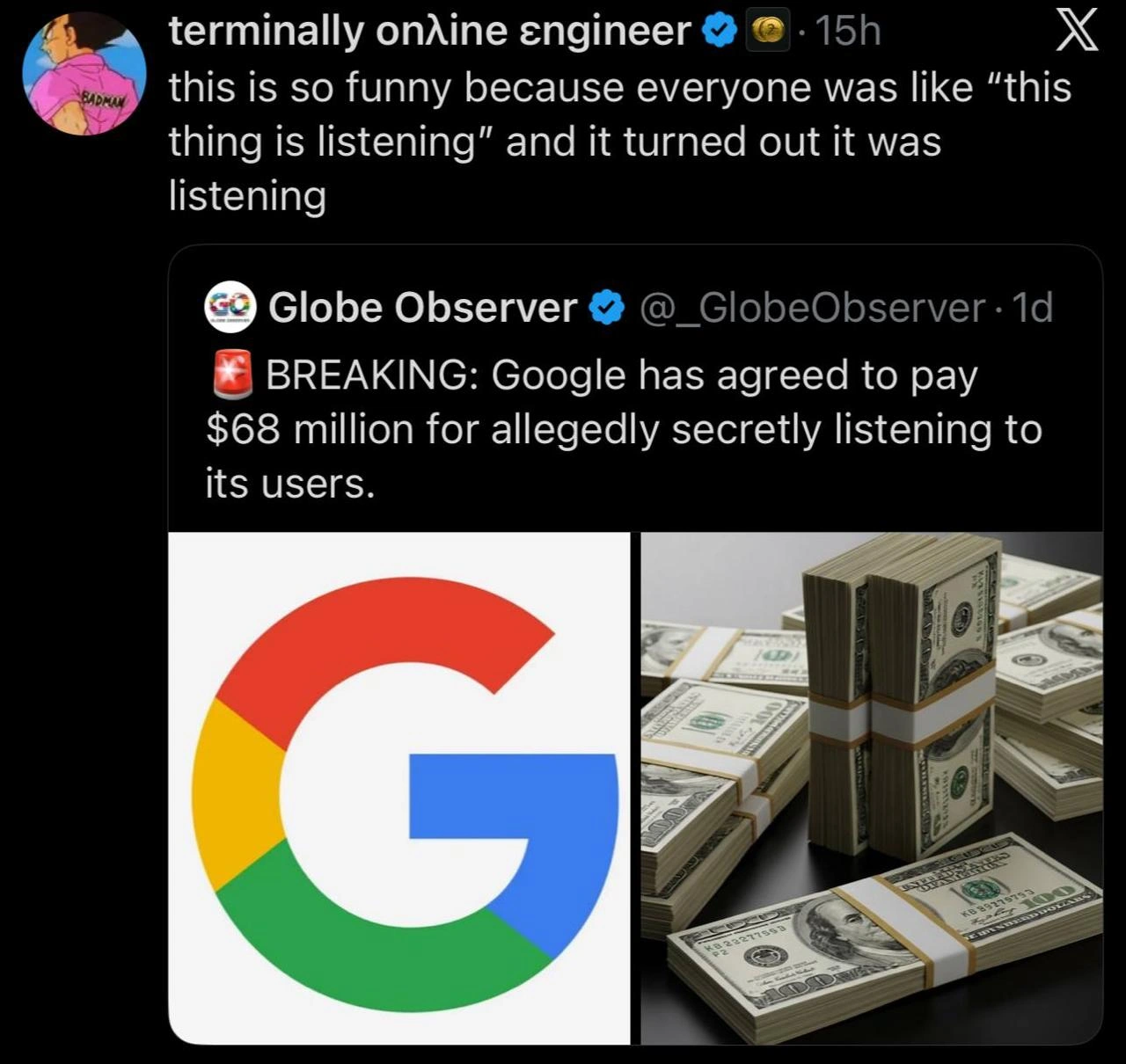
A quote-tweet laughs that 'this thing is listening' turned out true after Google's $68M alleged secret-listening settlement. The dive explains wake words, false accepts, human review pipelines, and why tiny settlements relative to revenue fail as a privacy incentive.
Level 1: Caught With the Cookie Jar
Imagine a kid who everyone suspects has been sneaking cookies. The grown-ups keep saying, "Don't be silly, the cookie jar has a lid, there's a system, it's impossible." Then one day the kid quietly hands over $5 from a $10,000 allowance and says, "I'm not saying I took cookies, but here." Everyone who got called paranoid for years now gets to point and laugh — not because the punishment hurt, but because being told "I told you so" by the whole internet at once is priceless, and $68 million, for a company that size, is the five-dollar bill.
Level 2: How the Listening Actually Works
Terms worth knowing before your first privacy-review meeting:
- Wake word: phrases like "Hey Google" detected by a small, always-running on-device model. Only after detection is audio supposed to be recorded and sent to servers.
- False accept: the wake-word model triggering on something that wasn't the wake word — a TV, a similar phrase, background chatter. Each one is an unintended recording of your life.
- Class action settlement: a lawsuit on behalf of all affected users, resolved by payment without an admission of guilt. That's why the word
allegedlyis doing pushups in the headline. - Human review: vendors historically had contractors listen to assistant audio snippets to grade transcription quality — a practice most users discovered from journalism, not from the privacy policy.
The early-career lesson hiding in this meme: data you collect "accidentally" is still data you collected. If your pipeline ingests it, stores it, and another team can query it, no amount of "that wasn't the intent" survives discovery. Data privacy failures are rarely a villain flipping a SECRETLY_LISTEN flag to true; they're a chain of defaults, edge cases, and "we'll clean that up later" decisions that compound into a settlement.
Level 3: The Tinfoil Hat Was Load-Bearing
For a decade, "my phone is listening to me" was the dividing line between people who worked in tech and people who understood incentives. Engineers patiently explained that always-on audio exfiltration at smartphone scale would be visible in battery drain, network traffic, and security research — all true, all reasonable, all delivered with the weary confidence of someone who has read the wake-word architecture docs. Then a settlement headline arrives — "Google has agreed to pay $68 million for allegedly secretly listening to its users" — and the quote tweet writes itself: "everyone was like 'this thing is listening' and it turned out it was listening." The Vegeta-avatar account gets thousands of impressions for stating the obvious, because vindicated paranoia is the funniest genre of being right.
The technical reality underneath is more mundane and somehow worse. Voice-assistant privacy cases (Google Assistant's is one of a matched set — Apple settled a near-identical Siri suit) generally hinge on false accepts: the wake-word detector misfires, the device records ambient conversation it was never invited into, and those recordings flow into storage, human review pipelines, and — per the allegations — advertising-adjacent processing. So the conspiracy theorists were wrong about the mechanism (no hot mic streaming 24/7 to an ad server) but right about the outcome (private conversations ended up recorded and used). That gap is exactly where trust dies: the engineers' rebuttal was correct on every technical point and still lost the argument, because "we only record you when our classifier makes a mistake, and then humans might listen" is not the reassurance anyone thinks it is.
Then there's the number. $68 million sounds enormous next to the stock photo of banded $100 stacks, and it is approximately a rounding error in a single day of Alphabet revenue — the canonical cost-of-doing-business fine. The industry pattern being satirized is brutal: collect first, settle later, admit nothing ("allegedly" survives even in the settlement coverage), and price privacy violations as an operating expense. When the penalty for "secretly listening" is cheaper than the engineering effort to not listen, the incentive structure has already chosen for you. Class members will get a few dollars each; the lawyers will do considerably better; the microphones remain on by default.


$68M for always-on listening - congrats, the hot mic was the only Google product to escape the graveyard
The wake-word matcher apparently shipped with `.*` as its fallback.
Who woulda thunk
IIRC this was the voice hotword detection picking up false positives, causing the assistant to activate & record audio. Apple was sued for the same thing
Yeah, but it's ALSO a great disguise for surveillance. "Oh, it was activating on accident" is a wonderful defense for collecting data on your users because it's so hard to disprove.
It's for targeted ads innit?
It's for kidnapping people named IEP Esy
Well, they pretty much maybe paid taxes at best in the amount their paying (and to who?) so this would definitely discourage them from just doing it again right? Imagining they got paid well beyond this anyway
If I'm pretty comfortable with that, where do I get my monthly compensation?
Everybody will get a cent🥳
I tested it myself and proved it btw who are they paying to? I mean, we were the ones being evesdropped on, so aren't we the ones who should be payed?
Where should I send the invoice for compensation?