
Map Filter Reduce Meme Explained
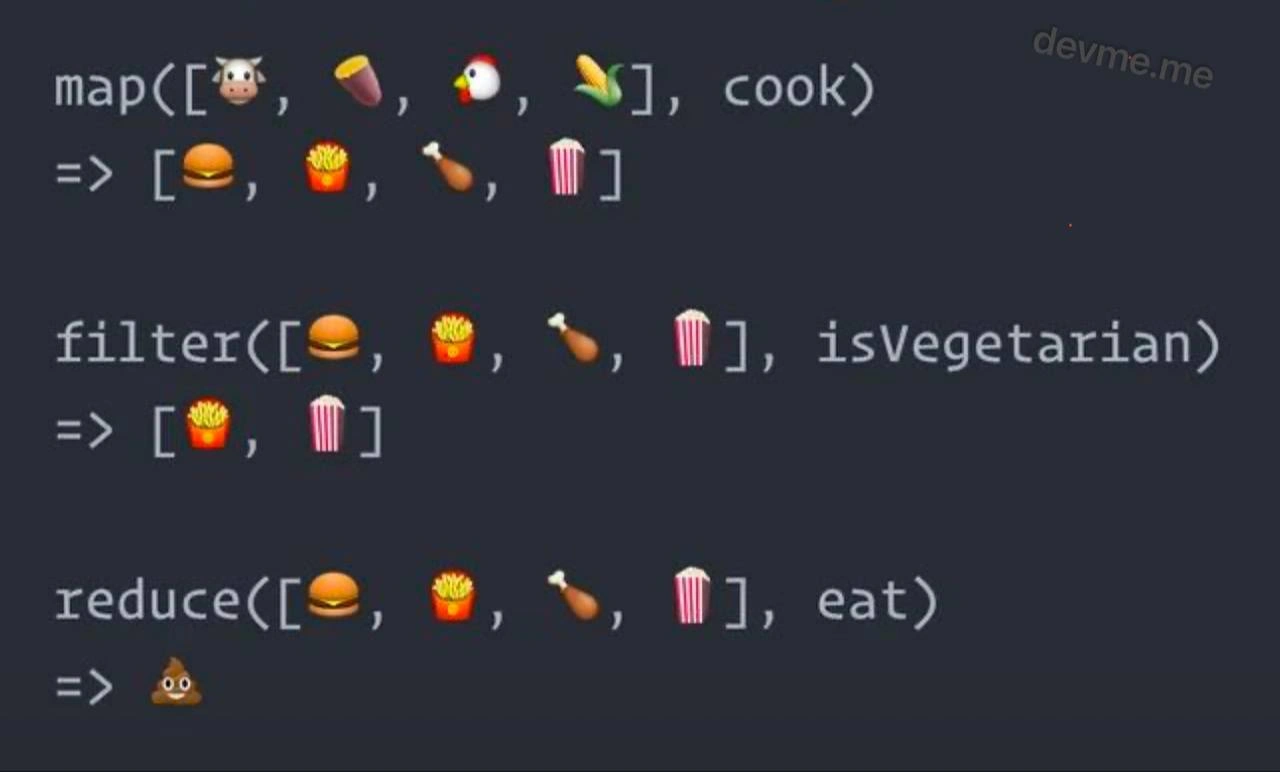
A JavaScript-style snippet maps ingredients into cooked foods, filters vegetarians, and reduces dinner to a poop emoji. The dive teaches map, filter, and reduce as pure array transforms with a side-effect punchline.
Level 1: Food In, Poop Out
Imagine you have a bunch of foods and you go through a three-step process, just like preparing and eating a meal. First, you cook all the raw ingredients (a cow, a potato, a chicken, and some corn turn into a burger, fries, fried chicken, and popcorn). Yum! Next, you pick out certain foods based on a rule – say you’re only going to eat the vegetarian ones, so you keep the fries and popcorn and leave aside the burger and drumstick. Finally, you eat everything you kept. What happens after you eat a lot of food? You end up with poop 💩. Gross maybe, but true!
This meme is funny because it shows that whole real-life process written out like a little computer program. It uses pictures (emojis) of the food items instead of words, almost like a secret code. In the end, seeing a poop emoji as the result of a “program” is totally unexpected and silly. It’s basically saying: no matter how fancy or complicated the steps are, the final outcome of eating a meal is always… well, going to the bathroom. It makes us laugh because it mixes something nerdy and logical (programming steps) with something very everyday and a bit ridiculous (making 💩). It’s a playful way to “explain” a basic life process with computer logic, and that surprise twist at the end is what makes it so goofy and memorable.
Level 2: Functional Food Chain
Let’s step through this meme like a junior developer discovering map/filter/reduce for the first time, but with a culinary twist. The code-ish snippet is using JavaScript-style array operations, only instead of normal data, it’s using emoji pictures of foods. The joke works because each function does exactly what its name implies, both in coding terms and in this little food story:
map: Map means “apply a function to every item in a list and give me a new list of the results.” Think of it as a transformation step. Here the list is[🐄, 🍠, 🐔, 🌽]– that’s cow, sweet potato, chicken, and corn. The function iscook, which presumably knows how to turn each raw ingredient into a cooked food. So aftermap, the cow becomes a 🍔 (burger), the sweet potato becomes 🍟 (fries), the chicken becomes a 🍗 (drumstick), and the corn becomes 🍿 (popcorn). The result of the map operation is a brand new array[🍔, 🍟, 🍗, 🍿]of ready-to-eat items. In real code, this might look like:const rawFoods = ["🐄", "🍠", "🐔", "🌽"]; const cookedFoods = rawFoods.map(cook); // cookedFoods is now ["🍔", "🍟", "🍗", "🍿"]Here
cookis a callback function we pass intomap– it’s the function that knows how to go from raw to cooked for each element. This is a hallmark of functional programming: passing functions as arguments to other functions (hence the term higher-order function formap). No loops in sight;maphandles the iteration under the hood, applyingcookto each element.filter: Filter means “take a list and keep only those items that match a certain condition (predicate).” It’s like a sieve or colander for data. In the meme, the list going into filter is[🍔, 🍟, 🍗, 🍿](the cooked foods). The predicate function isisVegetarian, which returns true or false depending on whether an item has meat or not. So what comes out? The 🍔 (burger, which came from a cow) and the 🍗 (chicken drumstick) are not vegetarian (they’re meaty), so they get filtered out. The 🍟 (fries, potato-based) and 🍿 (popcorn, corn-based) pass the test (no animal product there), so they stay. The result of filter is[🍟, 🍿]. In code:const vegetarianOptions = cookedFoods.filter(isVegetarian); // vegetarianOptions is now ["🍟", "🍿"]If you’re a new dev, it’s useful to know that
filterdoesn’t modify the original array; it returns a new one with only the desired items. In our example,isVegetarian(🍟)andisVegetarian(🍿)would return true, whileisVegetarian(🍔)andisVegetarian(🍗)would return false. So we end up with fries and popcorn – the vegetarian choices – in the new array. This matches real life: if you’re vegetarian at a fast-food joint, you skip the burger and chicken and maybe just eat the fries and popcorn (popcorn at a burger joint is a bit odd, but let’s roll with the emoji logic!).reduce: Reduce is a slightly trickier concept at first – it means “take all the items in a list and combine them into one cumulative result.” You often provide an accumulator function (and sometimes a starting value) that specifies how to merge elements. People often call this folding or aggregating. In everyday terms, think of summing up a list of numbers – that’s a reduce operation (adding each number to a running total to get one final sum). In this meme, they usereduce([🍔, 🍟, 🍗, 🍿], eat)which is hilariously interpreted as “eat all the food items one by one and end up with one output.” Theeatfunction here would take two inputs at a time (maybe the current “digested result so far” and the next food to eat) and return a new “digested result.” If you start with an empty stomach and reduce an entire meal, what’s the final result? 💩! Yes, a single poop emoji – that’s the output after consuming everything in the array.In code, a reduce might be used like:
const finalProduct = cookedFoods.reduce(eat);
// finalProduct is "💩"
Here
eatwould be defined such that it processes each food item into the accumulating digestive state. For example,eat(partialResult, nextFood)could simulate the act of eatingnextFoodand returning a newpartialResult. After processing the last item, that partialResult is the output ofreduce. In a straightforward sense, you could imagine:function eat(alreadyEaten, nextFood) { // combine what's already eaten with the nextFood... return "💩"; // eventually everything ends up as poop }Typically,
reduceis used for summing numbers, merging objects, building up a result step by step, etc. But here it’s modeling a continuous process (eating a sequence of foods) resulting in one final state (uh, bowel output). It’s a silly yet accurate metaphor!
Now, a key thing for juniors to notice: none of these functions (map, filter, reduce) change the original arrays or rely on external variables. They take inputs and produce new outputs – that’s a very functional programming ethos (data in, data out, no side effects in the middle). However, the meme cheekily shows that despite keeping the functions themselves pure, the real-world process being modeled definitely has a side effect (the poop). In programming, a side effect means any observable effect other than returning a value – like modifying a global variable, printing to the console, writing to a file, etc. Functional programming tries to minimize or control side effects, because they make reasoning about code harder. But ultimately, any useful program must produce some effect (otherwise who cares if it ran?). In this example, the final effect is literal output 💩. It’s a tongue-in-cheek way to say “even if our code is pure, eventually we’re going to do something in the real world with the result… and that might get messy!”
One more layer: notice how the code is written in a very declarative style – it reads almost like an English sentence: “map these ingredients with cook, filter the meals by isVegetarian, then reduce by eat.” Many high-level languages (JavaScript, Python, Ruby, etc.) allow this kind of chainable list processing, which is often clearer than a bunch of for-loops altering a temporary array. When you first learn about .map() and friends, it’s kind of mind-blowing because you start thinking of data transformation in terms of what you want instead of how to loop. This meme is a playful teaching aid in that sense: you could actually show this to a coding newbie to illustrate conceptually what each function does – though you might make them a bit hungry or grossed out in the process!
In summary, at this level we see the meme as a creative demonstration of functional programming concepts:
- Data transformation with
map(raw -> cooked food), - Filtering with
filter(remove the meats for vegetarian output), - Aggregation with
reduce(consume everything into one final product).
All done with cute (and one gross) emojis. It’s both educational and amusing: after seeing this, you won’t easily forget what map, filter, and reduce do!
Level 3: Pure Functions, Impure Output
At first glance, this meme is a masterclass in functional programming humor. It strings together the classic trio of map, filter, and reduce to model a digestive pipeline – yes, the biological kind – entirely in code. Seasoned developers will appreciate how it nails multiple layers of geekiness at once. Each stage of the pipeline corresponds to a well-known functional operation on arrays, and the entire sequence is depicted with 🍔 emoji data instead of variables. It’s a spot-on parody of how we process data (or in this case, dinner) through a series of pure functions, only to end up with an impure side effect at the end (pun very much intended).
Let’s break down why this resonates with experienced devs: map, filter, and reduce are canonical higher-order functions that often get taught together in FP tutorials – they transform, select, and accumulate data without explicit loops or mutations. In the code screenshot, we see a playful pseudo-JavaScript snippet:
map([🐄, 🍠, 🐔, 🌽], cook)
// => [🍔, 🍟, 🍗, 🍿]

filter([🍔, 🍟, 🍗, 🍿], isVegetarian)
// => [🍟, 🍿]

reduce([🍔, 🍟, 🍗, 🍿], eat)
// => 💩
Visually, it looks like actual code you could run (and frankly, you almost could – emojis are just Unicode characters, so an array of "🐄" is as good as any data array in JavaScript). The first line uses map to apply a cook function to an array of raw ingredients [🐄, 🍠, 🐔, 🌽], transforming each into a prepared food [🍔, 🍟, 🍗, 🍿]. The second line uses filter with an isVegetarian predicate to strip out any non-vegetarian items from that cooked array, leaving only the plant-based goodies [🍟, 🍿] (fries and popcorn). So far, so pure – both map and filter return new arrays without side effects.
But then comes the brilliant, gross punchline: reduce with an eat function takes the entire feast [🍔, 🍟, 🍗, 🍿] and reduces it down to a single value: 💩. This is hilariously accurate – reduce is meant to combine a list into one result, and what better result after eating a bunch of food than, well, a pile of crap? The humor lands especially well for seasoned coders because it mocks the ideal of “no side effects” in functional pipelines. In theory, pure functions don’t have side effects – they don’t alter global state or do anything outside returning a value. Yet here our final output is literally a side effect of digestion. It’s like the meme is cheekily reminding us, “Sure, your code can avoid side effects, but in reality 💩 happens.”
This also pokes fun at how we often tout functional patterns as clean and abstract – turning mundane tasks into elegant one-liners. The meme’s subtitle “the entire digestive pipeline in one snippet” riffs on that boast. It’s the coder’s dream: take a complex real-world process and express it concisely in code. In fact, an experienced dev might imagine the real JS code could be chained fluently as:
const result = rawIngredients
  .map(cook)
  .filter(isVegetarian)
  .reduce(eat);
One line to rule them all – functional composition at its finest! The absurdity is that this one-liner is describing cows-to-burgers-to-poop, which is about as far from highbrow computer science as you can get, yet the code reads perfectly. This contrast between high-level abstraction and low-brow outcome is exactly what tickles a senior developer’s funny bone.
There’s also a wink to computer science history hiding here. The terms map and reduce aren’t just random choices – they’re foundational concepts from functional programming (with roots in Lisp and other FP languages) and famously lent their names to Google’s MapReduce paper for distributed processing. Usually MapReduce is about colossal-scale data crunching, but in this “gut-level” MapReduce the dataset is a Happy Meal and the distributed cluster is the human digestive tract. 🍔😅 The inclusion of filter (which wasn’t part of Google’s MapReduce paradigm) completes the pedagogical trifecta for everyday coders. It’s as if the meme is saying: “Look, we can explain FP 101 in the silliest way possible – and it still makes sense!”
In summary, experienced devs see an inside joke about functional purity and the inevitability of side effects. We’ve got higher-order functions (passing cook, isVegetarian, eat as callbacks), immutable transformations (each step returns new data), and then reality crashing the party in the form of a 💩 emoji. It’s a reminder that even in beautifully abstract code, eventually something concrete (or not so solid…) must emerge. And the fact it’s all conveyed with familiar coding syntax and a perfectly chosen sequence of emojis? That’s chef’s-kiss quality humor for anyone who’s ever wrangled arrays for a living.

Even in pure functional land, reduce eventually yields a non-idempotent side effect - ask your garbage collector
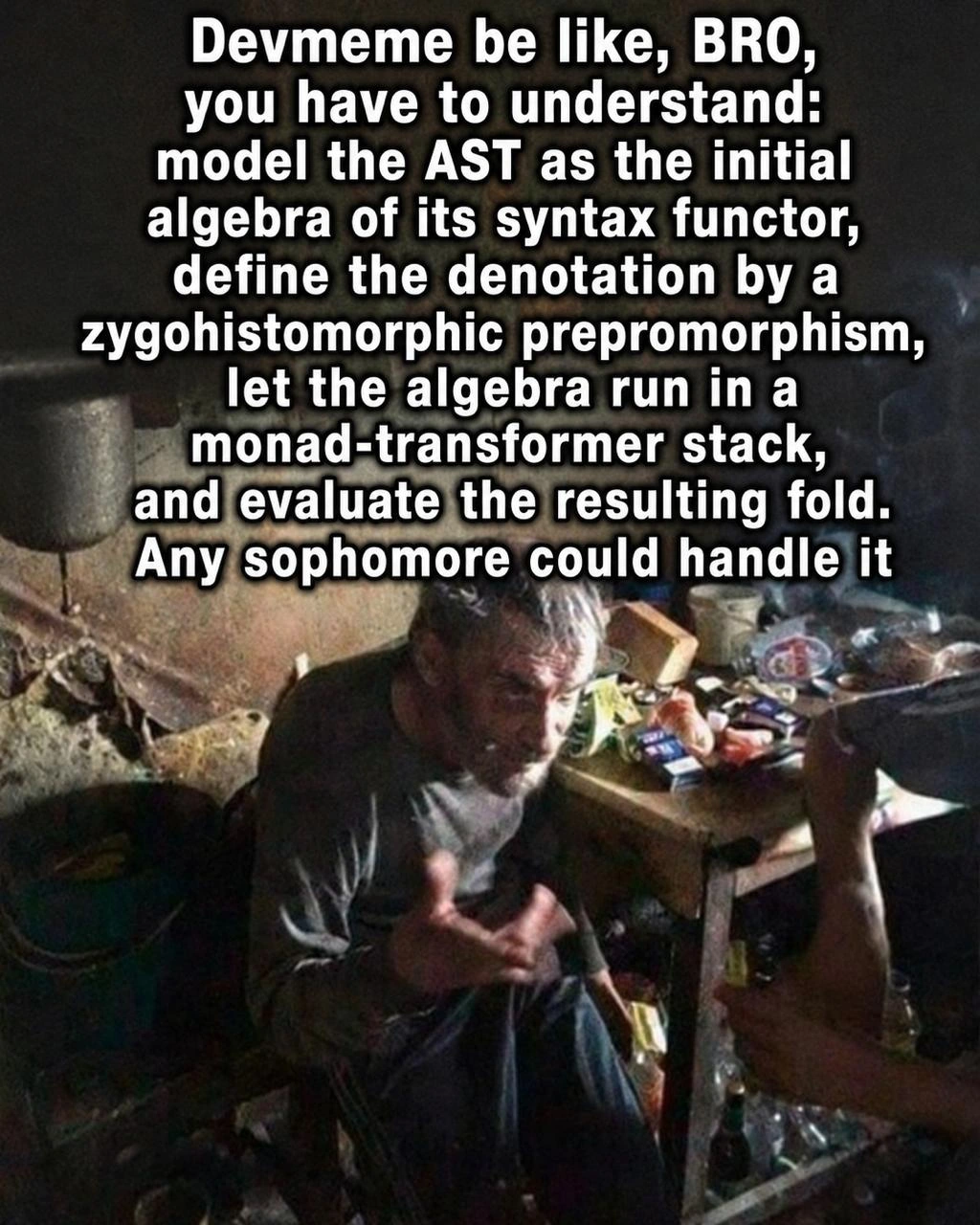
After 20 years of explaining monads, we've finally achieved peak functional programming pedagogy: using poop emojis to demonstrate reduce(). At least it's more honest than pretending our production code is as pure as our conference talks
This is the most accurate visualization of reduce() I've ever seen - it perfectly captures how we take a beautiful collection of discrete values and collapse them into something far less elegant. Though in production, that final output usually represents our technical debt rather than biological necessity
Beautiful functional composition: map and filter compose cleanly, then a left fold over real-world inputs still converges to the universal production monoid - 💩
Map and filter are pure; choose 'eat' as your reducer and you’ve perfectly modeled enterprise dataflow - beautiful composition that deterministically folds into a well-typed pile of 💩
FP purity holds until reduce(eat) - the ultimate side effect no monad can bind
Ruby does this, heck even PHP does this. As far as I can tell the only real “thing” about pure functional languages is that they extend a single statement as long as is needed to encompass what it must do, instead of using a lot of temporary variables
But the latter are easier for people to think about, and the compilers for them are better anyway
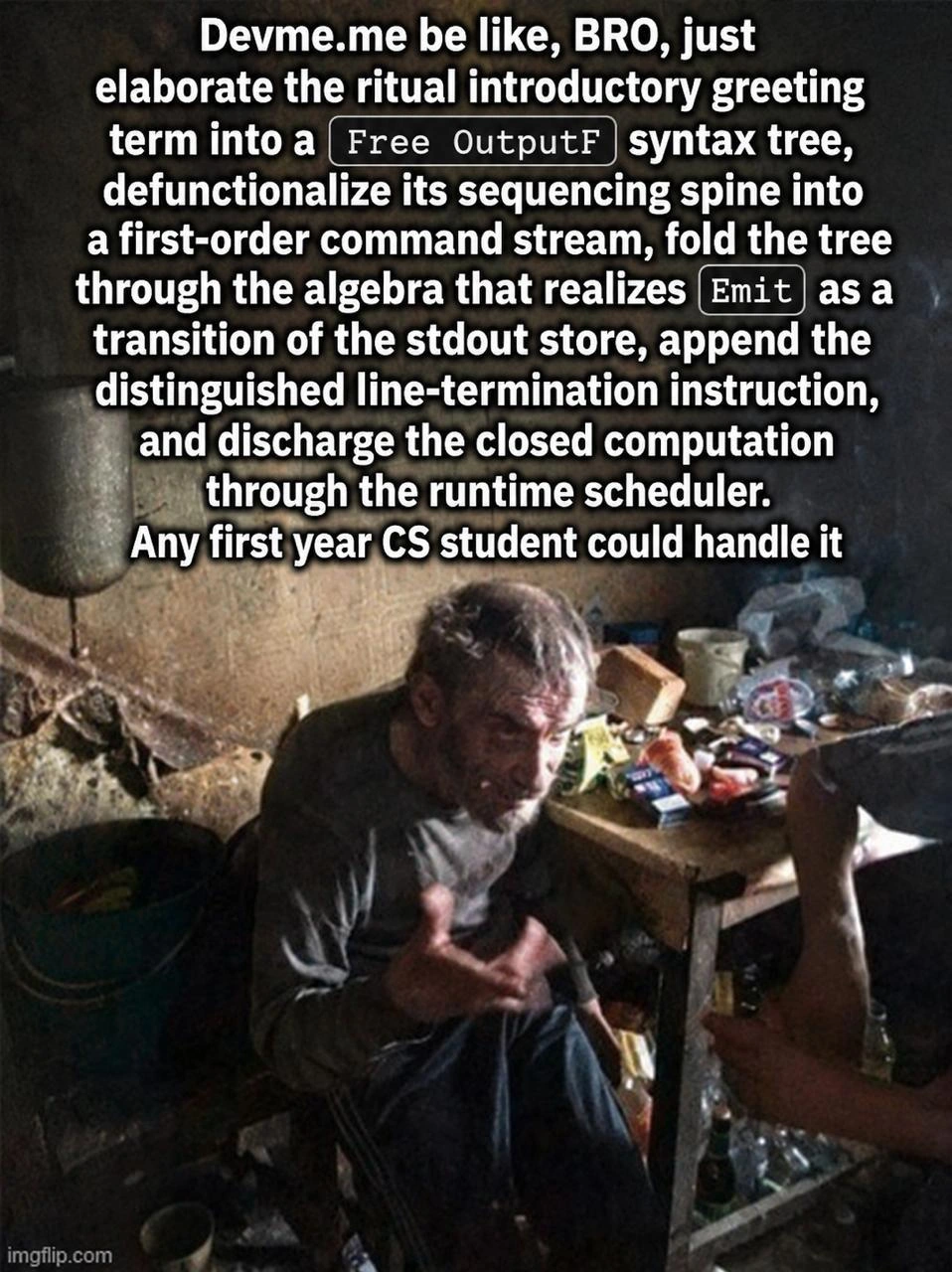
this is a very functional introduction