
AI Data Labeling Reality Meme Explained
An engineer expecting frontier ML code is ordered to label data instead. The dive explains why model training depends on human annotation, preprocessing, and quality checks hidden behind AI glamour.
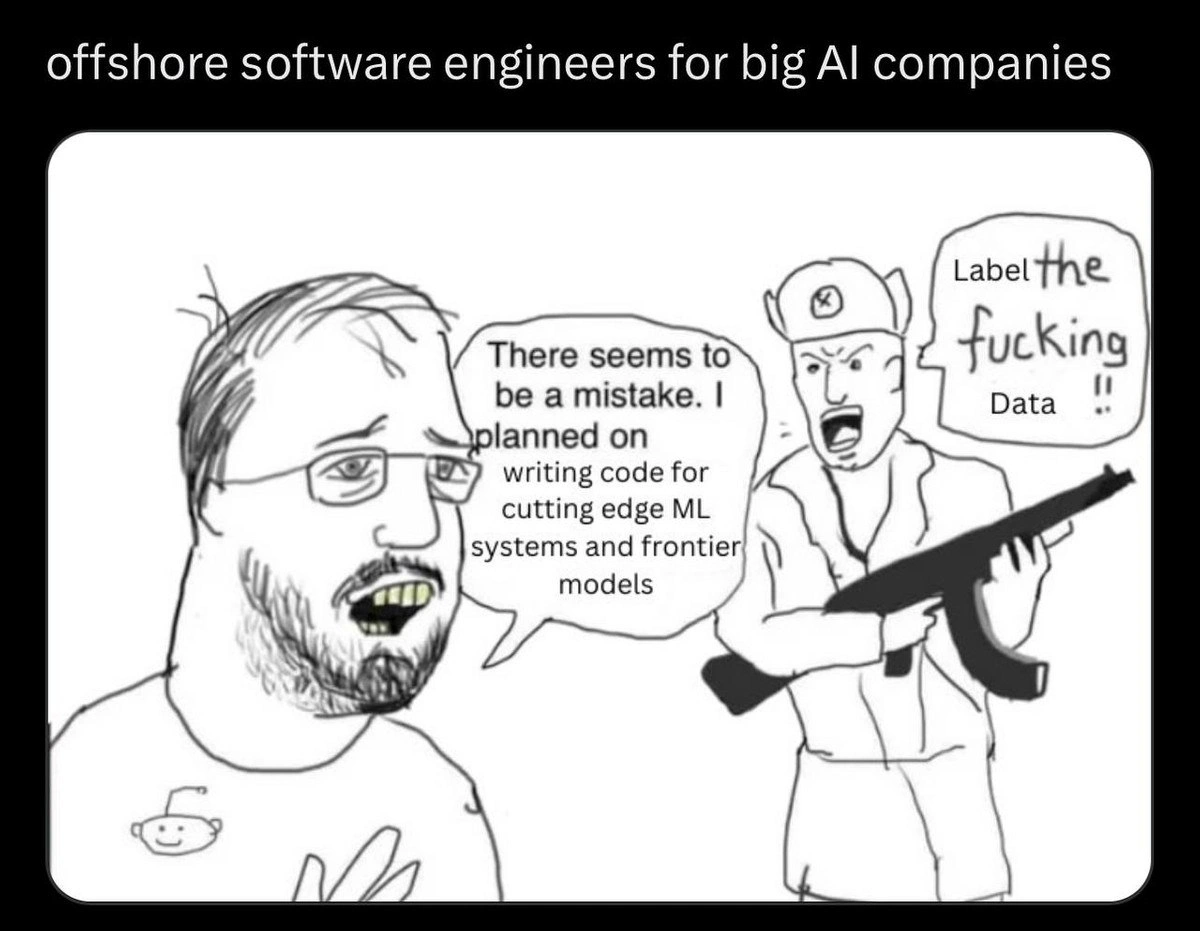
Level 1: Fancy Robot Homework
Imagine someone says you will help build the smartest robot in the world. You arrive excited to build its brain, but instead someone hands you a giant stack of flashcards and says, "First, write the correct answer on every single one." The joke is that the big magic robot still needs humans to do lots of boring homework before it can look smart.
Level 2: The Data Grind
In machine learning, a model learns patterns from examples. Those examples need labels: names, ratings, categories, corrections, or expected outputs. If the data says a cat is a dog, the model learns the wrong thing. If the data is messy, the model becomes messy in ways that later look mysterious and expensive.
That is why the guard yelling about data matters. Dataset preparation means collecting examples, removing junk, adding labels, checking label quality, and making the dataset consistent enough for training. Model training is the process where the algorithm uses that prepared data to adjust itself. Data preprocessing is the cleaning and formatting before training begins. None of that sounds as exciting as "cutting edge ML systems and frontier models," but without it the impressive part does not work.
For a junior developer, this is the first lesson that tech job titles can be wildly optimistic. "AI engineer" might mean building a clever inference service, but it can also mean reviewing thousands of examples in a spreadsheet, writing validation scripts, or arguing whether maybe harmful is different from probably harmful. The meme works because the engineer wanted the shiny part of AI and got assigned the part that makes the shiny part possible.
Level 3: Frontier Label Factory
The top caption says offshore software engineers for big AI companies, and the punchline is that the promised work is glamorous AI/ML engineering while the visible assignment is pure dataset preparation. The nervous engineer says:
There seems to be a mistake. I planned on writing code for cutting edge ML systems and frontier models
The guard's reply is the whole industry footnote shouted out loud:
Label the fucking Data !!
That mismatch is funny because modern model training depends on huge amounts of human judgment hidden behind words like frontier, foundation model, alignment, and data pipeline. The public story is often about architecture, GPUs, scaling laws, and benchmark wins. The private operational reality is someone deciding whether an image contains a stop sign, whether an answer is unsafe, whether a code suggestion is correct, or whether a refusal is too cautious. The meme turns that hidden labor into a literal armed demand.
The "offshore software engineers" label adds the sharper career joke. Many developers enter AI expecting to design systems, optimize training jobs, or build tooling around models. Instead, plenty of AI work collapses into data preprocessing, annotation QA, prompt evaluation, and cleaning edge cases that the model cannot magically infer. The uncomfortable truth is that bad labels create bad models, biased labels create training data bias, and ambiguous labels create months of Slack debates disguised as taxonomy work. Every "intelligent" system starts with a pile of boring human decisions. The rifle is not subtle, but neither are the deadlines.
Every frontier model starts as a spreadsheet where someone discovered the real AGI was Accurate Ground-truth Input.
I’m a phd - spent weeks of my life on that…
Well, also true! The light at the end of my tunnel is the corporate world 😅
I'm sorry for a mistake in my pervious reply. Let's try to solve this problem...