
TypeScript Type Erasure Meme Explained
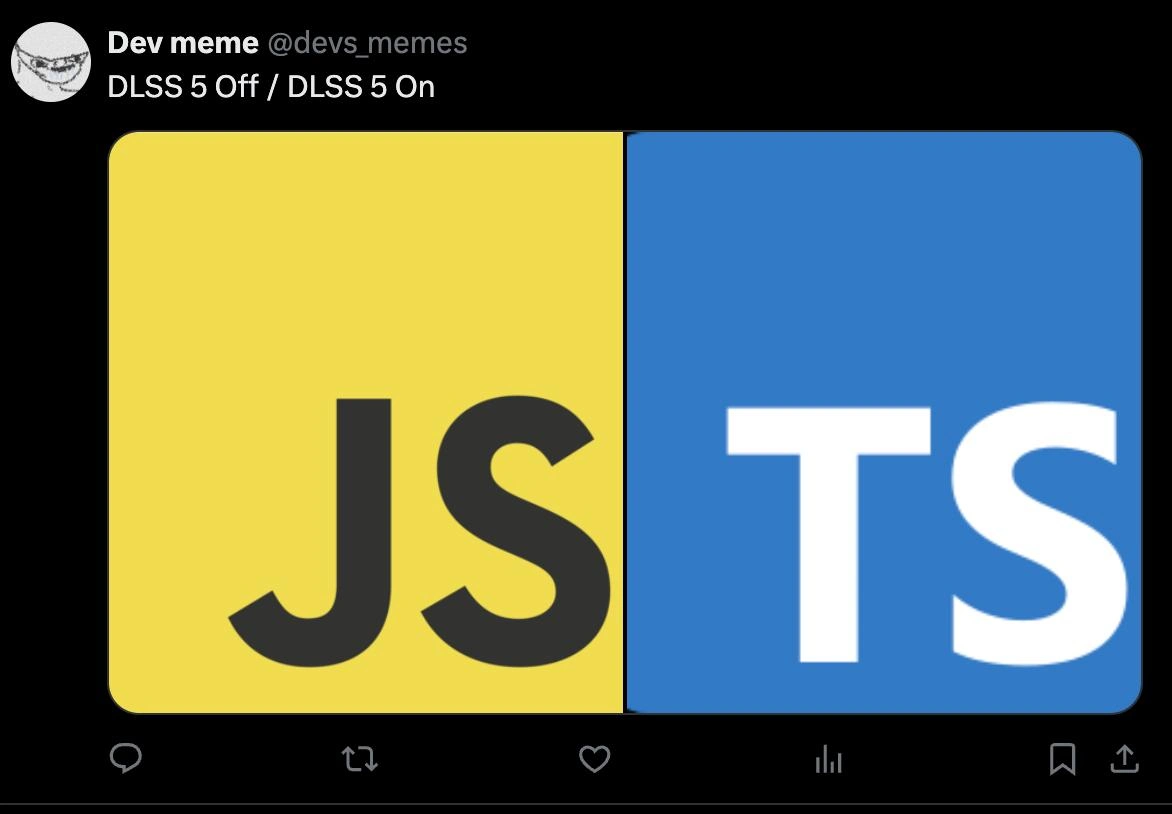
A DLSS Off/On split puts the yellow JS logo beside the blue TS logo. The dive maps TypeScript’s compile-time types onto neural upscaling: beautiful structure in the editor, full erasure at runtime, and failure modes when declarations lie at API boundaries.
Level 1: Glasses On, Glasses Off
The left picture and the right picture are basically the same thing — a square with two letters — but the right one is presented like a magical "enhanced" version, the way TV ads show a blurry photo getting sharpened. The joke is about two computer languages that are secretly the same language: one is the regular version, and one is the dressed-up version with its homework labeled and color-coded. Programmers argue endlessly about which is better, the way kids argue about whether a toy is cooler with or without the cape. And the sneaky smiley face posting it knows the secret: under the cape, it's the exact same toy.
Level 2: Two Logos, One Language
The cast: JavaScript (yellow square, JS) is the language every browser runs — flexible, forgiving, and famous for runtime surprises like "1" + 1 === "11". TypeScript (blue square, TS) is Microsoft's superset of JavaScript: the same language plus type annotations, so you declare function add(a: number, b: number) and the compiler yells before you ship the bug instead of a user finding it. Crucially, TypeScript compiles down to plain JavaScript — browsers never see the types. DLSS (Deep Learning Super Sampling) is NVIDIA's AI feature that renders games at lower resolution and uses a neural network to upscale the image, marketed with exactly this kind of side-by-side Off/On comparison; "DLSS 5" is the meme-of-the-week fictional version.
So the joke maps "blurry image → AI-sharpened image" onto "untyped code → typed code." For someone early in their career, the practical takeaway is real: your first week of TypeScript feels like the right half — everything labeled, autocomplete everywhere, the compiler catching typos. Your first production incident teaches you the left half is still what executes, and a type assertion is just you telling the upscaler what to hallucinate.
Level 3: Inferred Detail, Erased at Runtime
A tweet from "Dev meme" (@devs_memes), trollface avatar doing the editorializing, captioned "DLSS 5 Off / DLSS 5 On" over a split image: the yellow JavaScript logo on the left, the blue TypeScript logo on the right. Same square format, same two-letter monogram in the corner — same picture, enhanced, which is exactly the visual grammar of NVIDIA's upscaling comparison slides this meme borrows.
The analogy is far better than a logo-swap gag has any right to be, and it cuts in both directions. The flattering read: DLSS takes a low-information render and infers the detail that should be there; TypeScript takes dynamically-typed JavaScript and infers (or demands) the type information that should be there. Both add a layer of machine-checked structure over an underlying substrate that never had it. The unflattering read — the one the trollface is smirking about — is that in both cases the enhancement is presentation-layer only. TypeScript's types are fully erased at compile time: tsc strips every annotation and emits plain JavaScript, so at runtime you are executing the left half of the image no matter how blue your editor looks. DLSS likewise doesn't change what the engine simulated; it decorates the output. Fake frames, fake types — both real enough to ship, both gone when you inspect what actually runs.
This taps the longest-running flame war in web development. The TS side: type safety catches an entire bug class at compile time, IDE autocompletion becomes psychic, refactoring a 200-file codebase stops being Russian roulette. The JS side: it's a build step, the types lie at every API boundary (as any is load-bearing in more codebases than anyone admits), and the ecosystem spent a decade bolting tooling onto a language designed in ten days in 1995 rather than fixing the substrate. The DLSS framing slyly endorses the skeptics' core claim — that TypeScript is an upscaler, not a new engine. any is the type system's "render at 480p and let the model guess." And like frame generation, the failure mode is identical in shape: everything looks crisp until runtime hands you an undefined is not a function that the beautiful blue tooling swore was impossible, because somewhere a JSON response didn't match its declared interface and the types — like generated frames — were never actually there.


Accurate - TypeScript is exactly like DLSS: beautiful inferred detail everywhere, and at runtime it all renders back down to the same raw JS frames
DLSS 5 inferred the missing types; naturally, every edge case compiled to `any`.
I assumed this was a bot and was going to votekick it
Except that TS is actually just objectively better. I mean it's still shit, but it's better.
Stop these memes
English only, read the rules