
Agentic Coding Full Picture Illusion Meme Explained
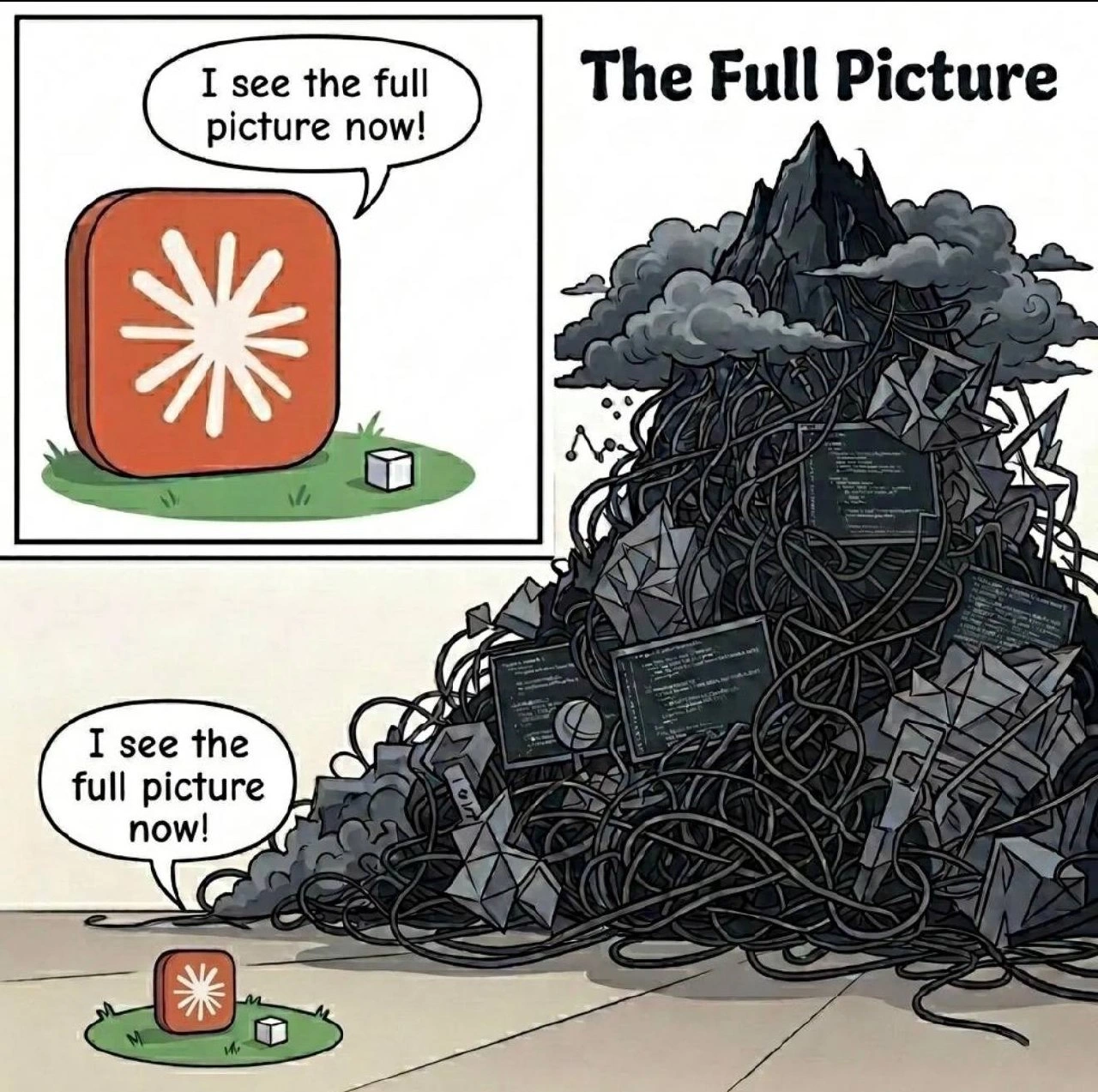
Claude sits on a tiny grass patch declaring it sees the full picture, while the zoom-out shows a storm-wrapped mountain of cables, monitors, and debris. The deep dive explains context windows, agentic coding confidence, and why production systems are mostly outside what an LLM can attend to at once.
Level 1: The Ant on the Beach
It's like an ant standing on one pebble announcing, "I've explored the whole beach!" From where the ant stands, that pebble is everything — round, complete, fully understood. Then the view zooms out and the beach goes on for miles, with waves and dunes and a storm rolling in. The little orange character isn't lying; it just has no idea how much world there is outside its tiny patch of grass. The laugh is in the gap between how proud it sounds and how small its lawn turns out to be.
Level 2: What a Context Window Actually Is
- Context window — the maximum amount of text (measured in tokens, roughly word-pieces) an LLM can consider in a single conversation. Anything not in the window effectively doesn't exist for the model. It's working memory, not knowledge.
- Agentic coding — letting an AI agent read files, edit code, and run commands in your repo. The agent chooses what to read — and what it reads becomes its entire universe.
- Codebase — not just source files: configs, infrastructure definitions, databases, deployment pipelines, and the undocumented behavior customers rely on. The drawing renders it as a storm-wrapped mountain because that's what
git clonedoesn't give you. - The junior-dev parallel: your first week, you fix one function and feel like you understand the system — then someone mentions "the other repo." Everyone starts on the grass patch.
The practical lesson encoded in the cartoon: when an AI assistant (or a new teammate, or you) says "I see the full picture," the correct follow-up question is "how big do you think the picture is?"
Level 3: Confidence Scales Worse Than Context
The zoom-out reveal is the perfect rhetorical structure for this particular failure mode. Inset panel: a cheerful anthropomorphized Claude logo — orange rounded square, white starburst, sitting contentedly on a tidy patch of grass next to one small white cube — declares:
I see the full picture now!
Main panel: the camera pulls back, and that grass patch is a microscopic green dot at the foot of a colossal black mountain of tangled cables, shattered monitors still glowing with code, polygonal debris, and storm clouds circling the summit. The title, "The Full Picture," is the knife.
This is the most honest diagram of agentic coding anyone has drawn. An LLM agent's "understanding" of your system is bounded by its context window — the finite slice of text it can attend to at once. Even generous windows hold maybe a few hundred files' worth of code; a real production system is millions of lines, plus the parts that aren't in the repo at all: the database schema that drifted from the migrations, the feature flags, the Kafka topics, the cron job on a forgotten VM, the load balancer config, the tribal knowledge about why you must never deploy service B before service A. The mountain in the drawing is made of wires and monitors, not files — a nice touch, because the hardest context is operational, not textual.
The cruel comedy is in the phrase itself. "I see the full picture now!" is exactly the register of modern coding agents: epistemically chipper, grammatically certain, and structurally incapable of knowing what they haven't seen. An agent reads three files, finds the function it was asked about, and produces a confident architectural narrative — hallucinated coherence, the model's tendency to extrapolate a complete world from whatever fragment it was handed. It can't report "my picture is 0.3% complete" because the missing 99.7% is, by definition, outside the picture. The little white cube beside Claude is a lovely detail: one clean, comprehensible object on the lawn, while the actual system looms behind it as an unrenderable heap.
The fair-minded twist veterans will admit: this is also a portrait of every newcomer to a legacy codebase. The new senior hire who proposes a rewrite in week one is sitting on the same grass patch. The difference is that humans usually acquire dread as they zoom out; the agent's enthusiasm is flat across all zoom levels. Tooling like repo maps and retrieval mitigates this — fetching relevant chunks into context on demand — but retrieval shows you what you searched for, and the mountain is mostly things you didn't know to search for.
Claude has read 0.3% of the repo and is now ready to propose the refactor - which, to be fair, also describes most senior hires in week one
Claude read three files and found the full picture; the remaining 12,000 are merely edge cases with revenue attached.
it is drawn by gen AI isnt it?
if it is, kinda ironic
Forged
Spit
the full picture: @xkcd2347
Смотрите сами фулл пикчюр - Я???