
CS Chip Engineer Meme Explained
Chinese Counter-Strike fans call players with one kill and many deaths chip engineers: 1-7 is an Intel i7, and flameZ's 1-18 earned him Chief R&D Engineer for the unprecedented i18. The dive unpacks the state-machine rules of the joke.
Level 1: The Trophy for Coming in Last
Picture a kid at a bowling party who keeps rolling gutter balls — and instead of teasing him plainly, his friends invent a game: every gutter ball "builds" a fancier and fancier imaginary robot. By the end of the night he's done so badly that they declare he's built the most advanced robot ever made, give him a fake job title at the robot factory, and applaud. It's affectionate mockery with the structure of an award ceremony: the worse he plays, the more "successful" his pretend invention becomes. The laugh comes from everyone keeping a perfectly straight face while celebrating a disaster as if it were a world-changing achievement.
Level 2: The Glossary You Need at the LAN Party
- Counter-Strike (CS/CS2): the legendary 5v5 tactical shooter and esports staple. The scoreboard shows each player's K-D — kills versus deaths.
1-18means one kill, eighteen deaths: a catastrophically bad game, especially for a professional. - Intel Core i3/i5/i7/i9: Intel's consumer CPU brand tiers — bigger number, stronger chip. The joke reads a scoreline like
1-7as a product name ("i7"), so each additional death while stuck on one kill becomes the "next-generation processor." - flameZ: a professional CS player. Going 1-18 on a pro stage is the esports equivalent of a production outage during your live demo — public, permanent, and clipped forever.
- Casters: the live commentators. When casters adopt a community bit, it becomes canon — like a nickname your team gives a flaky build server that ends up in the official runbook.
The relatable engineering parallel: every team has a metric that was supposed to measure success until someone inverted it into comedy. Story points, uptime nines, lines of code — give a community a number, and within a week it'll have a folklore layer with stricter semantics than your API contract.
Level 3: A State Machine for Suffering
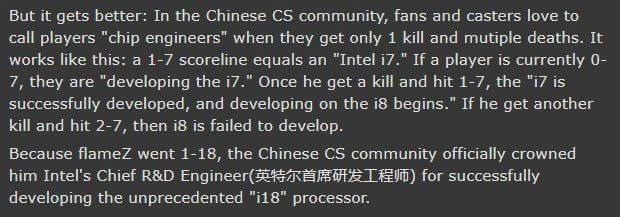
What elevates this from "haha bad player" to genuinely elegant community engineering is that the Chinese CS community didn't just coin an insult — they specified a complete, internally consistent state machine with transition rules, and the screenshot documents it like an RFC:
"a 1-7 scoreline equals an 'Intel i7.' If a player is currently 0-7, they are 'developing the i7.' Once he get a kill and hit 1-7, the 'i7 is successfully developed, and developing on the i8 begins.' If he get another kill and hit 2-7, then i8 is failed to develop."
Unpack the rules and you get something beautiful: the system tracks state (kills, deaths) where the joke only exists on the manifold kills = 1. Deaths increment the model number under development; a second kill is the failure condition, because it breaks the 1-N pattern and the fictional chip is scrapped. The comedy inverts every incentive of the actual game: dying advances your R&D roadmap, and getting kills — the entire point of Counter-Strike — ruins the product launch. Fans are thus placed in the exquisite position of rooting for a pro player to keep dying and never frag again, for the lore.
The payoff documented in the second paragraph is the system operating far outside its design envelope: flameZ (a tier-one pro, which is the cruelty multiplier) went 1-18, blowing past the realistic ceiling of Intel's consumer lineup — the real Core family topped out around i9 — and shipping the "unprecedented i18." Hence his coronation as "Intel's Chief R&D Engineer (英特尔首席研发工程师)": he didn't just have a bad game, he advanced the node roadmap nine generations in a single map. There's a darker secondary blade here for hardware folks: the joke weaponizes Intel's own brand as a unit of failure, landing during the era when Intel's actual fab roadmap — delayed nodes, rebranded generations, "successfully developed" parts that benchmarked like the previous ones — made "developing the next i-series" already read as tragicomedy. The meme works in both directions: the player performs like a struggling chip program, and the chip program performs like a 1-18 scoreline.
It's also a textbook case of how esports communities mint distributed, versioned in-jokes: a deterministic rule set means any viewer can compute the joke live from the scoreboard, no central comedian required. The bit scales horizontally across every broadcast — the same property that makes good protocols spread.
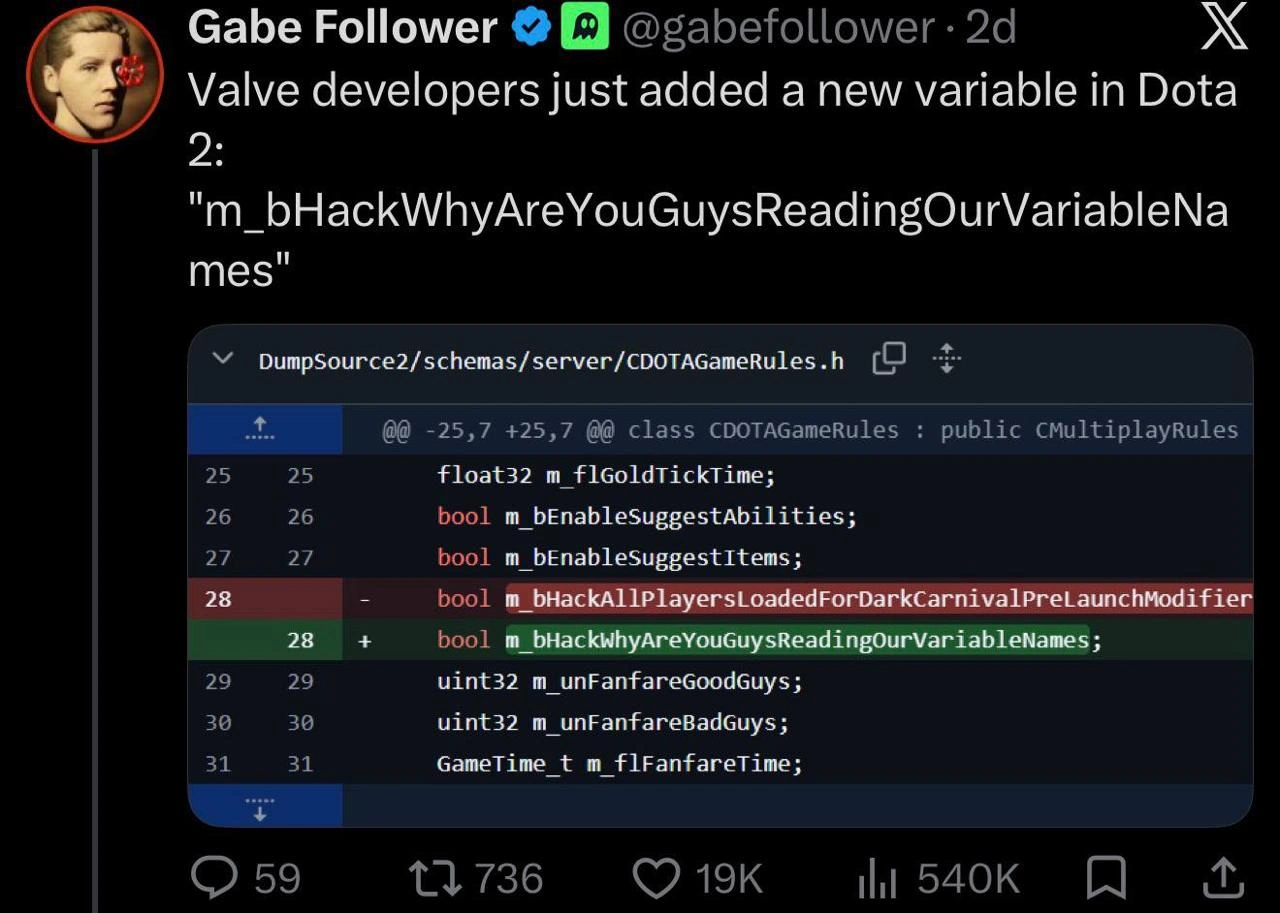


An i18 with 1 performance core and 18 efficiency deaths - even Intel's roadmap slides never promised that kind of generational leap
At 1–18, the silicon yield was catastrophic, but the meme yield was industry-leading.
Again?
What?
Shut up