
C++ vs Python Speed Tradeoff Meme Explained
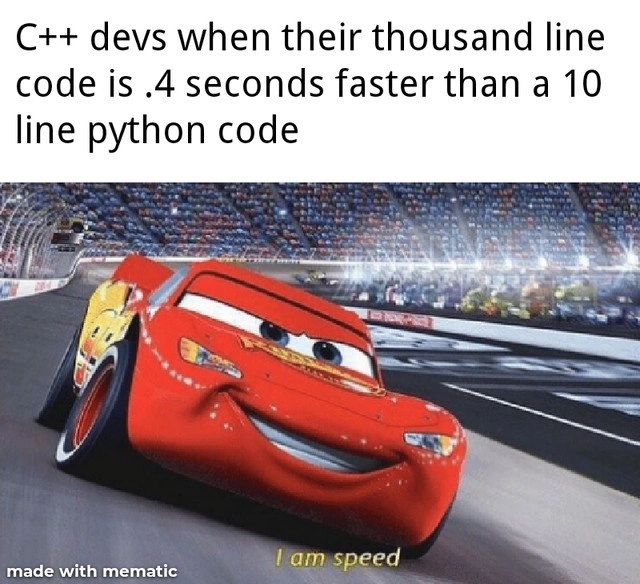
Lightning McQueen’s “I am speed” stands in for C++ pride after a huge codebase barely outruns short Python. The dive contrasts compiled versus interpreted runtimes, premature optimization, and when fractional gains are not worth the complexity.
Level 1: Big Effort, Small Win
Imagine two friends have a race to do a simple chore, like delivering a message across the playground. One friend, let's call him Charlie, spends all day building a super-complicated toy car to carry the message really fast. The other friend, Alex, just jogs across with the note in his hand. Sure enough, Charlie’s fancy little racecar does finish the task a bit faster – maybe a few seconds ahead of Alex. Charlie jumps up and down, bragging, “I’m the fastest! I am speed!” He’s as proud as a champion driver winning a race. But the funny thing is, everyone else can see how much extra effort Charlie put in for that tiny head start. Alex’s simple jog was only a tiny bit slower, and Alex didn’t have to build anything at all. The joke here is that Charlie did a ton of unnecessary work to win by a hair, and now he’s gloating about it. It’s like using a race car to beat someone on a bicycle by half a second, then acting like you broke a world record. It makes us laugh because the big effort for a small win is just not as impressive as Charlie thinks it is.
Level 2: Speed vs Simplicity
Let’s break down the joke in simpler terms. We have two programs solving the same problem: one written in C++ and one in Python. The C++ program is huge – about a thousand lines of code – while the Python solution is only about 10 lines. After all that extra work, the C++ program runs only 0.4 seconds faster than the Python one. The meme shows the C++ developer feeling as triumphant as a racecar champion, proudly saying “I am speed” (just like Lightning McQueen from the movie Cars).
Why would C++ ever beat Python in speed? The key is how these languages run. C++ is a compiled language. This means when you write C++ code, you run it through a compiler that translates it into machine code (the low-level instructions the computer’s CPU understands directly). Because of this, a C++ program can execute very fast, since the computer is running optimized machine instructions without much overhead. Python, on the other hand, is an interpreted language (specifically, CPython is interpreted). When you run a Python script, the Python interpreter executes your code line by line on the fly, which adds extra work during runtime. Python also does things like automatic memory management (garbage collection) and dynamic type checking while the program runs. These conveniences make coding easier, but they add overhead that slows Python down in raw execution speed compared to C++.
Now, if C++ is faster, why doesn’t everyone just use C++ for everything? It’s because of a trade-off between runtime speed and development time. Writing in C++ often requires a lot more effort and code for the same task. In the meme, the C++ solution is 1000 lines long because low-level languages like C++ make you spell out many details. For example, you have to declare data types, manage memory (allocate and free memory manually), and handle low-level operations yourself. Python is a high-level language, which means it abstracts away those details. A Python program can accomplish the same goal in 10 lines by using high-level constructs and libraries that do a lot of work for you behind the scenes. This difference is huge: a task that might need complex setup and loops in C++ can often be done with a few built-in functions or a one-liner in Python. In short, Python lets you write simple and concise code, which saves the developer’s time and effort, but the computer might take a bit longer to run it. C++ demands more developer time (writing and debugging many lines of code) but the final program can run faster and more efficiently.
The humor of the meme comes from this speed vs simplicity trade-off being taken to an extreme. The C++ dev has clearly put in a lot of work (1000 lines is a lot of code!) to get a program that runs only marginally faster (0.4 seconds is less than half a second) than the quick Python script. Micro-optimization is the term for when programmers focus on making very tiny performance improvements in their code. For example, they might obsess over using a slightly faster way to loop or a little trick to save a few milliseconds. Here, saving 0.4 seconds is the result of such micro-optimizations. On paper, yes, the C++ code “wins” the race – it is faster. But the meme jokes about whether that win was worth the huge increase in code and complexity.
This ties into a common saying: premature optimization. That means trying to make your code super efficient before you know if you really need that efficiency. It’s usually better to first write a clear and working program, and only optimize parts of it if you discover they are too slow (often by measuring or profiling the code). If you optimize too early, you might spend a lot of time making something faster that was already fast enough, or you might complicate the code for very little gain. In our scenario, the Python script might have been running in, say, 2.0 seconds originally, and the C++ version runs in 1.6 seconds. If 2.0 seconds was already acceptable to the users, spending extra days or weeks to trim it to 1.6 seconds is premature optimization. The code became harder to read and maintain for a speed-up that most people wouldn’t even notice.
Now about the picture and the quote: The meme uses Lightning McQueen, a character literally built for speed – a red race car from a Pixar animated movie. In the film, Lightning McQueen confidently says “I am speed!” before a race to psych himself up. In the meme, the C++ developer is portrayed as Lightning McQueen, declaring “I am speed!” to show how proud they are of their code’s performance. It’s a funny exaggeration because beating the Python script by 0.4 seconds probably doesn’t warrant that level of swagger, but to the C++ dev it feels like a big victory. The smug expression on the car’s face in the image matches the joke: the developer is very pleased with themselves.
For someone new to programming, the takeaway is about finding balance. C++ vs Python is a common comparison. C++ can run much faster and is great when performance really matters (like in video games, computer graphics, or real-time systems), but it requires writing more code and handling more complexity. Python is slower for CPU-heavy tasks, but it lets you write programs quickly and with less fuss, which is why it's popular for things like web apps, automation scripts, and data analysis. There’s an ongoing friendly rivalry (sometimes called language wars) between fans of different languages, and they like to compare whose is “better” – whether in speed, ease of use, or other aspects. This meme is a light-hearted jab in those debates. It shows an extreme case where one side (the C++ side) wins in speed, but it’s kind of a hollow victory because the effort was so disproportionate to the gain. In real life, good developers don’t brag about tiny improvements like this – instead, they focus on writing code that is fast enough for the task and easy to maintain. If a simple Python script gets the job done in a reasonable time, that’s usually a win. But if you truly need every bit of performance (for example, if you had to do that task millions of times a day, and 0.4 seconds saved each time actually adds up), then pulling out the big guns with C++ or optimizing the code could be justified. The meme exaggerates it to make us laugh: it’s poking fun at the idea of doing way more work just to brag about a tiny speed boost.
Level 3: The 0.4-Second Grand Prix
Behold the triumphant Lightning McQueen-like smirk on that C++ developer. In this meme, a C++ dev is boasting that their thousand-line, hand-tuned program is 0.4 seconds faster than a compact 10-line Python script. The image of Lightning McQueen from Cars saying "I am speed" perfectly encapsulates this performance bragging. It's the classic cpp_vs_python showdown: a low-level codebase revving at full throttle to beat a high-level script by a nose.
From a seasoned engineer’s perspective, the humor comes from the extreme micro-optimization effort for a vanishingly small payoff. C++ is a compiled language known for efficiency: it translates code directly to machine instructions, giving it a head start in raw speed. Python, on the other hand, is usually interpreted (executed through a virtual machine), which adds overhead at runtime. It's unsurprising that well-optimized C++ can outrun Python for CPU-heavy tasks. But here the victory is merely 0.4 seconds – a rounding error in many real-world applications. The meme exaggerates the lines_of_code_flex: the C++ code is a sprawling thousand lines (managing memory, inlining functions, perhaps some template metaprogramming wizardry), while the Python version is a neat 10 lines leveraging high-level abstractions. The C++ dev invests significantly more developer time (and introduces more complexity) for that slim performance edge.
This scenario lampoons the phenomenon of micro_benchmarks and premature optimization. A micro-benchmark might show a C++ loop running slightly faster than an equivalent Python loop. It's a small-scale test that ignores bigger context – much like bragging about winning a 100-meter sprint by a fraction of a second after months of extra training. Experienced developers even have a famous warning about this, from computer science legend Donald Knuth:
"Premature optimization is the root of all evil."
In other words, obsessing over tiny speed gains before they’re proven necessary can lead to wasted effort and overly complex code. Here, the C++ dev’s pride ("I am speed!") is funny because the trade-off is so skewed: they probably burned hours or days tweaking code to save a fraction of a second in runtime. Meanwhile, the Python dev got the same result working in minutes with a simple script.
Under the hood, that C++ program likely employs every trick to gain speed. It might be using manual memory management (avoiding garbage collection and squeezing every byte), inlined functions, loop unrolling, or even SIMD vector instructions. Compiler settings are probably cranked up to -O3 for maximum optimization, maybe even profile-guided optimization for that extra push. The result? Sure, it's fast – but it's also verbose and potentially fragile. A thousand lines of C++ can hide segmentation faults, memory leaks, and undefined behaviors if you're not careful. That 10-line Python script, conversely, uses clean, readable calls to well-tested library functions (written in C/C++ behind the scenes, ironically) and was ready to run in no time. The runtime_vs_devtime_tradeoff is crystal clear: optimizing for the machine’s speed has dramatically slowed down the human developer.
Many of us have seen this movie before (pun intended). In programming forums and code reviews, there's often that one enthusiastic engineer who rewrites a Python snippet in C++ just to show it's faster. They seize on benchmarks where the difference is measurable and declare victory, "Ka-chow!" The rest of the team might roll their eyes because in practice, users might never notice a 0.4 second improvement – especially if network calls, database queries, or user input dominate the overall response time. This meme’s relatable humor comes from shared experience: every senior dev remembers a time they (or a colleague) fell into the trap of optimizing the wrong thing. It's a gentle roast of prematureOptimization and the obsession with winning on paper. Why spend a week in C++-land conquering 0.4 seconds when you could spend that time implementing new features or improving an algorithm's Big-O complexity (which could save whole seconds or more)?
There's also a nod to ongoing LanguageWars culture. Fans of statically-typed, compiled languages like C++ (or Rust) often take pride in raw performance and control. Fans of dynamic languages like Python boast about agility and simplicity. Here the C++ camp has its moment to gloat about speed, personified by Lightning McQueen's confident grin. The meme jokingly implies the C++ dev’s ego is riding on this win, no matter how trivial. The image of a flashy red race car on a pro track, smugly saying "I am speed," is a tongue-in-cheek portrayal of that developer’s inner monologue. It's a playful jab at how performance bragging can cloud practical judgment. In the end, seasoned engineers know that maintainability, clarity, and real user impact matter as much as raw speed. This meme gives a knowing wink to that wisdom: sure, your C++ code is fast as Lightning – but was 0.4 seconds really worth the pit stop?



Great job shaving 400 ms - about the same time the build system spends deciding which of your template metaprogramming sins to recompile for the hotfix
After 20 years in the industry, you realize the real performance bottleneck was the 6 months it took to debug those thousand lines of C++, while the Python dev shipped three features and is already on vacation
Ah yes, the classic C++ developer's victory dance: spending three weeks optimizing memory allocation patterns and implementing custom SIMD intrinsics to shave 400 milliseconds off a batch job that runs once a month, while the Python team shipped five features using list comprehensions and called it a day. But hey, when that performance report shows your code executing in 0.6 seconds versus their 1.0 second, you get to feel like Lightning McQueen at Daytona - even if the business stakeholders can't perceive the difference and your codebase now requires a PhD to maintain. The real speed was the template metaprogramming we mastered along the way
1,000 lines of C++ to beat 10 lines of Python by 400ms - Amdahl’s Law says the win disappears behind the 2s network call and the 40‑minute build
Nothing says "I am speed" like 1,000 LOC of C++ templates, PGO, and a custom allocator trimming 400 ms off a nightly job - Amdahl's Law says only the pride scales
C++: 1000 lines of pain for 40ms glory. Python ships first; users never notice
Not .4 seconds, but .4 nanoseconds
It adds up over time
.4 milliseconds is a lot
I think people frequently underestimate the performance benefits of compiled rather than interpreted code. That being said, I'm more of a Java person than C++ anyways. There's a time and a place for python, that's in code that's not performance sensitive.
>python >speed kek
shitposting
Not .4 but whole 4 seconds faster. And also 1GB less memory spent.
Once rewritten python microservise to Kotlin/JVM. It was order of magnitude faster AND 138MB less memory used on average.
Yep but AOT is not a win win for any case. Also, in back-end services it's better to keep JVM as the efficiency and speed is superior to a short bootstrap and smaller memory footprint. If memory footprint is so important, still, you can use tree shakers like proguard to minimize binary size and as a result shrink code segment memory.
Mmm python bullshit meme. Nice
And yeah… I am still suck Python dicks as Kotlin is not yet sexy in my country and Python is kinda best selling job on the marked (not even C++, lol)
It’s not binary it’s a range: lower langs requiere knowladge of the hardware higher do not. Hiegher langs let you concentrate on the algo not the entire universe.
They already made it first class citizen for JVM (Android) and also adopting for GPC (ktor in particular)