
Browser Quirks Nightmare Meme Explained
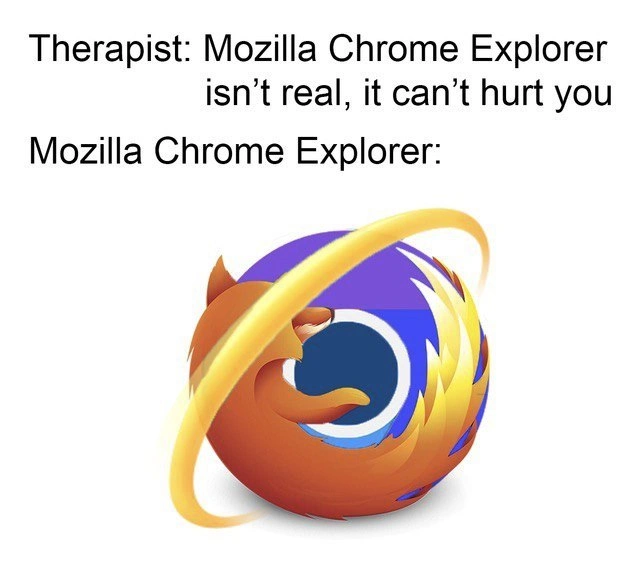
A therapy-meme format reassures that “Mozilla Chrome Explorer” can’t hurt you, then shows a hybrid logo of Firefox, Chrome, and Internet Explorer. The deep dive covers browser engines, IE quirks, vendor prefixes, and cross-browser testing trauma.
Level 1: Monster Under the Bed
Imagine you have three different toys that normally don’t fit together – like a robot, a dinosaur, and a ghost. Now picture a single monster that has the robot’s body, the dinosaur’s teeth, and the ghost’s spooky glow. Scary, right? If a kid was afraid of this crazy all-in-one monster, a parent or therapist might gently say, “Don’t worry, that monster isn’t real, it can’t hurt you.” In this meme, web developers are like that kid, and the monster is “Mozilla Chrome Explorer” – a made-up browser that mixes parts of all the big web browsers into one. The top text is basically the therapist saying, “Mozilla Chrome Explorer isn’t real; it can’t hurt you.” The joke is that developers feel like this ridiculous monster could exist in their nightmares because dealing with different browsers can be so unpredictable and scary for them.
Why do developers find this funny? Think of it this way: you draw a picture with nice colors, and it looks great on one friend’s phone, but on another friend’s phone the colors are weird and the picture is squished. Each phone’s viewer acts a bit differently, and it frustrates you. Now, pretend there’s a one super-phone that combines all those differences and weirdness into one – it would be a total mess! The meme shows a picture of a mixed-up browser logo (Firefox’s fox, Chrome’s colors, Explorer’s swirl) as if that crazy browser monster stepped out of a nightmare. It’s a silly way of saying, “I’m so stressed from making my website work on every browser that I joke about a monster browser that has all the problems in one.” Just like a child laughing later at how absurd their imagined under-bed monster is, developers share this meme to laugh at their own exaggerated fear. Even though “Mozilla Chrome Explorer” isn’t real, the feeling of dreading a new weird browser problem is very real – and sometimes the only way to cope with that stress is to joke about the imaginary monster.
Level 2: Browser Identity Crisis
For a newer developer or someone early in their WebDev journey, let’s break down why “Mozilla Chrome Explorer” is such a funny (and frightening) idea. The name is a mashup of three major web browsers: Mozilla Firefox, Google Chrome, and Internet Explorer. Normally, these are three separate applications made by different companies – Mozilla (Firefox), Google (Chrome), and Microsoft (Internet Explorer). Each browser has its own logo and its own way of displaying websites. In the meme’s image, we see a browser_logo_mashup: the familiar fiery fox from Firefox wrapped around Chrome’s red-green-yellow-blue circle, all slashed through by Internet Explorer’s gold ring. It’s like someone took each logo and glued them together into one logo_abomination. The text above the image follows a popular joke format where a therapist says, “XYZ isn’t real; it can’t hurt you.” Then the meme shows “XYZ” – in this case, “Mozilla Chrome Explorer” – appearing like a jump-scare. So the setup is: Therapist says this dreadful thing doesn’t exist, but then we see a picture of that exact dreadful thing. Classic punchline structure for internet humor!
Now, why would a developer even imagine a monstrous combined browser? This relates to BrowserCompatibility and the pains of cross_browser_support_joke in web development. Every web browser has its own engine under the hood – basically, a program that reads HTML, CSS, and JavaScript and turns it into the webpage you see. Ideally, all browsers should follow the same web standards (agreed-upon rules for how to interpret code). In practice, especially historically, they didn’t always agree. This led to BrowserQuirks: little differences in how each browser shows things. For example, a button might look perfect in Chrome but appear misaligned or oddly styled in Internet Explorer. Or a piece of JavaScript that runs fine in Firefox might throw errors in IE because IE used to support a slightly different version of the language or had its own way of doing things. Developers have to test their websites in multiple browsers to catch these issues – this is called ensuring cross-browser compatibility.
Dealing with these discrepancies is a rite of passage for frontend developers. It’s often frustrating: you fix one thing for Firefox and suddenly it breaks in IE, and so on. Internet Explorer (especially older versions like IE6, IE7, IE8) was notorious for not following standards and requiring special hacks or fallbacks. Chrome and Firefox generally behave more consistently nowadays, but there are still differences (and don’t even get us started on Safari’s quirks!). The meme exaggerates this pain by imagining Mozilla Chrome Explorer – a single browser containing all the unpredictable behavior and bugs of all three major browsers rolled into one. It’s like the ultimate FrontendPainPoints inside joke. The therapist in the meme is essentially saying, “Relax, that nightmare browser you worry about isn’t real.” And the developer (and the meme audience) responds internally with, “But what if it is? That’s my worst nightmare!” The humor comes from that feeling of developer trauma: we jokingly act like cross-browser issues have given us PTSD, so much so that we’d need a therapist to remind us the truly impossible scenarios aren’t real.
The phrase “browser identity crisis” fits perfectly here. Even the name “Mozilla Chrome Explorer” sounds confused – it’s mixing identities of rival products. It reminds newer devs of times when non-technical folks might say, “I opened the internet on Mozilla Chrome” by mistake, jumbling the names. It makes developers cringe because we’re very aware that Firefox ≠ Chrome ≠ Explorer. This meme takes that mix-up literally and imagines a browser with a severe identity crisis, visually and functionally. It’s funny because it’s absurd, and it’s FrontendHumor because only people who’ve wrestled with different browsers will fully appreciate why such a combo is scary. In essence, the meme is a playful way to vent about WebDevelopment struggles: you work hard to support Firefox, Chrome, and (back then) IE, and even when someone tells you not to stress, you can’t help but picture the worst-case scenario – a wild, buggy mélange of all three!
Level 3: The Unholy Trinity
At first glance, “Mozilla Chrome Explorer” sounds like an impossible chimera — a browser that mashes together Firefox’s open-source soul, Chrome’s Blink engine bravado, and Internet Explorer’s legacy quirks. This meme conjures an abominable browser_logo_mashup of the three big competitors from the BrowserWars era. For seasoned web developers, this image is equal parts hilarious and horrifying. It pokes fun at our deepest FrontendPainPoints: the nightmares of BrowserCompatibility. Each browser had its own rendering engine (Gecko for Firefox, Blink for Chrome, and the infamous Trident for IE) with subtle (and not-so-subtle) differences. Combine them into one logo_abomination, and you’ve got a monster that embodies every cross-browser bug imaginable. The meme’s therapist setup – “Therapist: Mozilla Chrome Explorer isn’t real, it can’t hurt you.” – is a tongue-in-cheek reference to how traumatized developers feel after years of debugging BrowserQuirks. Logically, such a Franken-browser doesn’t exist, but tell that to a dev who has battled layout issues at 3 AM; these FrontendHumor memes ring true because the fear is real.
Why is this mashup monster so terrifying to experienced devs? Because it represents the worst of all worlds in web development. Internet Explorer (especially older versions like IE6/IE7) was notorious for its non-standard DOM implementations and quirks mode rendering. Think of the broken CSS box model, the need for display:inline-block hacks, or hacks conditional comments like this just to target IE:
<!-- Only IE would read this ridiculous workaround -->
<!--[if IE]>
    <link rel="stylesheet" href="ie-only.css" />
<![endif]-->
Meanwhile, Firefox and Chrome usually follow standards, but each introduced unique APIs and CSS features with their own prefixes (-moz- and -webkit- respectively) during innovation races. Now, imagine a browser_identity_crisis where one application inexplicably mixes Gecko, Blink, and old Trident behaviors. Would a <div> tag obey the CSS flexbox model, or revert to some bizarre IE5 quirk? Would the JavaScript engine interpret modern ES6 features or choke like old JScript? A cross_browser_support_joke like this lands because every veteran frontend dev has been burnt by “it works in Chrome, but breaks in IE” (and vice versa). Combining them all sounds like a nightmare scenario: triple the engines, triple the chaos. It’s the ultimate boss fight of browser debugging.
There’s a sliver of dark irony here that senior devs might appreciate: every browser pretends to be Mozilla in some way deep down. In fact, user-agent strings – the little identifier your browser sends to websites – are famously Frankensteinian. Chrome’s user agent string includes Mozilla/5.0 and even mentions Safari, and old IE’s string had Mozilla and MSIE in it for compatibility. In other words, browsers have historically worn each other’s masks just to get along with websites. So “Mozilla Chrome Explorer” isn’t completely random – it’s like the literal text version of those disguised identities. It’s a witty nod to how the web’s history of competition and co-evolution forced browsers to become weird hybrids of each other on the inside. The meme exaggerates this truth: thank goodness we don’t actually have a single browser that merges all engines, but sometimes it feels like we do when we’re wrangling all their differences in our code.
By framing it as a therapy_meme_format, the joke acknowledges the psychological scarring. The therapist assures us this impossible “Mozilla Chrome Explorer” can’t hurt us, but the punchline image says otherwise – look, it’s right here, and it’s terrifying. Every senior web developer who’s suffered inexplicable CSS bugs or JavaScript inconsistencies across browsers can relate. It’s a playful way of saying, “I know you’re still haunted by those cross-browser issues… and you’re not alone.” In the end, this meme cleverly embodies the collective FrontendDeveloper PTSD: even an imaginary Mozilla Chrome Explorer sends shivers down the spine because it symbolizes all our WebDevelopment woes rolled into one monstrosity.
Its user agent string would just be 'Mozilla/5.0 (Windows NT 6.1; Trident/7.0; rv:11.0) like Gecko AppleWebKit/537.36 (KHTML, like Gecko) Chrome/125.0.0.0 Safari/537.36; I-am-pain/1.0'. And yes, `!important` would be ignored at random
Mozilla Chrome Explorer: the monster that spawns when the enterprise RFP says, “One codebase, but it must leverage Gecko’s privacy, Blink’s performance, and still run that Trident-only payroll app from 2004.”
After 15 years of writing -webkit-, -moz-, and -ms- prefixes, I've finally achieved enlightenment: the real browser compatibility issue was the friends we alienated along the way by insisting they upgrade from IE11
This meme perfectly captures the existential dread of every frontend developer who's ever had to support IE11 while explaining to stakeholders why 'just make it work in all browsers' isn't a trivial request. The fictional 'Mozilla Chrome Explorer' is somehow less cursed than the reality of maintaining separate CSS files for each rendering engine, writing polyfills for basic features, and discovering that your perfectly valid flexbox layout renders as a Picasso painting in older browsers. At least this chimera would theoretically consolidate our compatibility nightmares into one predictable horror show
The enterprise “single browser” strategy: Blink features, Gecko quirks, and Trident policies - supported only in Edge’s IE mode on Citrix with Autoprefixer and 500 KB of polyfills
Real enough to spike your BrowserStack bill and resurrect IE11 polyfills in prod
Pro tip: if your code still relies on UA sniffing, you’ll eventually support “Mozilla Chrome Explorer” - Edge’s IE mode on Chromium pretending to be Firefox
a-
😂😂😂
The only code that works in it is code that properly runs in all 3 browsers
I'm never scared But there's one horrible thing thar I'm afraid of (internet explorer)
the_rapist