
Diffie-Hellman Key Exchange Meme Explained
Bob’s Trade Offer exchanges modular exponentiations that look useless alone but form a Diffie-Hellman key agreement. The deep dive explains public values, private exponents, the shared secret g^(ab) mod p, and man-in-the-middle risk without authentication.
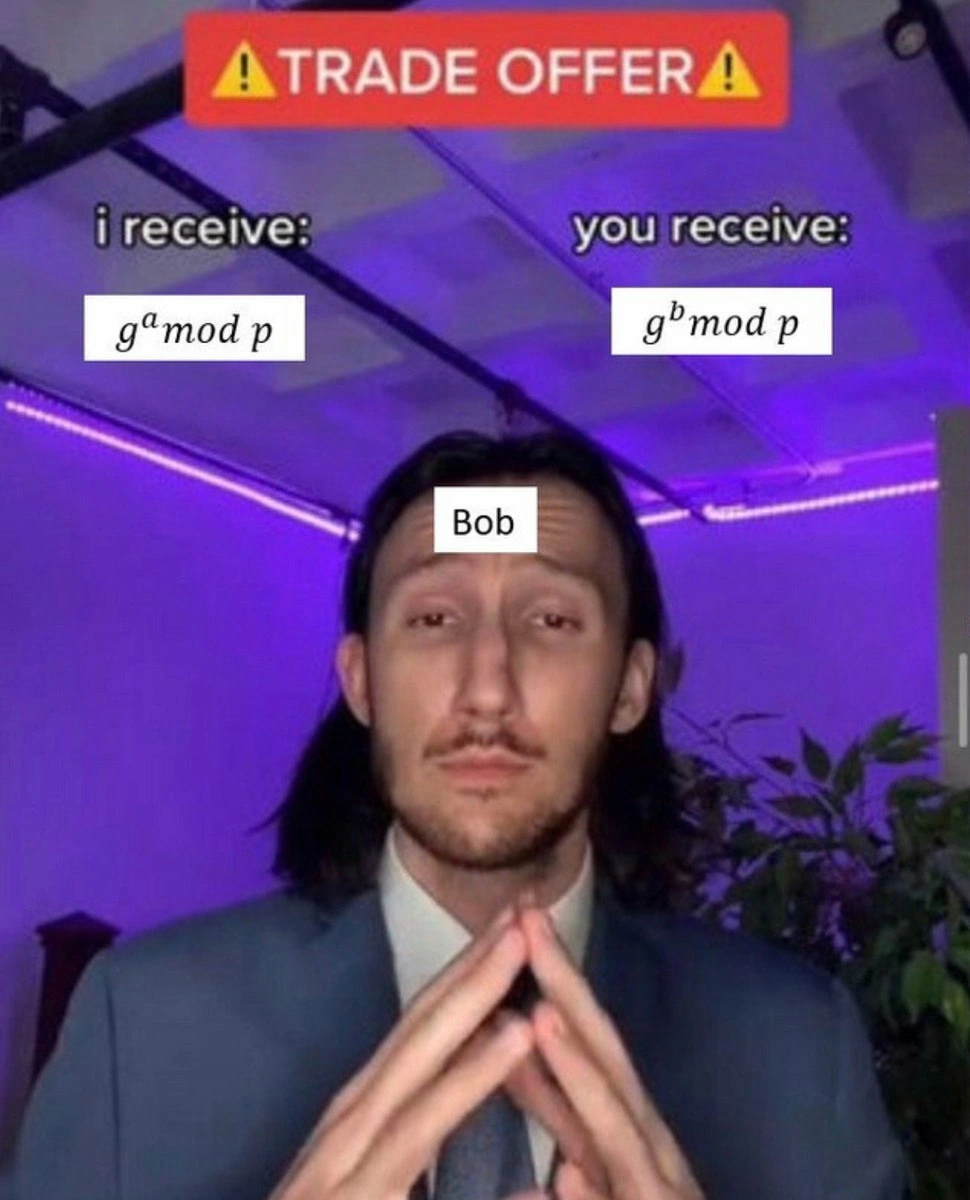
Level 1: Matching Secret Ingredients
This is like two friends each putting a private spice into a shared soup process. They can trade the partly mixed bowls in public, but nobody watching can easily figure out the final secret flavor without knowing one of the private spices. The joke is that Bob presents serious cryptographic math like a casual "you give me this, I give you that" deal.
Level 2: Secret Without Saying It
Cryptography is the field of protecting information using math. Diffie-Hellman is a cryptographic protocol that lets two people agree on a shared secret even if someone else can watch the messages they exchange.
In the meme, g^a mod p and g^b mod p are public values. The letters a and b represent private numbers. The operation mod p means "take the remainder after dividing by p," which keeps the numbers inside a fixed mathematical world. Each person sends a public value, then uses their own private value to compute the same final secret.
The label Bob matters because cryptography examples often use names like Alice, Bob, Eve, and Mallory to describe parties in a protocol. Bob receiving one formula and sending another is exactly the kind of exchange a textbook would show, except here it is framed like a meme-format negotiation.
Level 3: Bob's Public Offer
The trade-offer format is perfect because Diffie-Hellman really does look like a strange exchange of useless-looking numbers. Bob says, in effect: "Give me your modular exponentiation result, and I will give you mine." Neither value is the secret. Each is safe to send publicly only because the private exponent behind it is hard to recover.
That is why the formulas make the meme more than generic Encryption humor. The image is specifically about key agreement, not encrypting a message directly. The parties are negotiating material that can later become a symmetric key, which is then used by an encryption algorithm. This distinction matters: modern secure communication usually does not encrypt all data with Diffie-Hellman itself. It uses Diffie-Hellman or ECDH to agree on a secret, then derives actual encryption keys from it.
The funny part for security-aware developers is that the meme's "trade" is both absurd and accurate. In normal life, exchanging two numbers that look like g^a mod p and g^b mod p would be a terrible deal because neither one seems useful alone. In cryptography, that is exactly the point. Each side contributes something public that becomes valuable only when combined with its own private exponent. It is the rare trade offer where both parties receive the same thing and nobody has to say the thing out loud.
Level 4: Discrete Log Bargain
The meme is a compact Diffie-Hellman key exchange disguised as a suspiciously formal internet trade. The visible offer says:
i receive: g^a mod p
and:
you receive: g^b mod p
with Bob labeled on the negotiator's forehead. In finite-field Diffie-Hellman, p is a large prime modulus, g is a public generator or base, and a and b are private random exponents chosen by the two parties. Alice publishes A = g^a mod p; Bob publishes B = g^b mod p. Then Alice computes B^a mod p, Bob computes A^b mod p, and both arrive at the same shared value:
(g^b)^a mod p = (g^a)^b mod p = g^(ab) mod p
The beautiful trick is that the shared secret is never directly transmitted. An observer sees g, p, g^a mod p, and g^b mod p, but recovering g^(ab) mod p is believed to be computationally hard when the parameters are chosen correctly. That hardness is tied to the discrete logarithm problem: given g, p, and g^a mod p, find a. Multiplication and exponentiation modulo a prime are easy in one direction, but reversing the exponent is the trapdoor-looking part that is not actually a trapdoor for honest users.
The caution hidden under the joke is authentication. Plain Diffie-Hellman gives a shared secret with whoever is on the other side of the exchange. Without signatures, certificates, or another authentication mechanism, Mallory can sit in the middle, do one exchange with Alice and another with Bob, and both sides will confidently share secrets with the attacker. Bob's trade offer is mathematically elegant, but security protocols are where elegant primitives go to meet paperwork, identity, and failure modes at 3 AM.

Bob calls it a trade offer; Mallory calls it suspiciously useful metadata until authentication shows up.
The meme shows a decryption error
IF (month = 2 AND day = 29) AND ((year MOD 4 <> 0) OR ((year MOD 400 <> 0) AND (year MOD 100 = 0 ) AND mark$ = "G")) THEN GOSUB 5: GOTO 2 ELSE GOTO 3 EDIT: Translated variable names to English
Explain pls
the twist is, a = b
really? I'm gone for 10 minutes and some spam bot immediately joins? bruh
It's the fucking bob, the man in the middle... He knows how to change our message.
You know, after 50+ comments on this post I guess that meme was just a bait for increasing activity