
Blockchain Linked List Hype Meme Explained
A biblical-style comic frames “blockchains are just overhyped linked lists” as forbidden truth. The dive separates the hash-linked append-only structure from consensus, incentives, and when a plain database is enough.

Level 1: Fancy Chain
Imagine someone sells you a magical notebook and says it will change the world. Then you open it and see that every page just says, "this page comes after the last page," with a very serious stamp proving nobody changed it. The notebook can still be useful, but the joke is that people got very dramatic about something that starts as a chain of pages.
Level 2: Pointers With Publicists
A linked list is a basic computer science structure where each item points to another item. In a simple version, node A points to node B, node B points to node C, and so on. A blockchain has a similar chain shape: one block points back to the block before it.
The difference is that blockchains add stronger machinery around that chain. A hash is like a fingerprint of data; if the data changes, the fingerprint changes. A distributed ledger means many computers store and verify the history. Consensus is the process those computers use to decide which new block is accepted. Immutability means old records are meant to be extremely hard to rewrite without everyone noticing.
So the meme is funny because the sentence is too simple, but not completely wrong. A beginner might hear "blockchain" and imagine a mystical new computing substance. Then they learn the basic layout and think, "wait, this is a fancy chain of records?" That moment of disappointment is a rite of passage, right after learning that "serverless" still uses servers.
Level 3: Consensus and Blasphemy
At senior-engineer depth, the meme is not saying blockchains are useless. It is mocking how the hype cycle often hides the engineering trade-offs behind religious confidence. The panel says:
Most people rejected His message.
and then frames the blunt technical simplification as forbidden truth. Developers recognize the pattern: a technology gets surrounded by investors, evangelists, conference talks, and vocabulary until pointing at the underlying data structure feels impolite.
The satire lands because blockchain technology combines humble ingredients with dramatic branding. There is a chain. There are blocks. Each block references the previous block. The novelty comes from cryptographic linking, consensus, replication, incentive design, and adversarial assumptions. Those are real engineering concerns, but they do not magically erase mundane questions:
- Do you actually need multiple writers who do not trust each other?
- Is public verifiability worth lower throughput and higher operational complexity?
- Could an ordinary database, audit log, or signed append-only ledger solve the problem?
- Who pays for the failure modes when "immutable" records contain bad data?
The meme's bottom caption:
They hated Jesus because He told them the truth.
turns that architectural review into a mock martyrdom. Anyone who has asked "why not Postgres?" during a blockchain planning session can feel the room temperature drop. The technical pain point is that good architecture often begins by removing magic words. The organizational pain point is that magic words sometimes already have a budget.
Level 4: Hash-Linked Heresy
The joke works because the statement is both offensively reductive and annoyingly defensible. A blockchain is not merely a linked list, but the visible claim:
Blockchains are just overhyped linked lists
points at the core structure: each block contains data plus a reference to the previous block, usually by cryptographic hash. That hash is not a casual pointer like next or prev in a textbook LinkedList<T>; it is a tamper-evident commitment to the exact bytes of the previous block. Change an old transaction and the hash changes, which breaks every later reference unless the attacker can rebuild the chain faster than the honest network accepts the canonical history.
The expensive part is not the "linked list" shape. The expensive part is making many mutually suspicious machines agree on which append operation counts. Proof-of-work, proof-of-stake, finality rules, fork choice, block propagation, and incentives all exist because a decentralized append-only log has to survive Byzantine behavior, latency, and economic attacks. Calling that "just a linked list" is like calling TLS "just a handshake"; technically adjacent, socially dangerous.
That is why the biblical comic format fits. The silhouette delivers a truth that strips away marketing language like distributed ledger technology, decentralization, and immutability, while the crowd yells:
Shut up!
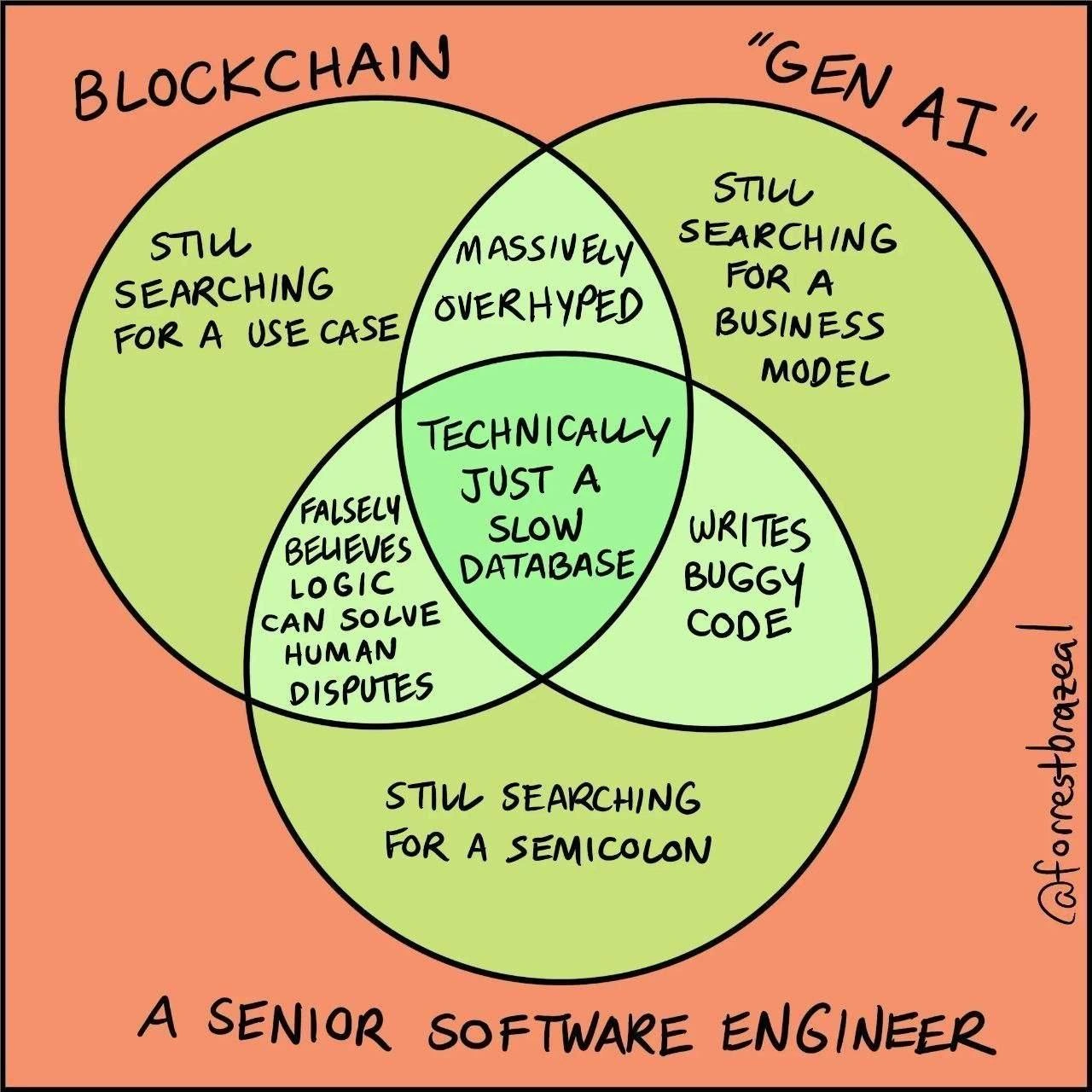
The crowd's anger is the punchline. Whole industries have been built around turning a hash-linked append-only log into a revolution, a token, a governance model, a fundraising event, and occasionally a database with worse throughput. Somewhere, a whitepaper just added "AI-powered" to survive the next pitch meeting.

It's a linked list with a marketing department, a consensus algorithm, and gas fees for every pointer dereference.
use IEEE.std_logic_arith.all
Bullshit, blockhain isn't overhyped
I wish the author to finish middle school.
True What matters is Bitcoin, Not Blockchain
Overhyped doesn't cover it by half. Overworshipped? Maybe "Blockchain are just linked lists with a cult?"