
Python vs C++ Speed meme explained
Batman slaps Robin for dismissing a 0.001 C++ speedup over ten-line Python. The dive covers constant factors at fixed big-O, hot-path scale math, microbenchmark traps, and the armistice where Python calls native code for the loops that matter.
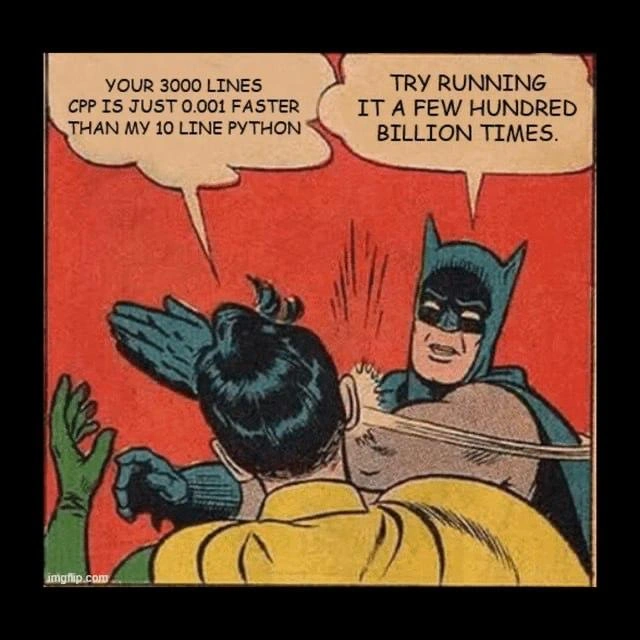
Level 1: One Penny, A Billion Times
Imagine two ways to walk to school, and one is just a single second shorter. Your friend laughs: "You studied maps for a month to save one second?" But now imagine you had to make that walk a hundred billion times — suddenly that silly one second adds up to three thousand years of walking, and the map-studying friend looks like a genius. The slap in the comic is the older kid's way of saying: tiny savings stop being tiny when you repeat them an unimaginable number of times. It's the same reason a one-penny discount doesn't matter on one candy bar but would make you rich if you sold a candy bar to everyone on Earth, thirteen times over.
Level 2: Why "A Little Faster" Becomes "A Lot Cheaper"
- Compiled vs interpreted: C++ compiles to machine code the CPU runs directly. Python is executed by an interpreter that reads your program step by step at runtime — flexible, but each step carries overhead, like cooking from a recipe versus having the dish already prepped.
- Constant factor: two programs can both be $O(n)$ yet differ 50x in speed. Big-O hides multipliers; production pays them.
- Hot path: the small piece of code that runs constantly — the inner loop handling every request, frame, or packet. Optimizing it pays off proportionally to how often it runs, which is the entire content of Batman's rebuttal.
- Scale math: save 1 millisecond per call × 100 billion calls = about 3.2 years of CPU time. That's the difference between one server and a rack.
The early-career trap this meme inoculates against runs both directions: don't rewrite your config parser in C++ for glory (it runs once at startup — Robin wins), and don't ship Python in the per-packet path of a load balancer (it runs forever — Batman wins). The skill isn't picking a side; it's knowing which panel of the comic your code lives in.
Level 3: Constant Factors Have a Posse
Robin, mid-gloat: "YOUR 3000 LINES CPP IS JUST 0.001 FASTER THAN MY 10 LINE PYTHON." Batman, mid-slap: "TRY RUNNING IT A FEW HUNDRED BILLION TIMES." The classic comic panel is the perfect vehicle because the Python-vs-C++ argument really does end this way in every thread: someone posts a microbenchmark, someone else posts a production bill.
Both characters are right, which is what makes it a forever-war. Robin is channeling the engineering-time argument: ten lines of Python that work today beat three thousand lines of C++ that segfault next week, and for the overwhelming majority of code — glue scripts, CRUD endpoints, anything I/O-bound — the interpreter overhead is noise behind network latency. This is why "premature optimization is the root of all evil" became scripture. Batman is channeling the hot path argument: asymptotic complexity gets the textbook chapters, but at fixed $O(n)$, the constant factor is the product. Python's interpreter dispatch, boxed objects, and reference counting typically cost 10–100x over compiled C++ on CPU-bound inner loops. Run a function once and 0.001 of anything is unmeasurable; run it a few hundred billion times and you've turned milliseconds into compute-years, server fleets, and a carbon footprint with its own dashboard. Trading-system matching engines, game engine frame loops, video codecs, ML kernels — these live or die on exactly the margin Robin is mocking.
The meme also quietly skewers a microbenchmark fallacy: "0.001 faster" (units bravely unspecified) measured once tells you nothing about cache behavior, allocation pressure, or tail latencies under load. And the industry's actual resolution is the punchline nobody in the panel says aloud: we write Robin's ten lines of Python, which then call NumPy, which is... Batman's C++ (and Fortran), pre-slapped for your convenience. The whole scientific Python ecosystem is an armistice in this exact fight — Python for the 95% where developer time dominates, native code for the 5% where the loop actually lives. The slap isn't C++ defeating Python; it's scale defeating intuition.


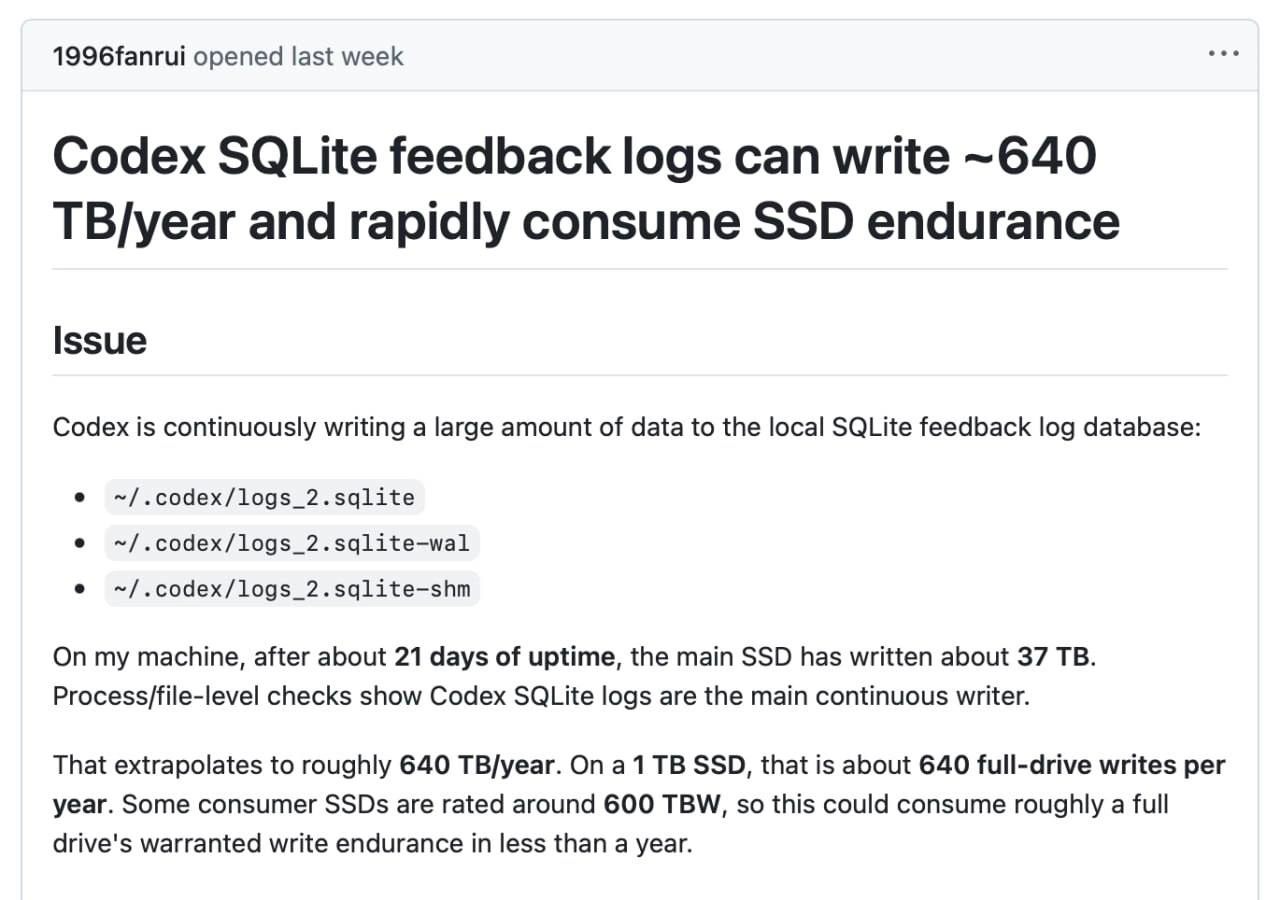
At one run it's premature optimization; at a few hundred billion runs it's the difference between a t3.micro and a datacenter line item with its own VP
A millisecond is negligible until 10¹¹ calls turn it into 3.17 CPU-years.
It absolutely depends on the situation if what matters the most is the extra performance or the time to production
performance is for the users. time to production is for the shareholders.
C/c++ is the reason for 99% of all CVEs. The people are a reason but try giving AK to a chimpanzee
No-fun-allowed zone
They forgot to mention that it’s the same instructions running on the cpu
Just use assembly
10 lines of the python in question: from something_written_on_c import read, loop1, loop2, loop3, write if __name__ == '__main__': a = read() b = loop1(a) c = loop2(b) d = loop3(c) write(d)
so switching languages will magically solve everything, right? right...? https://www.cvedetails.com/vulnerability-list/vendor_id-39558/product_id-190816/Uutils-Coreutils.html https://discourse.ubuntu.com/t/an-update-on-rust-coreutils/80773
I use void btw