
Confluence Stale Docs Wiki Meme Explained
A faithful Confluence brand parody swaps in the tagline “where documentation goes to die.” The dive explains asymmetric incentives—writing pages is rewarded, updating them isn’t—plus search folklore, stale runbooks, and why org-wide wikis often lose to docs-as-code in theory but win in procurement.
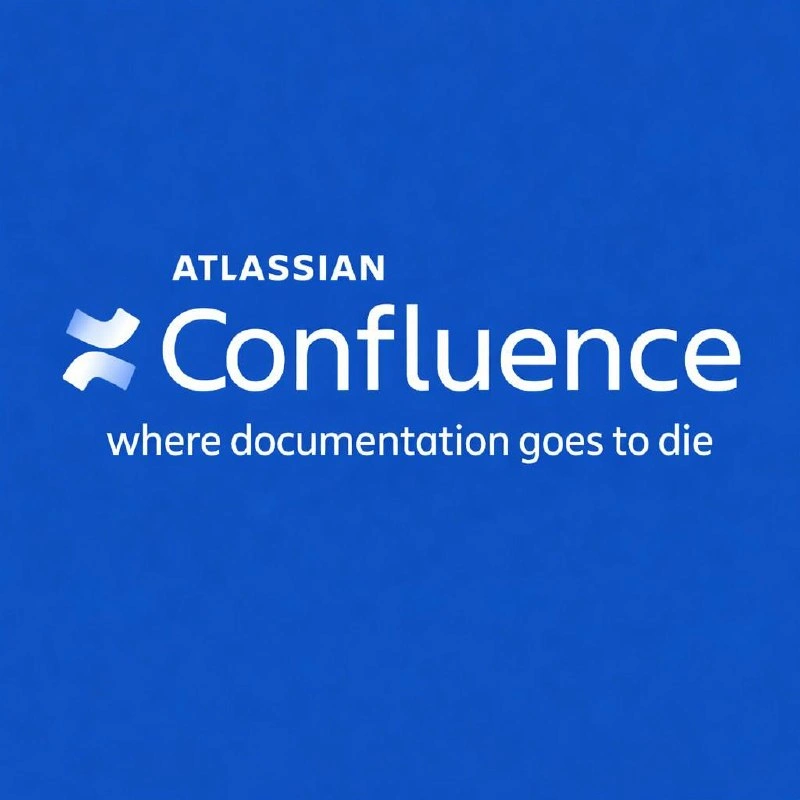
Level 1: The Attic of Promises
Imagine a family that keeps a big notebook called "Everything About Our House." Every time someone fixes the plumbing or rearranges the kitchen, they swear they'll write it down — and they do, once, in beautiful handwriting. Then they never look at it again, never cross anything out, and stuff it in the attic. Years later someone checks the notebook to find the spare key, and it describes a door that was bricked over before they were born. The joke slaps a brutally honest label on the notebook itself: this isn't where family knowledge lives — it's where it goes to die. It's funny because every team, club, and family has that notebook, and everyone keeps adding pages to it anyway.
Level 2: What a Wiki Is Supposed to Be
Confluence is Atlassian's enterprise wiki — a shared website where teams write internal pages: onboarding guides, architecture overviews, runbooks (step-by-step instructions for operating or fixing a system, usually consulted mid-incident), and meeting notes. It pairs with Jira, Atlassian's ticket tracker, which is why most companies you'll join already have it. "Documentation" in this world means everything that explains how the system works and why — and its mortal enemy is staleness: a doc that was accurate when written but silently wrong now, which is worse than no doc, because you'll trust it.
The rite of passage this meme predicts for every new hire: day one, you're handed an onboarding page; half the links 404, the setup steps reference a tool the team abandoned, and the diagram shows services that no longer exist. You fix none of it (you don't know what's wrong yet), and eventually you write your own page — which begins rotting the moment you hit publish. The survival habits worth learning early: check a page's "last updated" date before trusting it, update docs in the same change that alters the system, and when a doc saves you, leave it more accurate than you found it.
Level 3: Write-Only Memory, Enterprise Edition
The image is a deadpan brand parody executed with corporate fidelity: Confluence's signature blue field, the white ATLASSIAN wordmark in spaced capitals, the twin curved-page logo rendered faithfully — and beneath it, in the same friendly product-marketing typeface, a tagline the legal department never approved:
where documentation goes to die
The craft here is minimalism. No reaction faces, no panels — just a corrected slogan, which is the meme equivalent of fixing a typo in someone's mission statement. And it diagnoses a failure mode that has nothing to do with Atlassian's code and everything to do with organizational physics. Enterprise wikis fail because documentation has asymmetric incentives: writing a page is a visible, rewarded act (sprint task closed, onboarding checklist ticked, "we documented the architecture decision"), while updating a page is invisible janitorial labor with no owner, no deadline, and no Jira ticket. So the corpus only grows. Every page is a snapshot of the system at the moment someone felt guilty enough to write it, and the system immediately walks away from the snapshot. Three years later the runbook still says to restart a service that was decommissioned two re-orgs ago — and it's labeled "current," because Confluence pages don't expire, they just quietly stop being true.
Layer on the folklore of Confluence search — the community's longest-running grievance, where exact-title queries surface a 2019 meeting-notes page from a different team's space before the document you wrote on Tuesday — and you get the "graveyard" mechanic in full: easy burial, impossible exhumation. The deeper irony seniors will taste: the correct fix everyone preaches (docs-as-code, ADRs in the repo, docs reviewed in PRs so they change with the system) keeps losing to Confluence in procurement, because the wiki is bought org-wide, WYSIWYG-friendly to non-engineers, and bundled with Jira. The tool that lets everyone write documentation guarantees no one maintains it. That's not a bug in Confluence; it's a tragedy of the commons with a navigation sidebar.

Confluence search can't find the page you wrote last week, but the 2019 architecture doc describing a decommissioned system? First result, marked 'current'
Confluence offers perfect write availability and absolutely no read consistency.
or maybe yester'die
Or Jira: where companies go to die.
the question begs to be asked: has anyone here working in a company >50 ppl seen a working documentation/tickets system?
did ya come here todie?
the worse document format
Holy ai slop
Can we get some votekicks please