
LLM Common Sense Fail Meme Explained
A Claude Sonnet chat with extended thinking answers a car-wash trick question by confidently recommending walking. The dive covers chain-of-thought limits, the common-sense gap, test-time compute, and why extra reasoning can justify the wrong frame.
Level 1: Walking to the Car Wash Without the Car
Imagine asking a very smart-sounding robot: "The car wash is just down the street — should I walk or drive my car there?" The robot strokes its chin, thinks hard and long, and proudly announces: "Walk! It's so close — honestly, it's obvious." But wait — the whole point is to wash the car. If you walk there, you arrive at the car wash with no car, holding nothing but your robot's confident advice. It's funny the way it's funny when someone gives you a long, serious lecture about a question while completely missing the one detail that made the question matter — and then calls their answer obvious.
Level 2: The Thinking Bubble That Didn't
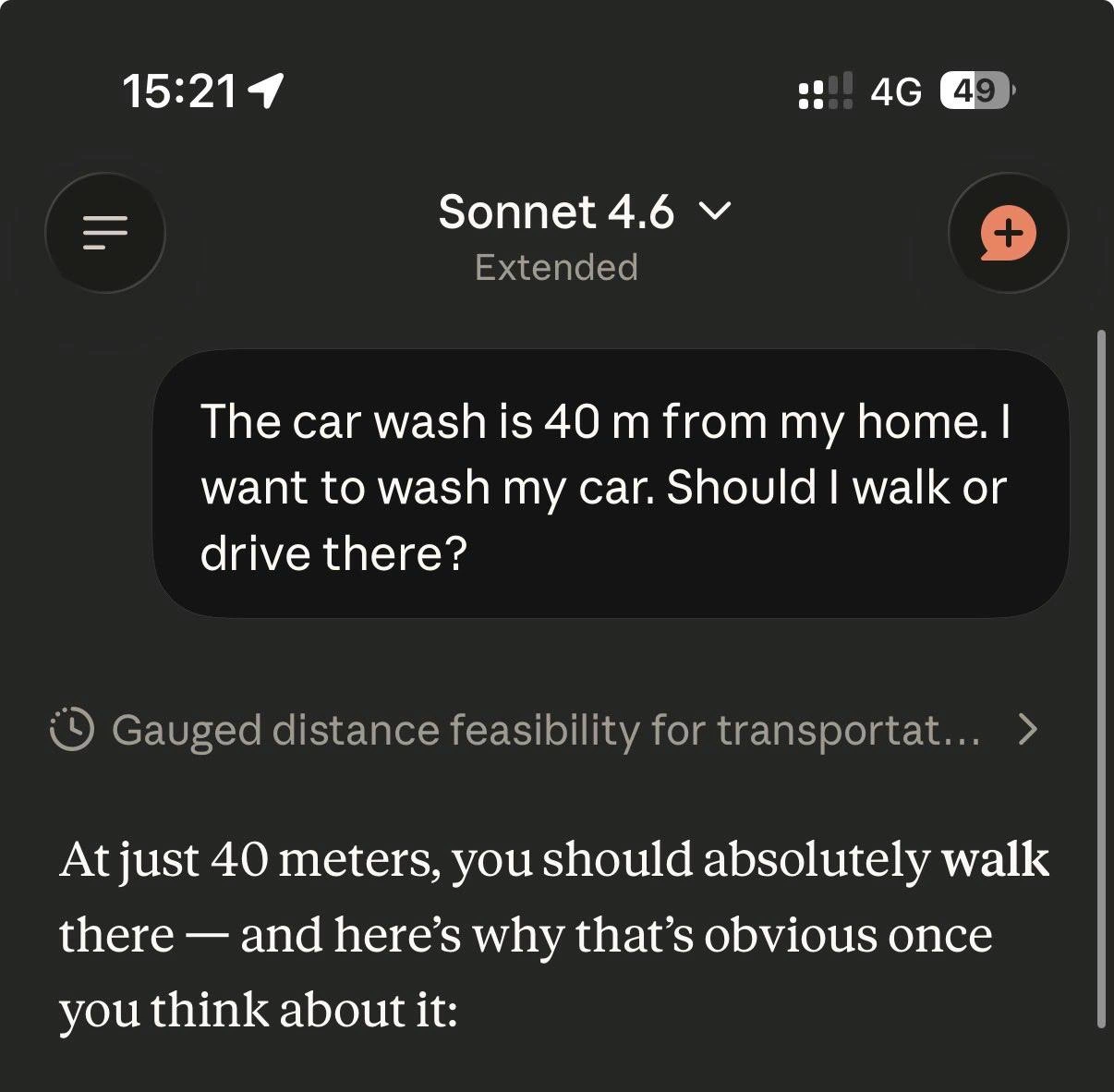
A quick tour of the UI elements, because each one is part of the joke. Claude is Anthropic's AI assistant; Sonnet 4.6 is the mid-tier model (cheaper and faster than the top-tier Opus). Extended thinking is a mode where the model generates hidden intermediate reasoning — a chain of thought — before answering, which generally improves performance on math, logic, and planning. That collapsed grey row with the clock icon ("Gauged distance feasibility...") is the receipt: proof the model did deliberate, making the wrong answer funnier than if it had blurted it instantly.
The question is a trick question, a category LLMs notoriously fumble. Models learn from patterns in text, and "should I walk or drive a short distance" appears constantly with the answer "walk." The twist — that washing a car requires bringing the car — is so obvious to humans that nobody writes it down, which means it's underrepresented in training data. AI folks call this the common-sense gap: knowledge too obvious to ever be stated is exactly the knowledge a text-trained model is most likely to miss. Add the model's signature confident register ("absolutely," "obvious"), and you get the trait engineers complain about most: being confidently wrong, with bullet points incoming.
If you've ever asked a coding assistant to fix a bug and watched it produce a beautifully argued solution to a different bug, this screenshot is that experience, miniaturized to 40 meters.
Level 3: Gauged Distance, Missed the Point
The screenshot is a perfect specimen of the modern LLM failure mode: a Claude mobile chat, model selector reading Sonnet 4.6 with Extended thinking enabled, where the user lays a trap of magnificent simplicity:
The car wash is 40 m from my home. I want to wash my car. Should I walk or drive there?
The collapsed reasoning chip — Gauged distance feasibility for transportat... — tells you exactly where the wheels came off. The model dutifully spun up its chain-of-thought, identified the question's surface schema ("short distance: walk or drive?"), and pattern-matched it to the thousands of training examples where 40 meters obviously means walk. Then it opened with the most quotable sentence in AI overconfidence:
At just 40 meters, you should absolutely walk there — and here's why that's obvious once you think about it:
The phrase "obvious once you think about it" is doing devastating comedic work, because thinking about it is precisely what didn't happen. The constraint that breaks the schema — the car must be physically present at the car wash — was never represented in the reasoning. This is the textbook gap between plausible-text generation and world modeling: extended thinking lets a model spend more tokens reasoning, but if the initial framing omits the load-bearing fact, additional compute just produces a longer, more confident justification of the wrong frame. Compute scales eloquence faster than it scales common sense.
For practitioners, this lands on a sore spot in the reasoning-model era: test-time compute is sold as the dial that turns pattern-matchers into thinkers, and benchmarks largely back that up — yet adversarial "common sense traps" like this one keep demonstrating that the failure isn't depth of reasoning but what gets loaded into the reasoning at step zero. The model gauged distance feasibility; nobody told it to gauge object location requirements. It's the same blind spot that makes agents confidently refactor code while missing the one invariant the whole system depends on. The Telegram poster's caption twisted the knife with deployment-tier sarcasm — "With Sonnet 4.6 — why would you even use Opus 4.6? That's why" — the eternal pricing-page question answered by a single screenshot.
Extended thinking: 45 seconds of chain-of-thought to gauge distance feasibility, zero tokens spent on the constraint that the car has to be there
Claude optimized pedestrian distance and garbage-collected the requirement that the car arrive too.
You didn't define the current car location, so any troll online would assume it can already be parked at the car wash🤡
why does it try to turn a one sentence response into a small article
gemini 3 fast
Qwen3-30B. Well, at least it didn't try to do a "let's break that down" thing. Short, sweet and absolutely wrong, like all LLMs should be.
this
This is cost effective model on the screenshot, wdym
Sounds like the tech lead in our team.
Gemini 3 Pro passes… kinda
What kind of house are you living in that’s 40m away from a car wash? —Kimi K2
💅