
JS Arrow Functions Overuse Meme Explained
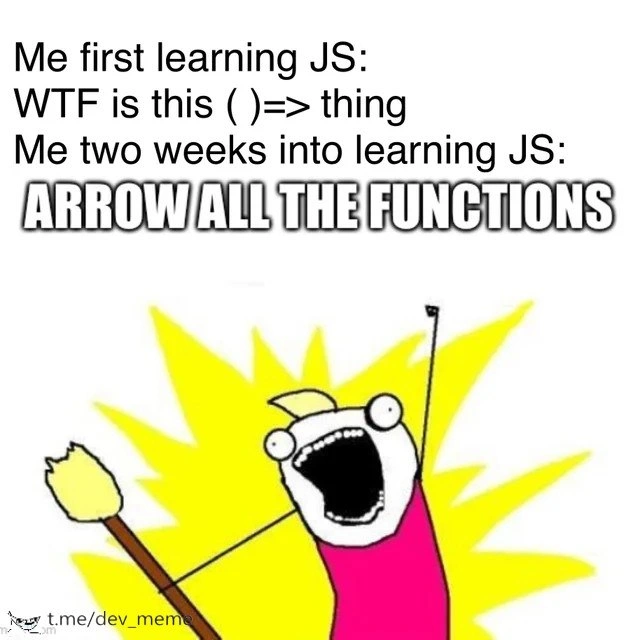
A learner first confuses arrow syntax, then two weeks later arrows every function with X All The Y energy. The dive covers lexical this, callback convenience, and why arrows are not a drop-in for every method.
Level 1: New Tool Excitement
Imagine finding a strange new screwdriver that looks confusing at first. After learning how it works, you start using it on every screw, every lid, and maybe one sandwich. The meme is funny because new JavaScript learners often do the same thing with arrow functions: first they fear the weird symbol, then they want to use it everywhere.
Level 2: Short Function Fever
In JavaScript, a normal function can be written with the function keyword:
function add(a, b) {
  return a + b;
}
An arrow function is a shorter way to write many functions:
const add = (a, b) => a + b;
Arrow functions are especially common in callbacks, such as map, filter, click handlers, promises, and React code. They are useful because they are compact and because they keep this from the surrounding code. But they are not always a drop-in replacement for every function.
For a junior developer, the meme captures a real learning pattern. A syntax starts out weird, then suddenly clicks, then becomes overused. That is not stupidity; it is how people learn tools. The next step is learning when not to use the shiny new thing.
Level 3: Lexical This Phase
The visible progression is perfect beginner whiplash: Me first learning JS: WTF is this ( )=> thing, followed by Me two weeks into learning JS: ARROW ALL THE FUNCTIONS. That is the JavaScript learning curve in miniature. At first, arrow functions look like punctuation escaped from a minified file. Then they feel sleek, modern, and shorter than function, so the new developer starts using them everywhere with the confidence of someone who has not yet had this ruin a Thursday.
Arrow functions are not just prettier function expressions. Their most important semantic difference is that they capture lexical this from the surrounding scope. That is wonderful for callbacks where you want the current class instance, component, or outer context to remain visible. It is also exactly wrong when you need a function to receive its own this from the caller, such as many object methods, event APIs, or older library patterns.
const user = {
  name: "Ada",
  speak: () => this.name
};

// Not "Ada" in normal object-method style.
The meme is funny because it catches the moment when a language feature becomes a hammer. The new JavaScript developer has learned one expressive syntax and starts applying it as an identity: callbacks, methods, handlers, helpers, maybe even places where named functions would be clearer. Every language has this phase. JavaScript just made the phase look like => and gave it enough real usefulness to be dangerous.
There is also a quiet frontend culture joke here. Modern JavaScript tutorials, React examples, array methods, promises, and functional-style code all make arrow functions feel like the default dialect of serious web development. That can be mostly fine, until readability, debugging names, hoisting expectations, arguments, constructors, or method binding rules enter the room. The senior version of "arrow all the functions" is "arrow the functions that benefit from arrow semantics," which is less memeable but causes fewer code reviews written in lowercase disappointment.



Arrow functions are the junior JS developer's first global search-and-replace architecture decision.