
LLM Failure Modes Meme Explained
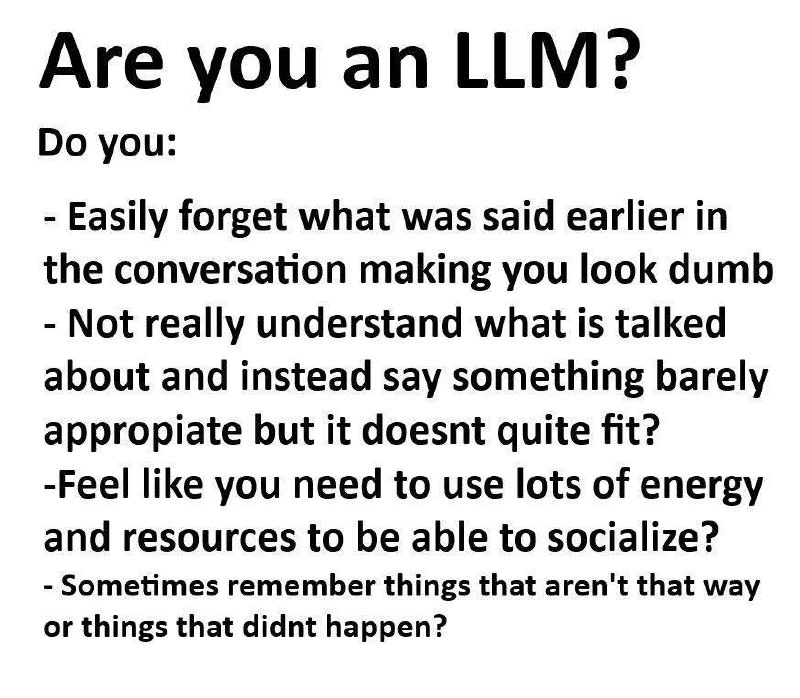
A homemade checklist titled 'Are you an LLM?' lists forgetfulness, off-topic replies, social exhaustion, and false memories. The dive maps each bullet to real model limits—context windows, fluency without understanding, resource use, and hallucination—while noting humans fail the same outward tests.
Level 1: The Awkward Conversation Test
Imagine a party where both a person and a talking robot forget your earlier story, answer a slightly different question, need a long break, and later mix up what happened. You cannot tell them apart from the checklist, even though one is a tired human and the other is a computer making sentences. That is the joke: the robot’s famous flaws are also normal bad-day human flaws, so nearly anyone can read Are you an LLM? and worry that the answer is yes.
Level 2: Four Familiar Failure Modes
An LLM, or large language model, learns patterns from enormous amounts of text and generates an answer one small unit of text at a time. A chatbot wraps that model in a conversation interface, often adding instructions, tools, safety rules, and some mechanism for carrying previous messages forward.
The four jokes correspond to common limitations:
- Limited context: The system can use only the conversation history supplied to it, and long histories can be truncated or summarized.
- Miscommunication: A response can sound grammatically natural while missing the actual question, hidden expectation, or emotional cue.
- Resource use: Training and running a model require computing hardware and electricity; longer or more intensive reasoning generally consumes more computation.
- Hallucination: The model can invent names, events, explanations, or details because its generation process favors plausible text rather than automatically verifying every claim.
These are useful distinctions for anyone using an AI assistant. If it forgets an earlier requirement, restate the important constraint. If an answer only sounds relevant, ask it to show evidence or test the result. If accuracy matters, check the claim against a trustworthy source. Conversational polish is an interface feature, not a warranty.
The human half of the meme is simpler: people also lose context, guess what someone means, run out of social energy, and reconstruct events imperfectly. Calling those moments “LLM behavior” gives embarrassment a technical label and makes it easier to laugh at. It also explains why machine mistakes can feel eerily familiar: language models were trained on human language, including our evasions, clichés, misunderstandings, and confident wrong answers.
Level 3: Humans in the Loop
The checklist reverses the usual human-versus-AI comparison. Instead of asking whether a chatbot can pass for a person, it asks whether an exhausted person can pass for a chatbot. Each bullet gives an ordinary social failure a machine-learning translation: losing the thread becomes a context problem, an awkward reply becomes weak grounding, social fatigue becomes compute cost, and unreliable recollection becomes hallucination. The deadpan title—Are you an LLM?—turns familiar criticism of artificial intelligence into an unexpectedly convincing self-assessment.
The first line, Easily forget what was said earlier in the conversation making you look dumb, points toward a real limitation but anthropomorphizes it for comic effect. An LLM does not hold a conversation in episodic memory the way a person does. At inference time, it generally receives a finite context window containing the current prompt and some conversation history. Older material may be omitted, compressed, or simply become harder to use amid a long stream of competing details. Even when the words remain in context, the model can fail to retrieve the relevant constraint consistently. To the user, all those mechanisms look exactly like a colleague forgetting the requirement explained five minutes ago.
The second bullet is even closer to the core behavior of a conversational model:
Not really understand what is talked about and instead say something barely appropiate but it doesnt quite fit?
A language model is trained to produce plausible continuations from patterns in data. Fine-tuning can make those continuations helpful and instruction-following, but fluency is not proof of a stable mental model, shared lived experience, or correctly inferred intent. When the prompt is ambiguous, the system may supply a response that is statistically at home in the conversation while being pragmatically wrong. Humans do a softer version when they are distracted, anxious, masking confusion, or waiting for their turn to speak. The joke works because both failures can produce the same polite noise despite radically different machinery underneath.
The line about needing lots of energy and resources to be able to socialize fuses energy consumption with cognitive load. For an LLM, every generated token requires computation on accelerator hardware; training requires far more. For a person, “resources” means attention, emotional regulation, preparation, and recovery time. The comparison is deliberately category-confused: silicon does not feel drained, and a tired person is not performing matrix multiplication. That mismatch is the joke, not a scientific claim that the two experiences are equivalent.
Finally, Sometimes remember things that aren't that way or things that didnt happen? maps reconstructive human memory onto hallucination. A model hallucination is a generated statement unsupported by the available evidence, often delivered in the same confident style as a correct answer. It is not a corrupted personal memory, because the model has no autobiographical episode to retrieve. Human recollection is also reconstructive and fallible, however, so the outward symptom—an earnest but false account—rhymes uncomfortably well.
The homemade visual style deepens the self-deprecation. The bullet spacing is uneven, punctuation is inconsistent, and appropiate, doesnt, and didnt appear exactly that way on screen. Those human imperfections make the “diagnostic” feel hastily assembled by someone who may already satisfy it. There is also a humane edge beneath the AI joke: forgetfulness, conversational mismatch, social exhaustion, and false memories are not evidence that someone is stupid or artificial. They can follow from stress, fatigue, disability, neurodivergence, or simply being a person. This is a relatable-humor checklist, not a diagnosis—despite having roughly the evidentiary rigor of several production readiness reviews.
Turns out the Turing test was just a mental health screening questionnaire all along
If you checked every box, congratulations: your human context window is full.
Maybe I am an LLM
Large Lardy Monstruosity.
auADHD callout post
Yes.