
Meeting Overload Culture Meme Explained
The meme shows a tied cat hoping for few meetings while standing before a “lots of meetings factory.” The dive explains coordination versus focus work, context switching, and how organizations industrially overproduce syncs.
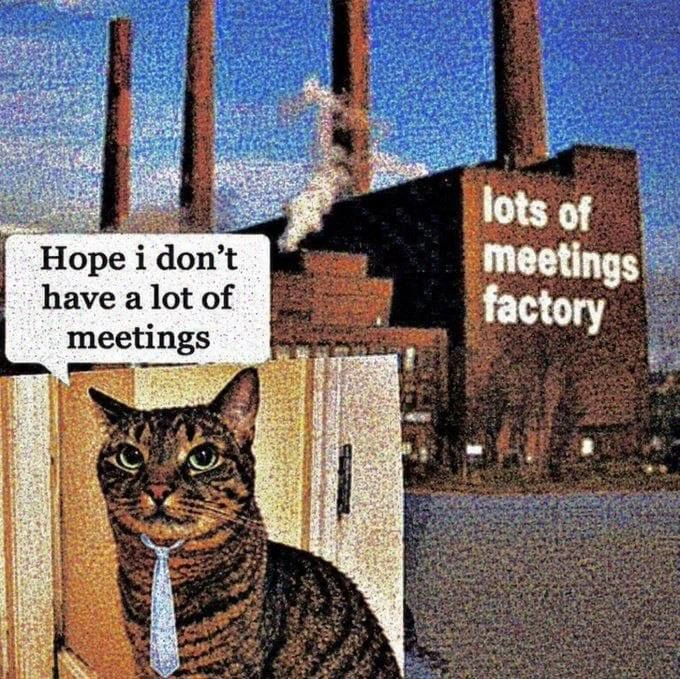
Level 1: The Talking Factory
It is like going to a toy factory and hoping there will not be many toys: the huge building behind you exists to make them all day. The nervous cat wants time to do its actual job, but its workplace keeps producing conversations instead, which is funny because its hopeful little wish never had a chance.
Level 2: Why the Cat Panics
A meeting is synchronous communication: everyone must be present at roughly the same time. It is valuable when people need rapid back-and-forth, emotional nuance, collaborative problem-solving, or an immediate decision. Asynchronous communication—a ticket, design document, recorded demonstration, or carefully written message—lets people contribute at different times and gives the team a durable record.
Context switching is the mental cost of moving between unlike tasks. Imagine debugging an authentication failure while remembering five clues. When a stand-up begins, those clues are displaced by updates from several projects. Returning to the bug means reconstructing the clues before making progress. Repeated switches create meeting fatigue even when every individual call seems harmless.
The image’s factory is funny because factories optimize repeatable output. Corporate calendars can do the same:
| Calendar Output | Intended Purpose | Failure Mode |
|---|---|---|
| Daily stand-up | Surface blockers quickly | Everyone recites status to a manager |
| Planning session | Agree on upcoming work | Guesses expand to fill the timebox |
| Design review | Catch risks before implementation | Too many attendees avoid a decision |
| Retrospective | Improve how the team works | The same issues return without owners |
| One-on-one | Support an individual | Urgent project status consumes the slot |
For a junior developer, attending can feel mandatory even when the discussion is irrelevant. Declining an invitation may seem rude, while accepting it quietly removes coding time. Healthier teams make the purpose explicit, invite only necessary participants, circulate context beforehand, record decisions afterward, and end or cancel recurring calls that no longer produce value. They also protect blocks of focus time instead of assuming developers can assemble concentration from the ten-minute gaps between events.
The goal is not “zero meetings.” That would merely replace calendar overload with message overload and accidental isolation. The goal is to choose the communication method that fits the problem. If a question can be answered clearly in a ticket, the cat need not put on its tie.
Level 3: Calendar Industrial Complex
The image turns meeting culture into heavy industry. Behind a tabby cat in a tiny necktie stands a brick plant with several tall smokestacks and the blunt label:
lots of meetings factory
The cat’s anxious, wide-eyed hope—Hope i don’t have a lot of meetings—is therefore doomed before the workday begins. This is not merely an office that happens to schedule too many calls. In the meme’s logic, meetings are the organization’s product, emitted at industrial scale. The little tie makes the cat look dutifully prepared for corporate life, while its expression suggests it has just understood the job description.
For software teams, the joke lands on the conflict between coordination work and focus work. A useful design review can prevent weeks of building the wrong thing. An incident call can rapidly assemble the people needed to restore production. A short planning discussion can expose dependencies before they become blockers. But each additional recurring sync has a cost beyond its scheduled duration: preparation, context switching, delayed concentration, and the mental residue of changing from code to conversation and back again.
Programming often requires holding a large, fragile model in working memory: data flow, invariants, call paths, failing tests, and the reason a suspicious line cannot yet be deleted. A thirty-minute interruption in the middle of that work does not consume only thirty minutes. The developer must later reload the model, assuming the next calendar notification does not arrive first. By late afternoon, the day may contain eight hours of employment and no uninterrupted hour in which to solve the difficult problem everyone met to discuss.
The “factory” metaphor also captures how organizations manufacture meeting overload systemically:
- Unclear ownership creates a call so that every possible owner can attend.
- Low trust creates status meetings because written progress is not considered sufficient.
- Too many dependencies create alignment meetings between teams that cannot act independently.
- Fear of exclusion expands the invite list until listeners outnumber decision-makers.
- Recurring events remain on calendars after their original purpose has disappeared.
- Decisions made in calls but not recorded generate later calls to reconstruct the decisions.
None of these outcomes requires a villain twirling a calendar invite. Smart people schedule individually reasonable meetings because the cost is distributed among all attendees while the scheduler receives the immediate benefit of access and reassurance. Management sees visible participation; deep work is mostly invisible until something ships. The incentive system keeps the smokestacks running.
The most painful anti-pattern is treating a meeting as proof that communication occurred. If nobody owns a decision, no agenda defines the question, and no written outcome survives the call, the organization has produced activity rather than coordination. Naturally, the corrective action will be a retrospective about why the previous meeting was ineffective. The factory does offer vertical integration.
The factory’s only deliverable is calendar conflicts, and somehow it still has five-nines availability.