
AI Written Code Hype Reality Meme Explained
A tweet calls Nadella’s AI-code boast “a threat” after a mandatory Windows 11 security update breaks WinRE and more. The deep dive covers Copilot-era productivity claims, recovery-environment risk, and why AI-generated code still needs human QA.
Level 1: Brag then Crash
Imagine you have a helper robot that can do part of your job. You’re really proud of it, so you tell everyone, “This robot does 30% of my work for me!” 😃 But the very next day, something goes wrong – the robot made a big mistake and broke something important. Now everything is messed up, and you have a huge problem to fix. People can’t help but chuckle because you just bragged about your robot helper, and immediately it caused chaos. It’s like saying “The robot is great!” and then the robot causes a disaster. The joke here is about being overly confident in a new helper (in this case an AI robot that writes code) and then that confidence backfiring in a very public way. It’s funny in the “oh no, that’s ironic!” kind of way. Just like boasting that your self-driving car is amazing, and then the car accidentally drives into a wall – it makes everyone say, “Maybe you shouldn’t have trusted it so much!” Here, Microsoft bragged about letting AI write a lot of their code, and right after that, a big Windows update (which is made of code) went horribly wrong. It’s a simple lesson: don’t celebrate too soon when a machine is doing the work, because if it fails, you’ll end up with egg on your face (and a mess to clean up).
Level 2: Mandatory Mayhem
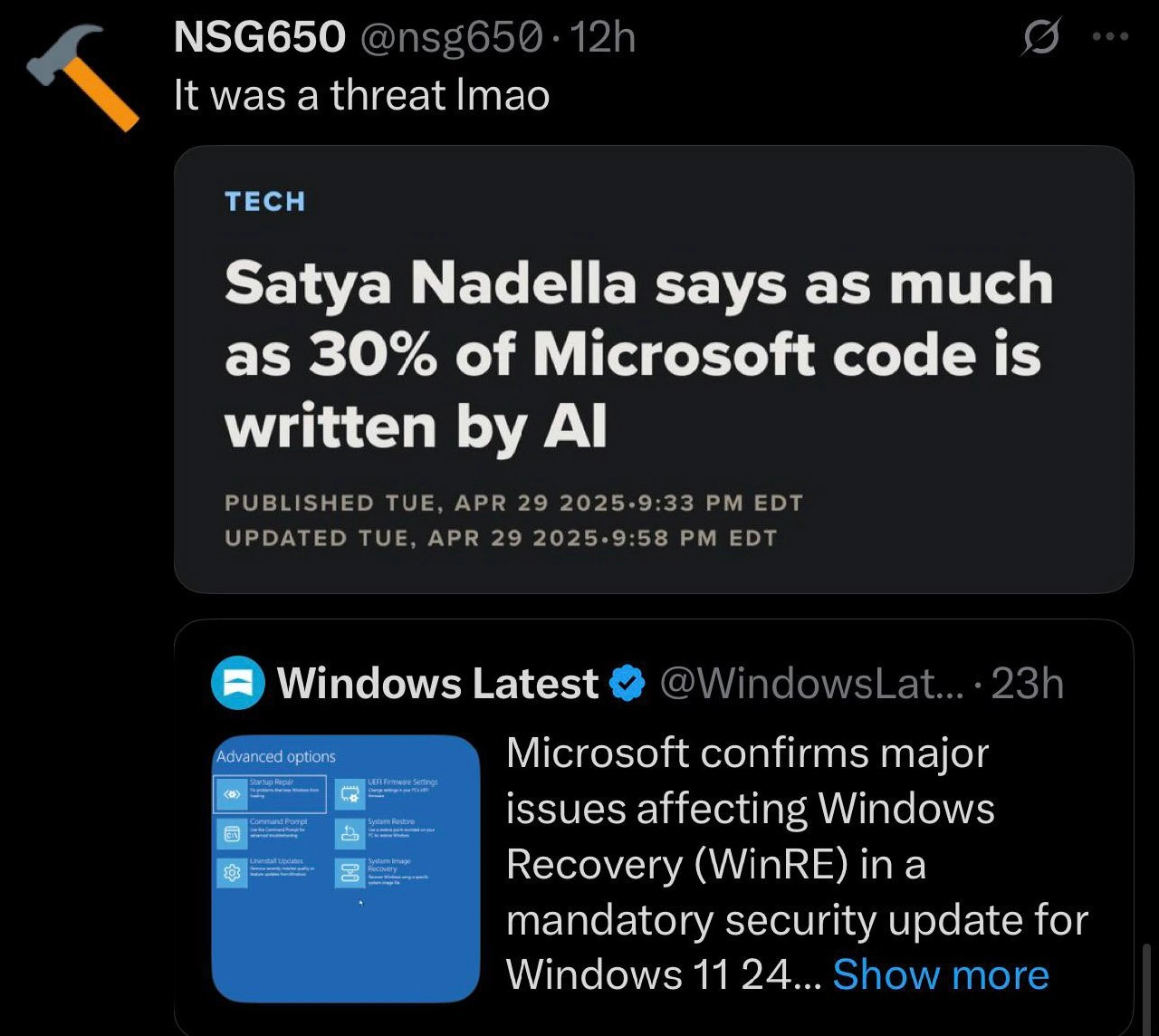
So what exactly happened here, and why are developers chuckling (and cringing) at this? Let's break it down in simpler terms. Microsoft’s CEO, Satya Nadella, announced that about 30% of the code at Microsoft is now written by AI. This likely refers to tools like GitHub Copilot (an AI coding assistant that helps write code) being widely used by Microsoft’s programmers. Essentially, nearly a third of the code might be coming from AI suggestions rather than humans typing every character. That’s a big chunk! It shows how much trust and dependence is being placed on AI in software development at a top-tier tech company.
Now enter the next part of the meme: a Windows 11 update that went horribly wrong. Windows 11 pushed out a mandatory security update – meaning your PC has to install it to patch some security holes. But instead of just fixing things, this update caused major problems. The headline specifically mentions issues affecting Windows Recovery (WinRE). WinRE is the Windows Recovery Environment, a special repair mode you use when Windows is so messed up it can’t start normally. For example, if a bad update makes your PC unbootable, you’d rely on WinRE for tools like Startup Repair, System Restore, or Safe Mode to recover. So WinRE is like the emergency kit for your OS.
The meme juxtaposes (places side by side) the AI code brag and the WinRE-breaking update to imply cause-and-effect humorously. It’s like saying, “Look, Microsoft let AI write a bunch of code, and now their latest update broke something fundamental.” The top tweet (“It was a threat lmao.”) jokes that the CEO’s AI comment wasn’t just a boast – it sounded almost ominous, and sure enough, a disaster followed as if on cue.
For a junior developer or someone newer to this arena, here’s why it’s such a facepalm moment: In software, bugs (flaws or errors) can slip in easily, especially when changes are made quickly or without full understanding. AI generating code might save time, but if that code isn’t carefully verified, you can introduce bugs faster than you fix them. ProductionIssues (problems in the released software) are the bane of every engineer – it’s embarrassing and harmful when customers experience failures like this. Here, one of the worst types of bug happened: the update intended to make Windows more secure ended up breaking critical functionality. And because it was a mandatory update, users didn’t have much choice; it auto-installed, and they woke up to find, say, their recovery options or other features not working.
The “major issues” confirmed by Microsoft included several things that would freak out both users and developers: for instance, localhost not working means if you’re a developer running a local server on your machine (which is very common for testing websites or apps), the loopback address 127.0.0.1 (localhost) was refusing connections. That’s like your computer suddenly not allowing you to access your own locally hosted projects – super frustrating when you’re trying to debug or develop. Another issue from the update was install failures – some people couldn’t even get the update to fully install, leading to error messages or incomplete installations (which could leave the system in a weird state). The File Explorer preview pane breaking is a more everyday annoyance: normally when you click a file (like an image or PDF) in Windows’ file browser, a preview appears – that just stopped working for some after the update. And performance problems mean the computer started running slow or behaving laggy, which no one appreciates. Each of these issues alone would be a headache; together, they spell out that this update was really botched.
So why tie this to AI? Well, the implication (jokingly) is that maybe the code written by AI had mistakes that a human might catch, or that relying so much on AI-produced code led to less oversight. In reality, any update can introduce bugs – human-written or AI-written – especially in something as complex as an operating system like Windows. But the timing of Microsoft boasting about their AI usage and then immediately having a very public failure is chef’s kiss for meme-makers. It highlights the gap between AI hype (woo, look how advanced we are, 30% of our code is from futuristic AI helpers!) and AI reality (uh oh, that code might not have been thoroughly vetted, and now things are broken).
For a junior dev, the lesson or insight here is: cool new tech (like AI code generators) can boost productivity, but they don’t replace careful engineering practices. Code reviews, testing, and understanding your code are as crucial as ever. The meme resonates because many devs fear a scenario where a higher-up forces AI adoption (“it’ll make us faster!”) but doesn’t invest equally in quality control – leading to bugs in production and late-night emergency fixes. In short, don’t let the magic of AI blind you to the basics: every line of code (AI or not) can break something, especially in a massive system like Windows.
Level 3: Hype vs Hotfix
"It was a threat lmao." – a Twitter user’s dry quip after Microsoft bragged about AI-written code and then scrambled to fix a busted Windows update. The meme mashes up Satya Nadella proudly stating “30% of Microsoft code is written by AI” with a grim headline that a Windows 11 mandatory security update broke Windows Recovery (WinRE). Seasoned engineers see the punchline immediately: bragging about AI productivity one day, fighting production issues the next. It’s a textbook case of AI hype vs. reality – and an all-too-familiar scenario of SoftwareBugs coming home to roost.
Let’s unpack the humor step by step. Microsoft’s CEO touts their use of AI (think tools like GitHub Copilot) to write a sizable chunk of code. That’s the AI/ML hype: faster coding, fewer human hours. But almost on cue, the next news is a serious Windows bug: an update meant to improve security ironically breaks the system recovery environment. The tweet “It was a threat” jokes that Nadella’s boast sounded less like an achievement and more like a warning – a threat fulfilled by the AI-written code causing chaos. The implication: “Let an AI commit code to Windows, and look what happened.” Experienced devs smirk at this because we’ve all seen AIHypeVsReality: lofty promises face-planting into messy reality.
Why is this so relatable (and funny in a dark way)? For one, Windows updates have a reputation. Many of us have been jolted awake at 3 AM by an on-call alert after a patch borked something critical. Here, the mandatory update (you can’t defer it – it’s pushed to everyone for security) ironically disables WinRE – the very tool you’d use to fix a broken system. It’s the kind of nasty bug that veterans joke about but dread in production. A boast about AI in the codebase immediately followed by “major issues” is comedic timing and cruel irony rolled into one. It suggests that maybe that 30% AI-generated code snuck in a nasty bug that human developers now have to clean up. Call it ai_generated_technical_debt: the idea that AI can speed up coding, but might also speed up the accumulation of problems to solve later.
Inside big enterprise codebases like Windows, even a small mistake can wreak havoc. The Windows Recovery Environment (WinRE) is a mini-OS used for repairing your system when things go wrong. Imagine an AI-driven change that accidentally messed up how WinRE boots or interacts with the main OS. Perhaps an AI suggested code that looked fine in review but had an edge case it didn’t foresee. Maybe a script that cleans up old recovery images but ends up disabling recovery entirely due to a logic error. The AI wouldn’t know – it’s just confidently auto-completing patterns from training data. If no human caught the mistake, that faulty code ships in an update. Boom: millions of PCs potentially lose their safety net for crashes. It’s a nightmare scenario that hits home for engineers: “ We let the bot commit, and now we’re in damage control.”
The meme cleverly hints at a fear many devs have: giving AI too much autonomy in critical systems. Without stringent code reviews and testing, AI-suggested code can introduce subtle bugs. Unlike a human, an AI doesn’t truly understand the intent or the full context – it’s not thinking about how an update might fail and need recovery. Engineers joke about Skynet and AI overlords, but when a patch goes awry, it’s not so funny to those fixing it. There’s also an unspoken “I told you so” here: skeptics of the AI-coding hype warn that rushing AI-written code into products will backfire. This Windows fiasco seems to prove their point. It’s a bit of schadenfreude for anyone who’s been burned by over-optimistic tech trends.
To rub salt in the wound, the update didn’t just break recovery. Reports rolled in of all sorts of collateral damage caused by this Windows 11 patch. It’s like a greatest-hits list of unintended bugs:
- Localhost stopped working – Developers found that after the update, their
localhost(the loopback address for running local servers) was refusing connections, breaking local dev environments. - Install failures – Ironically, the mandatory security update couldn’t even install cleanly for some users, throwing errors and leaving systems in limbo.
- Broken preview pane – Even File Explorer’s preview pane (which shows file thumbnails and content previews) was mysteriously busted, a minor but telling UI glitch.
- Performance hits – Users reported their PCs running sluggishly or other weird slowdowns post-patch.
This laundry list underscores how one bad update can hit everything from developer workflows to basic OS features. The meme’s subtext is clear: maybe that AI-written 30% needs a lot more human QA. Seasoned engineers are nodding (or facepalming) because we’ve seen similar trains wreck: a supposedly smart solution introduces new bugs and we end up in a firefight, deploying hotfixes at odd hours. It’s a cautionary tale wrapped in humor: AIHype meets the grim reality of maintaining complex software. The result? A very public “L” for Microsoft, and a wry meme for the rest of us.
Satya: '30% of our code is AI-written!' Twitter: 'It was a threat lmao.' The AI passed all the unit tests -- it just forgot that users actually need to boot their computers
So 30% of the code is written by AI, and 100% of the blame is assigned to a mandatory security update. Sounds like a successful management-level abstraction
This is what happens when your CI pipeline’s approval step is just ChatGPT telling itself, “LGTM, ship it.”
After 20 years in the industry, I've learned that '30% AI-generated code' is just corporate speak for 'we finally found something to blame besides offshore contractors when Windows Update bricks your recovery partition.'
When your CEO brags about 30% AI-generated code and Windows Recovery immediately breaks, that's not correlation - that's a code review finding itself
Correlation isn’t causation, but my error budget just added a panel for ‘Copilot LOC vs WinRE breakage’ - Patch Tuesday has officially become Prompt Tuesday
Satya's 30% AI code KPI: perfectly scaling hallucinations from dev to mandatory prod recovery
When you let me touch prod
Each function I generate with AI, I review before pushing to my Gitlab. I mean yeah, it generates code fast and often times faster than me when I google the stuff together. But I want to understand the code AND want it to work, so proper studying is necessary.
Fuck this I‘m out here selling Windows 11 updates and clients WILL blame me for a preview pane not working.
Vibe coding is not coding then - it's QA...
is that unusual by any margin tho?
Also didnt the other update brick ssds lmfao
Am I incentivized to upgrade from now-deprecated Win10? Hell naaaaw, I'll stick to ESU, even if I have to switch regions because of that