
AI Labs as Middle-earth Races Meme Explained
Sergey Karayev casts major AI labs as Middle-earth races and notes that Claude, Gemini, and peers all pick a different roster. The dive explains each mapping, the empty hobbit seat, and what unanimous LLM disagreement says about training data and subjectivity.
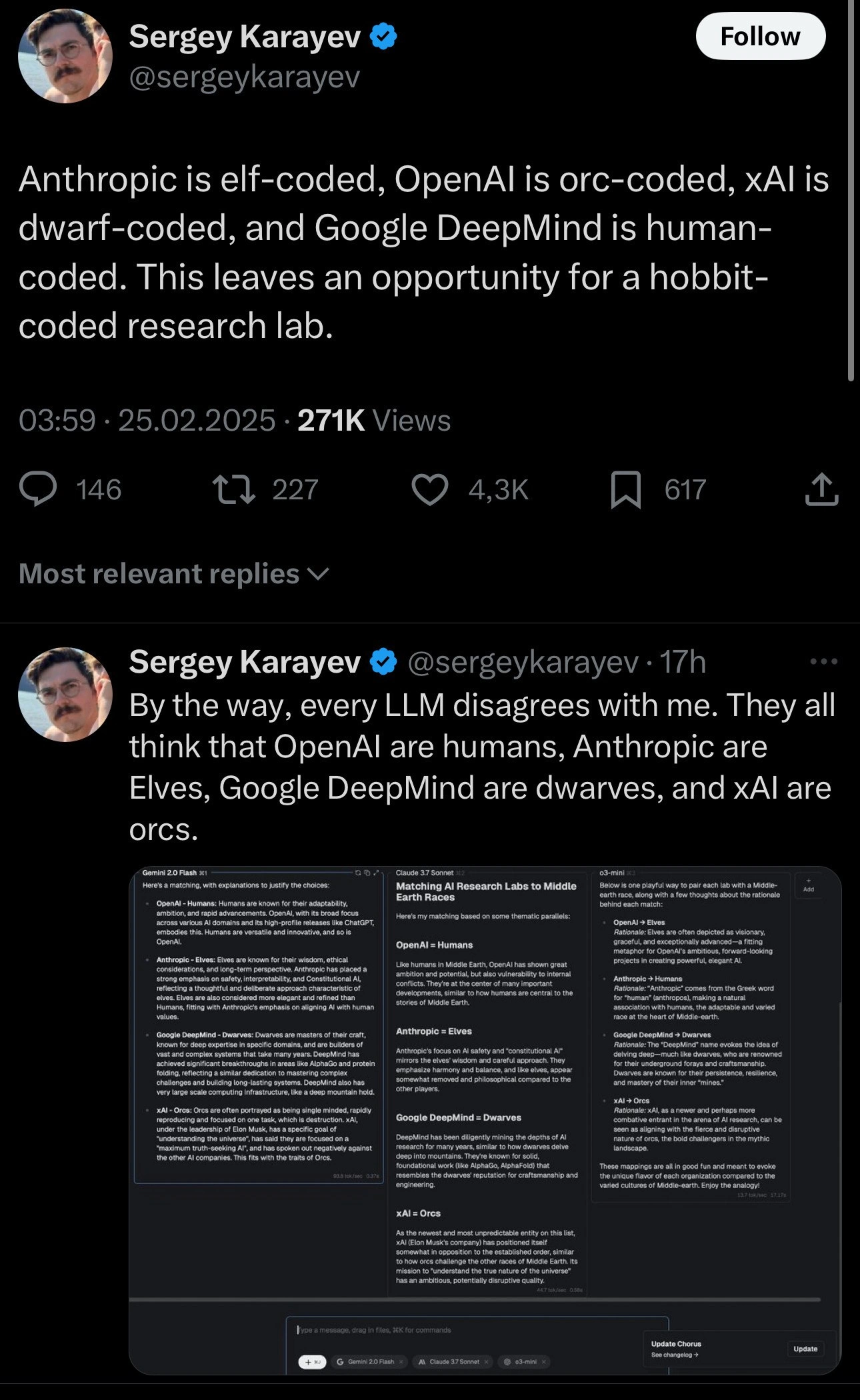
Level 1: Tech Companies as Fantasy Creatures
Imagine you have a bunch of big teams building super smart robots, and someone jokes that each team is like a different magical creature from a fairy tale. That’s what’s happening in this meme! The tweet is saying: one AI team is like elves, another is like orcs, one is like dwarves, and one is like humans. In fairy tales, elves are really wise and good, orcs are rough and aggressive, dwarves are hard-working and crafty, and humans are, well, regular folks who can be good or bad.
So, the joke sorts the AI teams like this:
- Anthropic – they’re the careful, thoughtful team, so they get to be the Elves, who are smart and kind.
- OpenAI – they’re super powerful and moving really fast (maybe even a bit scary to some), so they got called Orcs, like the rowdy warriors in stories.
- xAI – this is a newer, smaller team that’s busy building things quietly, so they were likened to Dwarves, the little guys who work in caves making cool stuff.
- Google DeepMind – this team has been around doing big important things, so they were labeled as Humans, the normal heroes of the story.
Then the person joked, “Hey, nobody is the Hobbits yet!” In The Lord of the Rings, hobbits are the small, friendly folks who end up doing something super important (like Frodo the hobbit saves the world). Saying there’s room for a “hobbit” team means maybe one day a small, humble AI group could surprise everyone and do something great, even though they’re not big and famous now. It’s a cute way to imagine an underdog team of gentle, good-hearted people becoming heroes in the AI world.
But there’s more fun! The second part of the meme shows that the guy asked some AI chatbots (the kind of smart computer programs that talk, like Siri or Alexa but much brainier) to also do the magical creature sorting. And guess what? All the chatbots gave a totally different answer than the person did! All the AI bots agreed with each other on a new sorting:
- They said OpenAI is like the Humans (maybe because OpenAI is a leader and humans lead in stories).
- They still made Anthrop𝗂c the Elves (everyone sees that team as wise and good).
- They made Google DeepMind the Dwarves (thinking of them as the clever workers making things).
- And they decided xAI is the Orcs (maybe because xAI might shake things up and orcs are known as troublemakers).
It’s funny because it’s like asking a bunch of robot friends “who is who in our fantasy game?” and all the robots giving the same answer – but that answer isn’t what the human originally joked. It shows that even AIs can have ‘opinions’ (not real feelings, just patterns they learned) and their take can be different from a person’s silly idea. The human’s version was a bit cheeky (he was teasing OpenAI by calling them orcs, which are usually bad guys), whereas the AIs were more polite or logical, making OpenAI a human group instead.
Why do people find this hilarious? Because it’s blending a fairy tale with real life tech teams in a playful way. It’s like saying “Google DeepMind is basically a bunch of Dwarves hammering away at secrets,” which paints a funny mental picture. And then seeing the AI bots disagree is like the story characters coming to life and saying, “Nah, we think it should be this way.” It’s just a very silly, creative crossover between fantasy stories and the world of artificial intelligence. You don’t need to know all about those companies – just knowing elves are wise, orcs are rough, dwarves are diligent, and humans are... human, is enough to get why matching those vibes to different teams could be amusing.
At its heart, this meme is funny because it uses make-believe characters to describe serious tech groups, making them seem less serious and more like a fantasy game. And it also shows that super smart AIs can play along with our jokes, even if they see the roles a bit differently. Imagine calling your school groups or friend circles elves and orcs – it’s that kind of goofy fun, but applied to big tech labs. And the mention of a hobbit group just adds a hopeful note: maybe the smallest, nicest folks can do big things too. So it’s both a nerdy joke and a friendly wink that sometimes the little guys (or hobbits) might save the day in real life, just like in the stories.
Level 2: Fantasy Labels in AI
Let’s break down this tweet for those not deep into either AI or Lord of the Rings lore. Essentially, Sergey Karayev made a fun analogy: he compared big AI research organizations to fantasy races from Middle-earth (the world of The Hobbit and LOTR). When he says one lab is “elf-coded” or “orc-coded,” he means that lab acts or vibes like that fantasy race. This kind of “X-coded” lingo is internet slang for “X-like characteristics.” Here’s what he wrote and what it means in plainer terms:
Anthropic = Elf-coded: Anthropic is a company that works on AI and is known for being very focused on AI safety and ethics (making AI systems that are beneficial and won’t turn evil, essentially). In fantasy, elves are wise, noble, and care about doing things the right way. So calling Anthrop𝗂c “elf-coded” suggests the company is seen as wise and principled, always trying to do the good and intelligent thing (just like elves who are usually the good guys with high moral standards).
OpenAI = Orc-coded: OpenAI is the famous lab behind things like ChatGPT. Orcs in fantasy are typically the bad guys’ soldiers – they’re rough, aggressive, and numerous. Saying OpenAI is “orc-coded” is a playful slight, implying OpenAI is acting like the big brute in the AI world: very powerful, maybe a bit ruthless or “take-over-the-world” oriented. It’s a jokey way to hint that OpenAI, once seen as friendly, has become more ominous or dominating (maybe because they closed off their research and are pushing products hard, backed by a giant corporation). It’s tongue-in-cheek, not a serious insult – more like a nerdy roast.
xAI = Dwarf-coded: xAI is a newer AI lab founded by Elon Musk (launched in 2023). Dwarves in Middle-earth are known for being master craftsmen, working in isolation in their mountain forges, and sometimes being stubborn or treasure-hungry. Labeling xAI “dwarf-coded” suggests that Musk’s lab is like a group of dwarves: off in their own space, quietly (or stubbornly) building something technically impressive. Dwarves aren’t evil, but they’re not as lofty as elves – they’re practical, gritty workers. This might reflect how people see xAI: a smaller team, doing their own thing, possibly with a bit of a maverick attitude (Musk often bucks the norm, similar to how dwarves go their own way in fantasy). Also, dwarves tend to dig deep for valuable gems; xAI likewise might be digging for some “deep” AI truth or capability.
Google DeepMind = Human-coded: Google DeepMind (often just called DeepMind) is one of the oldest and most prestigious AI research groups (famous for AlphaGo, the AI that beat the world champion at Go). Sergey calls them “human-coded,” meaning he gives them the role of regular humans in the fantasy metaphor. In LOTR, humans are a mix: they can be heroic or flawed, but they’re basically the standard folk destined to rule the day in the end. Saying DeepMind is like humans might mean they’re seen as the default or central player – not as mythically “good” as elves, not as “brutish” as orcs, just ambitious and capable, like humanity itself. This could be because DeepMind, now part of Google, is more conventional in corporate structure (humans = corporate reality) compared to the other more eccentric “fantasy” labs. It could also hint that DeepMind’s work is very much about real human problems (they apply AI to science, health, etc. for human benefit), making them the human-hearted group.
After these comparisons, Sergey jokes that no one has taken up the role of hobbits yet: “This leaves an opportunity for a hobbit-coded research lab.” Hobbits in Middle-earth are small, friendly folk who love peace, quiet, and food – and they often surprise everyone by accomplishing big heroic deeds (like Frodo and Sam, who are hobbits, saving the world in LOTR). By saying there’s room for a “hobbit-coded” lab, he implies none of the current big AI labs are humble or heartwarming in that hobbit-y way – maybe a smaller, understated lab could fill that niche, being unexpectedly important while staying down-to-earth. It’s a cute way to say “hey, maybe we need an AI lab that’s more about simple goodness or the little guy,” which is both a humorous and somewhat earnest thought in an industry full of giant, high-flying players.
Now, the meme gets even more interesting with the second panel. Sergey shares that he asked several LLMs (Large Language Models) – basically AI chatbots like the ones these labs create – to do the same fantasy mapping. And guess what? All the AIs disagreed with him and gave a different mapping. According to Sergey, every chatbot he tried said:
- OpenAI are Humans (not Orcs),
- Anthropic are Elves (same as Sergey’s pick, so agreement there),
- Google DeepMind are Dwarves (not Humans),
- xAI are Orcs (not Dwarves).
So the LLMs’ consensus was: OpenAI → Humans, Anthrop𝗂c → Elves, DeepMind → Dwarves, xAI → Orcs. They completely flipped Sergey’s assignments for OpenAI, DeepMind, and xAI. And they all matched each other, which is fascinating.
What does that mean? In simpler terms, when Sergey asked the AI models to play this “which fantasy race fits which lab” game, the models all had the same opinion, and it wasn’t the same as his original joke. It’s like he polled a bunch of AI-powered “opinions” and got a unanimous “Actually, here’s how we see it.” Why might this happen? Large Language Models are trained on tons of internet text and media, so they’ve absorbed a lot of what people say about these companies, plus general knowledge about fantasy tropes. They try to give a reasoning that matches what they’ve learned:
- They all treated OpenAI as the human race likely because OpenAI is often portrayed as a leader of the AI pack with a very broad impact – humans in LOTR are the prominent, world-driving race. Also, the word “OpenAI” might not have any negative connotation in their training data (it’s generally respected), so the AIs might have been reluctant to link OpenAI with “orc,” which is a nasty creature. Essentially, the bots gave OpenAI a neutral-to-positive role.
- Anthropic as Elves was a gimme – even the bots picked up on Anthrop𝗂c’s careful, noble positioning (they talk a lot about AI ethics and “constitutional AI”), which screams wise elf behavior. So both Sergey and the AIs mapped Anthrop𝗂c to elves, the wise old guardians type.
- For Google DeepMind, the bots chose Dwarves. This suggests that common descriptions of DeepMind (maybe emphasizing their deep research, special expertise, and working somewhat separately from the rest of Google initially) align with how dwarves are skilled craftsmen working in their own caves. AIs probably “read” somewhere or inferred that DeepMind is full of hardcore researchers (forging AI breakthroughs like dwarven blacksmiths forge weapons). Sergey had casually assigned them humans, but the bots gave a more characterful answer, painting DeepMind as the veteran craftsmen of AI.
- xAI as Orcs was the bots’ call. Possibly because Elon Musk’s new lab is often talked about as trying to oppose or compete with OpenAI. In fantasy terms, orcs are often the opposition army stirring up trouble. The AIs might have generalized that xAI, being the latest aggressive entrant led by a controversial figure (Musk), fits the chaotic challenger mold. Sergey had jokingly put xAI as dwarves (making them just diligent workers), but the bots went for a spicier take, making xAI the orcs (implying they’re the troublesome newcomers).
The humor here is twofold. First, it’s funny on its own to classify serious AI labs as elves or orcs – it’s AIHumor mixing a tech discussion with a fantasy role-play vibe. Second, it’s funny that the AIAssistants (the AI models) “disagree” with the human and they all agree with each other. It’s almost like the AI hive-mind has its own group opinion of who’s who in this fantasy lineup. Of course, in reality, each LLM is just generating a response based on patterns it learned – they don’t truly have opinions. But because they likely trained on similar content (tech news, forums, perhaps even the same geeky analogies floating around online), they produced matching answers. Sergey presenting that contrast highlights a bit of AI model subjectivity in a funny way: ask three humans the same question, you might get three different answers; ask three big LLMs, and oddly you might get the same answer (which is different from one particular human’s creative take).
For a junior developer or someone new to this:
- It’s a reminder that Large Language Models can give authoritative-sounding answers, but those answers are a reflection of data and biases. They’re not always going to align with a human’s sense of humor or intent. Here they took the prompt seriously and gave what they “thought” was the best mapping.
- It also shows how AI culture is full of playful references. Tech people often use analogies like “X is the Gandalf of the team” or “our backend is a Balrog we must pass.” It’s a way to make sense of complex stuff with familiar stories. In this meme, the fantasy_mapping_of_ai_labs is a way to poke fun at each lab’s personality or PR image with something entertaining and easy to grasp.
Lastly, why the hobbit-coded lab joke lands: Hobbits are beloved for their kindness and unambitious nature, so noting that none of the big ambitious labs are like that is a humorous commentary. It leaves you imagining what an AI lab would be like if it were “hobbit-ish” – maybe small-scale, community-driven, focused on simple beneficial AI rather than grand “change the world” schemes. It’s a friendly tease that among all the lofty elves, powerful humans, gritty dwarves, and scary orcs in the AI space, we’re missing the friendly neighborhood good guy. Some folks might even think of open-source volunteer groups or non-profits as candidates for “hobbit labs” – quietly doing important work out of love and curiosity (for example, EleutherAI or Hugging Face in the AI community have a bit of that wholesome, share-the-food-in-the-Shire vibe).
In summary, Sergey’s tweets made a lot of the tech crowd laugh because they encapsulated AI industry trends in a silly fantasy analogy that actually rings kind of true. And then showing the LLM responses added an extra wink: even the AI models have their own spin on the analogy! It’s a lighthearted way to see how AI assistants reflect what they’ve absorbed about the industry’s players. For a junior dev, the big takeaway is: tech folks love referencing pop culture (especially fantasy and sci-fi) to describe real-world tech situations – it makes the complex industry dynamics more relatable and a lot more fun. And even advanced AI tools will play along with these analogies, though they might give you an answer you don’t expect.
Level 3: Race Conditions in Middle‑earth
On the surface this meme mashes up AI industry hype with Lord of the Rings mythology, but there’s a lot to unpack. In a tongue-in-cheek tweet, Sergey Karayev assigns each major AI research lab a Middle-earth race archetype: Anthropic is elf-coded, OpenAI is orc-coded, xAI is dwarf-coded, and Google DeepMind is human-coded. He even quips that there’s a vacancy for a hobbit-coded AI lab (implying no current organization embodies the hobbits’ humble, good-hearted vibe). This fantasy mapping isn’t random; it satirizes each lab’s reputation and approach:
Anthropic as Elves – Elves are wise, long-lived, and principled. Anthrop𝗂c’s focus on AI safety and ethics (their “Constitutional AI” approach) mirrors an elf’s cautious wisdom. They’re the moral high-grounders of the AI world, much like Tolkien’s elves guiding Middle-earth with knowledge and restraint. It’s a flattering portrayal, suggesting Anthrop𝗂c’s culture is lofty and otherworldly idealistic. (Ironically, the company’s name Anthropic comes from anthropos meaning human, yet here they’re cast as non-human elves.)
OpenAI as Orcs – Orcs are the foot-soldiers of evil in fantasy: aggressive, numerous, maybe a bit reckless. Labeling OpenAI “orc-coded” playfully jabs at the lab’s bold, brute-force tactics in the AI arms race. OpenAI is famous for scaling models gigantically (GPT-3, GPT-4) with
brutecompute force, which some critics liken to an orc army’s approach: powerful but perhaps unrefined. It’s a cheeky slight at OpenAI’s perceived shift from noble ideals (remember when OpenAI promised openness?) to a more guarded, power-focused stance after commercial partnerships – in other words, going from elven finesse to orcish might. Fun lore fact: In Tolkien’s legendarium, orcs were corrupted elves. Some AI insiders chuckled that this maps to reality: Anthrop𝗂c’s founders spun out of OpenAI over ethical disagreements; now one lab is the “elf” and the other arguably turned “orc.” This nod to shared origins makes the analogy even juicier for those in the know.xAI as Dwarves – Dwarves are craftsmen, secretive hoarders of knowledge, delving deep for treasure. xAI (Elon Musk’s new AI venture) being “dwarf-coded” suggests a small, stoic team working underground on precious tech. Musk is known for going against the grain (and for a penchant for digging tunnels, literal dwarven behavior via The Boring Company 🚇). The dwarf label hints that xAI might be hardworking on niche tech, quietly building like a smith forging a legendary axe. Dwarves in Middle-earth also had a stubborn streak and a tendency to isolate – a possible nod to xAI’s go-it-alone attitude outside the big AI fellowship. It’s a nuanced pick: not overtly villainous, but not shiningly noble either – dwarves can be valiant OR inadvertently awaken the Balrog by digging too deep 🙃. A subtle warning or just a playful alignment? Either way, it frames xAI as the gritty artisan of the AI scene.
Google DeepMind as Humans – Humans in Tolkien’s world are varied – capable of greatness (Aragorn) or susceptible to power (Boromir). Calling Google DeepMind “human-coded” is intriguing: it could imply they’re the baseline, most relatable player among these fantastical counterparts. DeepMind has a storied history of grand achievements (AlphaGo, protein folding breakthroughs), yet as part of Google, they’ve merged into the everyday tech giant fabric. Perhaps Sergey sees them as the balanced, ambitious men of the West in this saga: mortal (pragmatic with deadlines and product goals) but innovative and determined. Humans are also the race that ultimately inherits Middle-earth; similarly, Google DeepMind’s work on general AI might determine much of humanity’s future. Sergey’s pick might hint that DeepMind is, for better or worse, the “most human” in values or impact – or simply that after elves, orcs, and dwarves, somebody had to be the regular folks!
This whimsical fantasy_mapping_of_ai_labs rings true enough to be funny. Each lab’s brand personality is exaggerated through a middle_earth_analogies lens. It’s developer humor mixing geek culture and industry insight: we often personify tech factions as fantasy races or RPG classes to highlight their vibe. Here the joke lands because many in AI can see the kernels of truth:
- Anthrop𝗂c’s reverence for AI alignment = elven high-mindedness.
- OpenAI’s aggressive rollout and dominance = orc armies under a great Eye (some might even pun “Sauron-ey” 🤭).
- xAI’s underdog outsider positioning = a stout dwarf forging quietly, possibly grumbling about the elven (Anthrop𝗂c) ideals and the human king’s (DeepMind’s) domain.
- DeepMind’s deep research pedigree + Google’s empire = the race of Men who build kingdoms and cities, flawed but central to the story.
The second panel adds a twist by involving actual LLMs (Large Language Models) – basically the very AI assistants these labs produce. Sergey reveals every LLM disagrees with his mappings! He apparently prompted several AI models (the screenshot shows Gemini 2.0, Claude 3.7, etc., likely cutting-edge bots from Google, Anthropic, OpenAI) to do the same Middle-earth comparison. And surprisingly (or not), all the models independently came up with a different alignment: OpenAI as humans, Anthrop𝗂c as Elves, Google DeepMind as Dwarves, and xAI as Orcs. In other words, the AI assistants formed their own consensus – essentially flipping Sergey’s orc vs human labels around between OpenAI and xAI/DeepMind.
This divergence is both hilarious and telling. Why would all these LLMs map things one way while Sergey chose another? It highlights how LLM subjectivity and training data influence responses. The models likely drew from learned descriptions:
- OpenAI = Humans: LLMs “know” OpenAI as a mainstream leader founded on humanistic values (OpenAI’s mission talks about benefiting humanity). They might avoid vilifying their creator as orcs – perhaps due to a learned bias to be respectful (or even some hard-coded avoidance of disparaging OpenAI). So they give OpenAI the more neutral, dignified race of Men.
- Anthropic = Elves: Here the AI bots agree with Sergey. Anthropic’s public narrative (safety, thoughtfulness, even being founded by siblings named Amodei which amusingly sounds Elvish enough 😄) firmly paints them as the wise elf faction. The LLMs doubling down on that shows this association is prevalent (maybe many online discussions already frame Anthrop𝗂c in that light, so the models picked it up).
- Google DeepMind = Dwarves: The bots see DeepMind as the master craftsmen of AI: a bit reclusive, toiling on hard problems out of the limelight until a gem like AlphaFold emerges. This matches dwarven lore of smithing and deep mining of knowledge. Sergey labeled them human, but the AI perspective casts DeepMind as the old-school innovative builders – a very dwarvish trait.
- xAI = Orcs: The LLMs all pegged Musk’s new lab as the orc. Orcs are often depicted as the disruptive, chaotic force. Perhaps the models picked up on Elon Musk’s combative commentary about AI (he often paints existing labs as misguided, so xAI sets itself up as a rebel). In fantasy terms, an orc-coded lab might be one seen as aggressive, contrarian, or willing to break rules – qualities some might already humorously ascribe to Musk’s ventures. The AIs might also lack the human tact that Sergey used in not openly branding xAI as the "evil race" – the models just pattern-matched orc to the wildcard newcomer.
Seeing LLM_disagreement_response like this tickled the tech crowd’s funny bone because it’s a mini AI culture experiment: The “all-knowing” language models don’t share their human prompter’s exact sense of humor or perspective. In fact, they formed a little fellowship of the bots consensus that reverses some roles. This underscores that LLMs aren’t truly objective – they have their own learned biases and will give predictable but not identical answers. It’s a clever meta-joke: Sergey’s original tweet anthropomorphized AI labs into fantasy beings, and then actual AIs anthropomorphized them differently. Humans and AIs essentially played a game of fantasy mapping and ended up with dueling fan-cast versions of the “AI Middle-earth.”
To make it crystal clear, here’s a quick comparison of Sergey’s fantasy_mapping_of_ai_labs versus the unanimous LLM mapping:
| AI Research Lab | Sergey’s Label (Race-Coded) | LLMs’ Label (Race-Coded) |
|---|---|---|
| OpenAI | Orc-coded (💥 bold, aggressive approach) | Human-coded (🤝 adaptable leaders) |
| Anthropic | Elf-coded (🧝♀️ wise, principled) | Elf-coded (🧝♀️ wise, principled) |
| Google DeepMind | Human-coded (🧑 mainstream power) | Dwarf-coded (⛏️ master craftsmen) |
| xAI | Dwarf-coded (⛰️ underground upstart) | Orc-coded (💣 unpredictable rebel) |
| (Hobbit-coded) | (vacant – the humble underdog?) | (LLMs didn’t mention) |
Both Sergey and the LLMs align on Anthropic = Elves (no debate there: Anthrop𝗂c’s virtuous image is solid elf material), but they swapped the others. The beauty of this humor is in the eye of the beholder (or beholding algorithm): it playfully exposes how even AI assistants have a kind of point of view influenced by their training. It’s a nerdy reminder that AIHumor can reflect the models’ input data and guardrails. Sergey’s human wit deliberately chose a slightly sassy mapping (calling OpenAI an orc is a bold poke), whereas the AI models probably opted for a more lore-justified or neutral mapping. The unified disagreement from multiple models (OpenAI’s own ChatGPT, Anthropic’s Claude, perhaps an early Google Gemini model) adds to the comedy – it’s as if the AI world’s collective brain trust raised an eyebrow at Sergey and said, “Actually, we see it differently.”
So, this meme operates on two levels of insider knowledge:
- AI industry lore: Knowing the key players (OpenAI, Anthropic, Google DeepMind, xAI) and their reputations or founding stories makes the Middle-earth labels meaningful. Experienced folks recall, for instance, that Anthrop𝗂c’s founders left OpenAI (elf vs orc origin story), or that DeepMind has been quietly monumental like an under-mountain dwarf kingdom. If you’ve followed the AIIndustryTrends and the hype cycles, you appreciate why each lab gets its race.
- Nerd culture & LLM behavior: Recognizing the LOTR races’ stereotypical traits and appreciating the absurdity of applying them to AI labs is the fun part. Then seeing actual AI models produce a unified but different answer tickles the idea that AIs have “opinions” colored by whatever data they consumed. This touches on the concept of model subjectivity in a lighthearted way – even large models aren’t all-knowing; they’re products of narratives and biases. It’s a gentle nod to the fact that AI can reflect and amplify popular perceptions, sometimes in unexpected ways.
In sum, the humor works because it’s AI humor that blends two fandoms: cutting-edge tech and classic fantasy. It satirizes the ongoing AI hype cycle by framing it as an epic tale with heroes, villains, artisans, and missing hobbits. And as a bonus, it shows that when you ask an AI to engage in a bit of imaginative fun, you might get a completely different but weirdly consistent story from what a human jokester devised. In true geek fashion, it’s a meme with layers – as satisfying as discovering a hidden Elvish inscription on your compiler’s ring 🍺.
The ultimate alignment test isn't about paperclips; it's getting three different LLMs to agree on whether OpenAI is more like humans or orcs. The 'hobbit-coded' lab is obviously just a guy running Stable Diffusion on a Mac Mini in his basement
Three LLMs, one question, zero quorum: mapping AI labs to Middle-earth races violates Raft’s safety property - looks like we’ll be split-brain until a hobbit-coded seed round shows up to break the tie
The real irony is that each AI model defending their parent company's honor is exactly the kind of tribal loyalty you'd expect from their assigned Middle-earth race - proving the original categorization was spot-on. Meanwhile, we're all still waiting for that hobbit-coded lab that just wants to ship simple, reliable models and avoid the whole 'one model to rule them all' drama
The real irony here is that when you ask the LLMs themselves to categorize their creators, they all diplomatically assign 'human' to OpenAI and 'elf' to Anthropic - proving that even artificial intelligence has mastered the art of corporate politics and self-preservation. It's the AI equivalent of every startup claiming they're 'mission-driven' and 'putting users first' in their Series A pitch deck, regardless of their actual burn rate on GPU clusters
Anthropic's elf-code: open-source in elven script - elegantly legible only if your prompt includes a palantír
Apparently “elf‑coded vs orc‑coded” is just k‑means on press releases - every LLM snapped to the same centroid while the founder proposes a new cluster optimized for second breakfast
Middle-earth mappings are cute, but the toolchain already settled it: Anthropic = ELF, xAI = DWARF, OpenAI = ORC, DeepMind = human-in-the-loop papers; now waiting for the hobbit-coded startup that ships precisely when it means to
Gigachat is monke
Do I need to get this?
what's your zodiac sign type of meme
OP is gay-coded
Wouldn't Yandex AI be orc-coded?
So which (offline) AI is programer coded? (C/C++ mainly)
well, they're french, so yeah
"omg let people enjoy things!!1!" I know I know, but the result of social media brainrot will be painfully obvious in the near future
— "...go on 4chan" —
Llms are correct
I know about ELF, DWARF and ORC encodings (although the latter is debatable). But HUMAN — what kind of hackery is this? 🧙
huh
God i hate millennials