
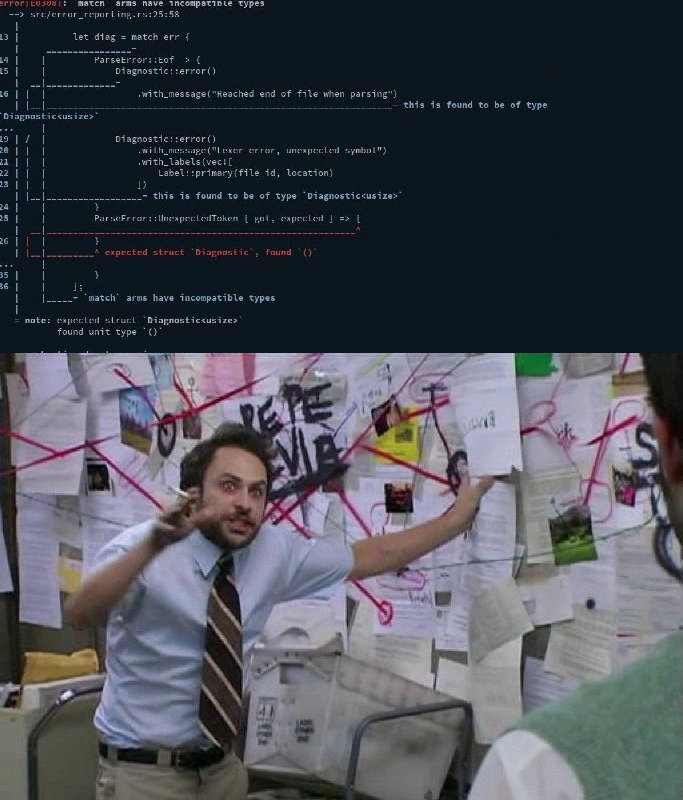
When the Rust Compiler Tries to Be Helpful
Description
A two-panel meme. The top panel contains a screenshot of a code editor with a dark theme, displaying a verbose Rust compiler error. The error message, 'error[E0308]: match arms have incompatible types', is shown with detailed ASCII art pointing out that different branches of a 'match' statement are returning different types: one returns an 'expected struct `Diagnostic`' while another returns a 'unit type ()'. The bottom panel features the famous 'Pepe Silvia' conspiracy board meme from 'It's Always Sunny in Philadelphia,' where Charlie Kelly frantically explains his convoluted theories in front of a wall covered in notes and connected by red string. This meme humorously equates the experience of deciphering a detailed, yet overwhelming, Rust compiler error with the feeling of descending into a mad conspiracy. For senior developers, it's a relatable take on the Rust experience: the compiler is an incredibly powerful and helpful tool that prevents bugs, but its exhaustive explanations can sometimes feel like a complex puzzle that pushes one's sanity to the limit

Comments
7Comment deleted
The Rust compiler gives you so much information to fix your bug that you start to feel like you're not debugging code, you're just a few red strings away from discovering who really wrote the initial commit
rustc builds a full red-string detective board to explain E0308, only to reveal the culprit was a lone semicolon that converted your Diagnostic into ()
After 15 years in the industry, you realize the real conspiracy isn't who Pepe Silvia is - it's why your perfectly typed struct suddenly thinks it's incompatible with itself after passing through three layers of generic abstractions and a macro expansion
When the Rust compiler gives you a type mismatch error, you don't just fix the bug - you embark on a full forensic investigation through your entire codebase, connecting lifetime annotations with red string until you realize the real error was the `Option<T>` you unwrapped along the way. Senior engineers know: Rust doesn't have bugs, it has 'opportunities for architectural enlightenment' that require a PhD in type theory and the investigative skills of a detective to resolve
E0308 is Hindley - Milner asking your match arms to unify; a single semicolon argues for returning (), and rustc takes its side every time
Rust: “expected Diagnostic<'_>, found ()” - the moment you break out the red string to trace how a single semicolon erased a match arm’s return and confused type unification
TypeScript template literals: Trading runtime bugs for compiler errors that demand a type theory exorcism