
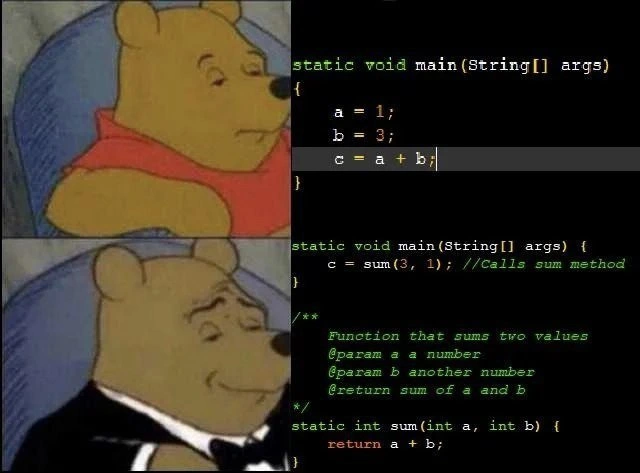
Code Simplicity vs. The Over-Engineered Masterpiece
Description
A two-panel meme using the 'Tuxedo Winnie the Pooh' format to contrast different coding styles. In the top panel, the standard Winnie the Pooh looks on with a simple expression next to a snippet of Java-like code within a `main` function that directly calculates `c = a + b`. This represents a straightforward, procedural approach. In the bottom panel, a sophisticated Winnie the Pooh in a tuxedo smirks approvingly next to a more 'correct' version of the code. Here, the `main` function calls a separate, dedicated `sum(3, 1)` method. Below, the `sum` method is meticulously documented with Javadoc-style comments explaining its purpose, parameters, and return value, before finally executing `return a + b;`. The meme satirizes the concept of 'clean code' by showing how applying principles like abstraction and documentation to a trivial operation can result in comical over-engineering. Experienced developers find this funny because it highlights the tendency, especially among those rigidly following textbook rules, to overcomplicate simple solutions in the name of 'best practices'

Comments
31Comment deleted
That 'sum' function is just one JIRA ticket away from becoming a generic `ArithmeticStrategy` passed via a `NumericProcessorFactory` singleton
Inline a + b is fine… right up until finance wants currency conversion, audit wants trace IDs, and legal wants 128-bit overflow checks - Tuxedo Pooh just pre-paid the abstraction tax
Ah yes, the classic 'AbstractSingletonProxyFactoryBean' approach to addition - because why write 'a + b' when you can create a fully documented, unit-tested, SOLID-compliant arithmetic microservice with OpenAPI specs, Kubernetes deployment manifests, and a 47-page architectural decision record explaining why addition deserves its own bounded context?
Ah yes, the classic 'sum' method - because directly adding two numbers is far too pedestrian for a *professional* codebase. Why write 'a + b' when you can craft a beautifully documented, statically-typed abstraction that future archaeologists will marvel at? Nothing says 'I've read Clean Code' quite like wrapping the '+' operator in a method signature. Next sprint: extract 'sum' into an interface, add a factory, and implement the Strategy pattern. The business logic of '1 + 3 = 4' demands nothing less than enterprise-grade architecture
Junior refactor special: swapped scope soup for arity fondue, now with interpretive Javadoc dance
In enterprise Java, '+' is a leaky abstraction - wrap it in SumService so Product can feature-flag math, Finance can swap in BigDecimal, Legal can audit it, and SRE gets a span for every addition
Classic enterprise refactor: inline a + b becomes SumService with Javadoc, ready for a strategy pattern behind a feature flag
I dont know where the joke is, thats just how normal person would write a code Comment deleted
Perfectly needed comments Comment deleted
Why the fuck you need whole function for sum two fucking numbers? Comment deleted
to not to repeat the "+" operator each time you wanna add two numbers Comment deleted
But it cost more time to calculate more time to compile and more symbols to type it's fucking pointless . I hope it's only for meme purposes 🤣 Comment deleted
is there inline in java? Comment deleted
C# > Java Because operator overload Comment deleted
you can just use 2-dimensional array for doing that Comment deleted
BiFunction Comment deleted
Ohhhh, that meme makes sense now Comment deleted
Autowired with spring BiFunction Comment deleted
BinaryOperator for better type safety and foolproofing (you don't want to have sum that adds String and Person) Comment deleted
Because + is a fucking function Comment deleted
it is not in most langs, try to pass + to a hof, you can't Comment deleted
unless you use haskell or some other lang which actually supports it Comment deleted
Need unit tests Comment deleted
PM says we spend to much time on CR and Unit Tests so we dropped it:D Comment deleted
then they will say that you spend too much time on coding Comment deleted
This is the agenda for next meeting you know Comment deleted
their motto: less coding, more code Comment deleted
…probably in the daily 3hr meeting Comment deleted
this is me flexing my skills to my friends Comment deleted
*elegancy* Comment deleted
It's time to recall it https://github.com/EnterpriseQualityCoding/FizzBuzzEnterpriseEdition Comment deleted