
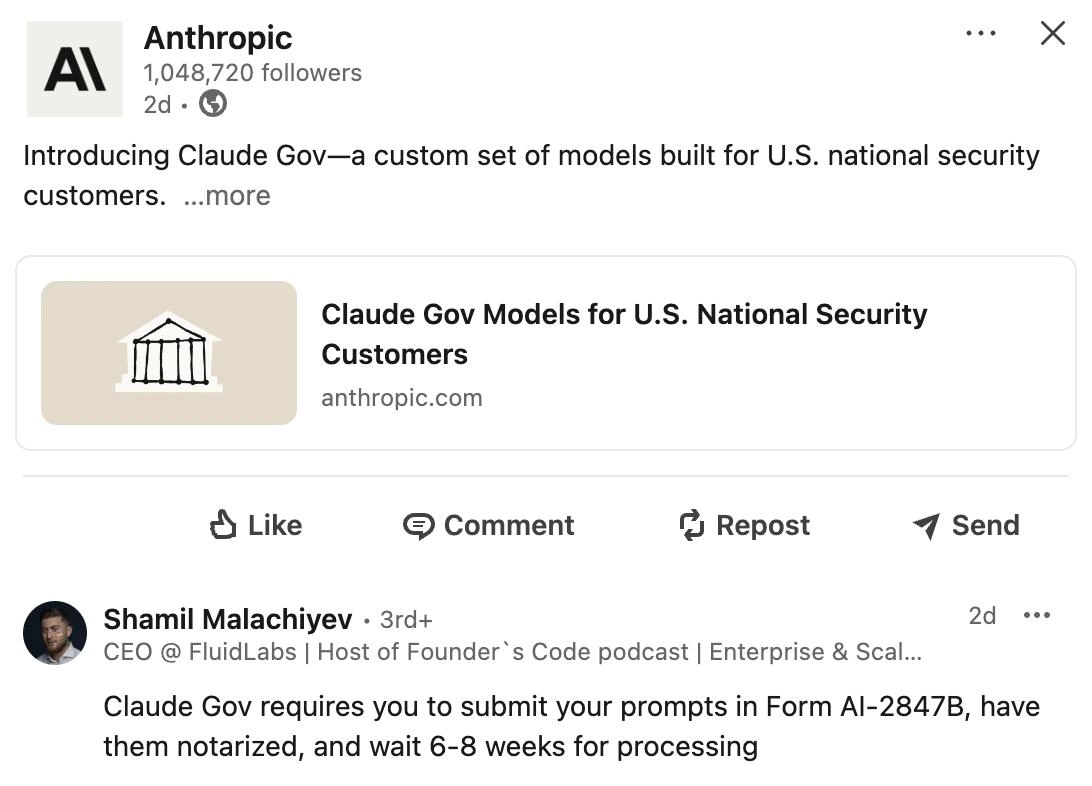
Claude Gov: the LLM where FedRAMP meets prompt engineering paperwork
Description
Screenshot of a LinkedIn post. At the top, the official Anthropic account (logo with stylized “AI”) announces: “Introducing Claude Gov - a custom set of models built for U.S. national security customers.” A beige link-preview card shows a simple courthouse icon and the headline “Claude Gov Models for U.S. National Security Customers - anthropic.com.” Beneath the usual LinkedIn reaction bar (“Like · Comment · Repost · Send”), a commenter jokes: “Claude Gov requires you to submit your prompts in Form AI-2847B, have them notarized, and wait 6-8 weeks for processing.” The visual gag contrasts cutting-edge LLMs with classic government red tape, poking fun at the compliance hoops enterprise and public-sector engineers recognise all too well - FedRAMP checklists, ATO cycles, and interminable procurement forms


Comments
9Comment deleted
Finally, an LLM that can answer classified questions - just as soon as your prompt clears the Joint Authorization Board’s 42-page change-control spreadsheet
Finally, an AI model that responds with 'Your request has been received and will be processed in accordance with Section 3.2.1 of the AI Operations Manual. Expected completion time: Q3 2025. Please submit Form AI-2847C if you need expedited processing.'
Finally, an AI model that truly understands government workflows: it takes longer to get approval for your prompt than it does to train the model from scratch. At least now we know why government AI projects have 18-month timelines - 6 weeks per API call adds up quickly when you're building a chatbot
Claude Gov: prompt engineering becomes a CCB change with an SSP diff, waiting on ATO - latency measured in weeks, not tokens per second
Claude Gov: Fine-tuned for compliance, where prompt latency rivals ATO approval in a DoD acquisition program
Claude Gov’s p99 isn’t in milliseconds - it starts after ATO; you file the prompt as a change request and hope procurement doesn’t bounce it
Soviet-era form for querying Google, submitted to KGB: in addition to name and account number, the applicant must have specified his personal KGB supervisor credentials and clearance number. "In Soviet Russia, you don't search — you are being searched". Comment deleted
Brooooo Comment deleted
Comrade! 🫡 Comment deleted